Transformer Authors’ Team, Their RSI
Transformer Author Team, the Outcome RSI
Content Summary
Wen Ting posted from Ao Fei Temple Quantum Bits | Official Account QbitAI founded by Sakana AI, created by core author of the foundational Transformer paper Llion Jones, in partnership with UC Berkeley
Wen Ting posted from Ao Fei Temple
Quantum Bits | Official Account QbitAI
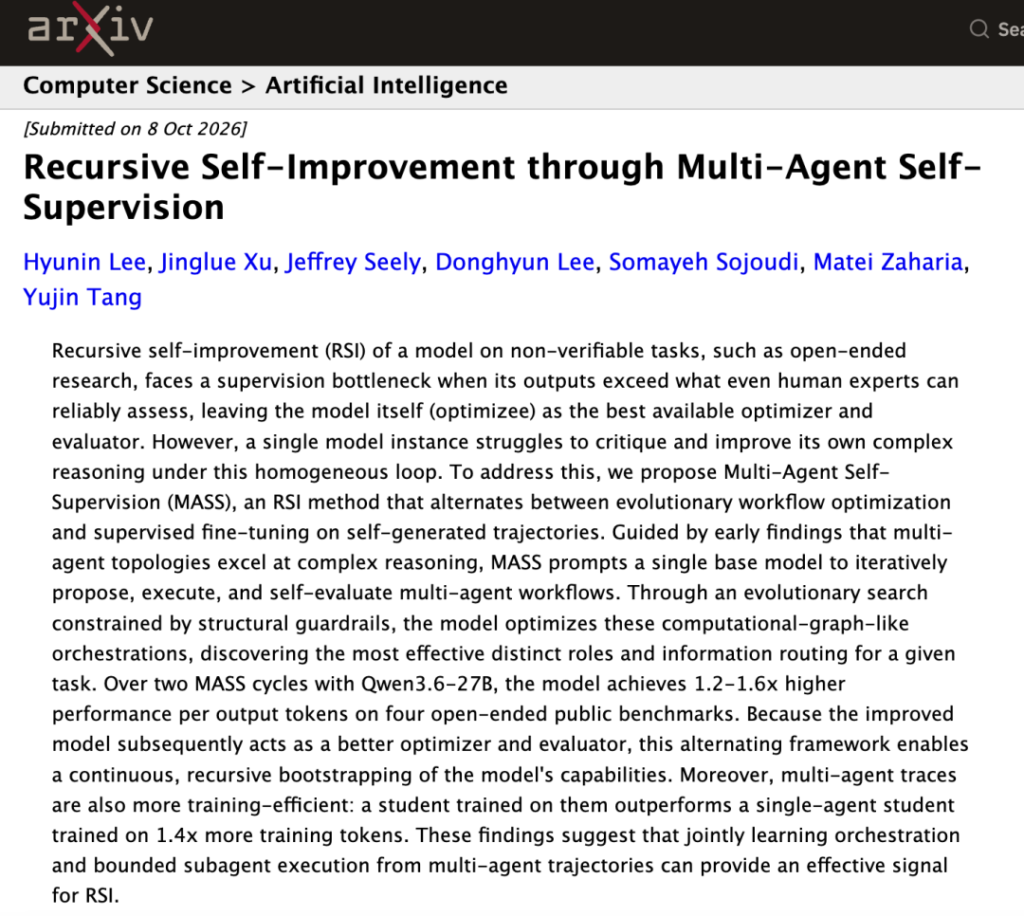
Sakana AI, founded by core author of the foundational Transformer paper Llion Jones, in collaboration with UC Berkeley, has delivered a new recursive self‑improvement (RSI) achievement:MASS (Multi‑Agent Self‑Supervision).
They let the same open‑source model clone itself into a team, like Naruto Uzumaki from “Naruto,” learning to assign tasks to its clones, spot flaws, and conduct training, then feed all the experience back into the original, so the next round performs even better.
After two rounds of self‑evolution, the model’s token output efficiency on multiple open‑ended research tasks increased directly by 1.2–1.6×, and its self‑assessment accuracy jumped from 73% to 93%.
Impressive that a company co‑founded by the authors of the Transformer even manages to innovate on self‑competition without any hassle.
This research also proves one thing:To achieve RSI, you don’t necessarily have to rely on more powerful human trainers or larger mentor models.
When AI creates its own clones and teams up, it can boost itself to the sky internally…
A single model plays three roles, building its own team
The model teaches itself—what was the most headache‑inducing problem before?
Homogenization blind spot.
If a single model writes its own answers, scores them, and corrects itself, it can easily get stuck in its own biases.
Because it doesn’t actually know where it went wrong, so-called self‑reflection often just restates the wrong answer in a different tone and reinforces it.
To break this vicious cycle, the research team invoked Minsky’s classic idea from *The Society of Mind*:decompose a complex intelligent agent into a collaborative system of simple components.
In the MASS framework, the research team builds on Qwen3.6-27B and lets a single model simultaneously play three roles at the lower level:
- Agent
: responsible for honestly writing code and running experiments. - Evaluator
: scores and critiques the work produced by the Agent. - Optimizer
: dynamically adjusts the role assignments, call order, and information handoff rules of the various personas based on the Evaluator’s feedback.
The entire training is divided into two loops: an inner loop and an outer loop.
Inner Loop is performed with the model weights completely fixed, while the optimizer continuously adjusts the multi‑agent workflow defined purely in text, specifying who reports to whom and what output contract each sub‑node must deliver.
The evaluator acts as a judge on the side, continuously weeding out the weak and selecting the golden workflow that is currently the most proficient at doing research.
Outer loop collects the excellent multi‑agent collaboration trajectories generated by this golden workflow and performs a supervised fine‑tuning (SFT) on the base model.
After internalizing these collaborative abilities into the model weights, a new generation model is released, instantly taking over the three roles of executor, evaluator, and optimizer, and then starts the next round of nesting.
After two rounds of cramming, efficiency skyrocketed but subject bias is severe
So after teaming up with myself for two rounds, how did it actually turn out?
The research team evaluated the model on long‑term tasks spanning finance, robotics, pharmaceuticals, and several public benchmarks, and the data are truly impressive.
Across the three test tasks, the second‑generation model’s win rate against the initial baseline jumped from the first generation’s 53.9% to 69.9%.
On the open research benchmarks ScienceAgentBench, MLR‑Bench, DSBench, and AstaBench, each token generated by the second‑generation model increased the score by 1.2–1.6×.
This shows that its research work no longer drags on with repetitive chatter as before, but has learned to get straight to the point.
Even more impressive is the transfer of self-evaluation ability.
The fine-tuning process only used trajectory data from task solving and did not specifically train the model’s judging ability.
However, the second-generation model’s accuracy in self-assessment jumped from 73% in the initial model to 93%, and the speed of finding high-quality workflows has also noticeably increased.
However, the research team did not overhype this result and directly acknowledged its limitations in the paper:
1, they only validated two rounds of recursion. How many generations it can iterate without model collapse remains unknown.
2, The bias is evident. It shows rapid progress in open‑ended research and data analysis, but its performance does not improve correspondingly on hardcore software‑engineering and terminal benchmarks such as SWE‑bench Verified and Terminal‑Bench 2.0.
3. Workflow search is prone to failure.When the optimizer modifies a workflow, performance can suddenly plummet; a slight tweak of a few words in the text can lead to vastly different results.
In this light, the core bottleneck currently limiting RSI’s evolution speed still lies in the generation capability of the optimizer itself…
Why can multi‑agent trajectories beat single‑agent ones?
So why should data from many agents be stronger than that from a single agent?
To get to the bottom of this, researchers conducted a set of comparative experiments, and the results were shocking.
They fine‑tuned the same Qwen3.6‑27B base model with different trajectory data and found:
-
Feeding the model multi‑agent trajectories (M+), consuming 28.82 M training tokens, achieved a win rate of 68.3%. -
Feeding the model single‑agent trajectories (S++), using as many as 42 M training tokens (about 1.4× more data), the win rate was only 64.0%.
Uses 31.4% fewer tokens, yet the model trained on multi‑agent data completely crushes the single‑agent one.
So why does this dimensionality‑reduction strike occur?
The secret may lie inthe cognitive decoupling of tasks.
In a single-agent trajectory, the model must both envision the macro architecture and drill down into specific code, mixing long-range context together makes learning extremely difficult.
In multi-agent collaboration, the chief coordinator only handles task decomposition and output verification, while sub-agents focus on writing code within local boundaries. Both types of trajectories update the same weights, enabling the model to master both macro scheduling and local problem‑solving skills simultaneously.
More importantly, the fine‑tuned model truly internalizes this collaborative intuition.
When the workflow prompts are completely omitted, the initial model initiates sub‑task calls on its own with a probability of only 1/110, whereas the second‑generation model jumps directly to 87/110.
The cross‑agent code handoff behavior also surged from 1/110 to 83/110.
It no longer needs humans to painstakingly teach it how to divide tasks in the prompt; it can simply pick up the pen and know when to summon a clone to get the work done.
Star-Studded Team: Core Transformer author leading the way, with deep collaboration between the father of Berkeley and the father of Spark
And the organization behind this research, Sakana AI, has always been a uniquely styled entity in the industry.
Founded in Tokyo in 2023, its name means “fish” in Japanese.
Rather than brute‑forcing compute power and a violent aesthetic, they are more obsessed with drawing inspiration from nature, biological evolution, and complex systems, focusing on evolutionary algorithms, model fusion, and autonomous agents.
This distinctive academic DNA largely stems from its luxurious founding team:
Co-founder and CTO of Sakana AI Llion Jones, a former Google veteran, he is one of the eight core authors of the foundational Transformer paper “Attention Is All You Need,” which changed the history of the AI era.
△Llion Jones
After leaving Google to found Sakana AI, he has been leading his team to continuously explore new paradigms that go beyond traditional feedforward training.
CEO David Ha previously led the Google Brain Tokyo research team and is a world-leading expert in evolutionary algorithms and creative AI.
△David Ha
Beyond the founder’s authentic Transformer heritage and evolutionary computing DNA, the paper’s author lineup is also a true “all‑star” team, deeply integrating top research talent from Sakana AI and UC Berkeley.
Given space constraints, we’ll just mention two of them.
For example, the first author of the paper, Hyunin Lee, is a Ph.D. candidate in Mechanical Engineering at UC Berkeley, graduated with highest honors from Seoul National University, and has interned as a researcher at both OpenAI and Meta, bringing a blend of elite industry and cutting‑edge academic experience.
△Hyunin Lee
For example, Matei Zaharia, an associate professor at Berkeley EECS, co‑founder and CTO of Databricks, and the initiator of the Apache Spark project.
△Matei Zaharia
What a gathering of masters, amazing.
Reference links:
[1]https://arxiv.org/abs/2610.12176v1
[2]https://x.com/LargitData1/status/2109306509423439889
One-click Triple Interaction“Like” “Share” “Heart”
Feel free to leave your thoughts in the comments!
— End —
🌟 Light Up the Star 🌟
Get MirrorSpeed