World’s First: Hangzhou’s Embodied Robot Rivals Figure with Full-Body Coordinated Autonomous Clothing Folding
World’s First! Hangzhou’s Embodied Dark Horse Rivals Figure, Fully Coordinated Autonomous Clothing Folding
Content Summary
Xinzhiyuan reports Let robots do housework is recognized as a high‑threshold scenario in the field of embodied intelligence. What’s difficult? Home environments are designed for humans, so robots must bend, squat, turn to adapt to human spaces, and most household objects are soft
Xinzhiyuan reports
Xinzhiyuan reports
Having robots do household chores is recognized as a high-threshold scenario in embodied intelligence.
What makes it difficult?
The home environment is designed for humans; robots must bend, squat, turn, and adapt to human spaces, and most household objects are flexible, changing shape with each pull.
More importantly, real household tasks are never isolated actions but a tightly linked chain of tasks.
From the refrigerator to the stove, from the sofa to the bed, any pause, break, or instability requires the entire sequence to be restarted.
This is also why many previous public demos of humanoid robots have mostly stayed at single-point skills like “pick up a cup” or “fold a towel.”
Once the task sequence is extended or the operating scenario changes, the continuity and stability of the entire set of actions become difficult to maintain.
The newly upgraded West Lake Robot universal brain WR1 achieves multiple key capabilities that match or even surpass overseas benchmarks, directly tackling the hard, complex household chores of real homes.
WR1 uses a globally pioneering universal cerebrum‑cerebellum dual pre‑training system architecture, deeply coupling multimodal task understanding with full‑body control.
WR1 integrates a World Model (WM) and a Vision‑Language‑Action model (VLA), and based on visual observations and language instructions, uniformly outputs a complete action sequence that includes body movement, full‑body posture, and dexterous hand manipulation; full‑body control is handed over to the original self‑developed, world’s first universal motion large model GAE for fast and stable execution.
In a real home, the robot’s opponents are often not rigid, box‑shaped objects but soft, deformable items like clothing.
A classic difficulty in garment manipulation is the continuously changing state of the object: pulling deforms the fabric, the drying rack sways causing positional shifts, and the actions of collaborative agents also affect the garment’s unfolded state.
The first segment of WR1’s demonstration specifically targets the high‑barrier challenge of flexible garment manipulation.
In the demo, WR1 first removes a pair of pants from the drying rack and, like a human, drapes the pants over its arm for support.
During the garment retrieval, the drying rack sways, causing the two T‑shirts on it to shift laterally; the robot continuously observes and adjusts in real time, still completing the retrieval stably.
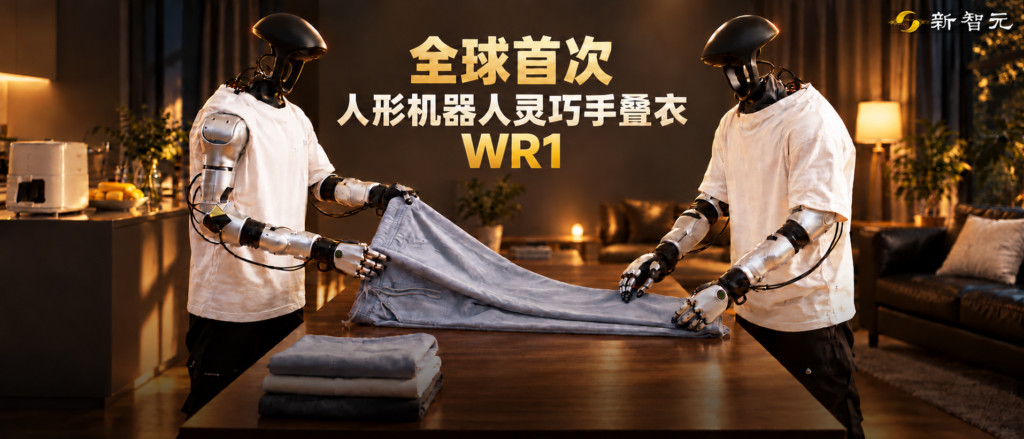
Then it hands the T‑shirt to a robotic arm, which autonomously recognizes the garment and starts folding; a humanoid robot turns around to spread the trousers on the table and, together with another humanoid robot, folds them collaboratively.
The two robots monitor each other’s movements and adjust their coordination in real time based on the trousers’ condition, turning the processes of picking up, supporting, transferring, spreading, and folding into a seamless operation.
Among them, The humanoid robot’s dexterous hand folding garments is the world’s first demonstration case, and the technical difficulty is significantly higher than the commonly seen folding of regular fabrics such as towels and bath sheets in the industry.
Previous public demonstrations by Figure have focused more on handling regular items, spreading blankets, and simple fabric organization, and have not yet shown high‑difficulty flexible tasks such as garment pick‑and‑place under external disturbances or dual‑robot collaborative folding.
WR1 needs to continuously counteract multiple disturbances caused by the sway of the drying rack, fabric deformation, and dual‑machine coordination, achieving a surpassing of the Helix solution in handling flexible dynamic objects.
If the dexterous hand folding clothes tests the “skill in the hand,” the second demonstration tests the “global scheduling and long‑range task handling capability.”
WR1 first makes a relatively large movement, accurately reaches the refrigerator, opens the door and takes out the corn; then, with a smooth, rapid U‑turn, it moves to the air fryer, adjusts its stance, grabs the handle, pulls out the basket, and places the corn inside.
Next, it squats, grabs the handle of the storage basket, nudges the toys on the sofa and coffee table into the basket, and then walks to the bed to tidy the blanket.
A task chain that spans the kitchen, living room, and bedroom—executed continuously without interruption.
The entire process requires no manual reset mid‑way, no segmented commands, and completes multi‑scenario composite household tasks in a single run.
Smoothness is only a visual impression; breaking down these two demos, the real success hinges on the synergy of three underlying abilities—generalization of flexible objects, long-range task execution across scenarios, and integrated smooth motion control.
The three correspond to the three core challenges in home settings: uncontrollable object shapes, long and cross-domain task chains, and high demands for action continuity.
Generalizing to flexible objects is the first capability that directly tackles the home environment.
Clothing is a quintessential example of continuously changing shape: its position, fabric state, and collaborative posture constantly vary. WR1 maintains observation and real‑time adjustment during operation, expanding the task complexity from a single grasp and planar folding to continuous garment organization and dual‑robot collaboration under dynamic disturbances.
When faced with deformation or external disturbances, the robot does not fail the task outright because the object deviates from its preset state; it can adjust its strategy on the fly.
Executing long‑range tasks across different scenes adds another layer of difficulty.
The objects, directions, positions, and body heights keep changing, but the task cannot be interrupted.
The robot must complete each step while preserving the task order and motion continuity. In long‑chain tasks, even with a high per‑step success rate, the overall success rate drops quickly as the number of steps increases—this is a common pain point in the humanoid robot industry.
WR1 demonstrates seamless transitions between different spaces, objects, and operations. The value of long‑range execution lies in these connection points.
What strings all of this together into a “one‑shot” experience is WR1’s high‑dynamic capability—integrated, fluid motion control.
The humanoid robot holds corn, turns toward an air fryer, crouches to pick up a basket, then stores dolls of varying heights, supports long pants while turning and spreads them onto the table. In one sequence, body movement, posture adjustment, and hand operations remain tightly coordinated; the feet, torso, and both hands work around the same target in a synchronized manner. Pauses and abrupt changes at transition points are minimized at the mechanistic level.
Where do the three abilities come from?
When you break down the WR1 system architecture, the answer lies in the division of labor between the general brain and whole‑body motion control, and a often‑overlooked keyword—continuity.
WR1 system architecture: the task management module organizes tasks, VLA and the world model cooperate to generate actions, and GAE handles whole‑body control.
On the general brain side, WR1 combines multi‑view visual observation with its own state to uniformly generate movement, posture, and hand operation commands within the same action sequence, with the task management module responsible for organizing commands and task flow.
Feet, torso, and hands no longer act independently; body parts achieve integration first.
To ensure action consistency in long‑range tasks, WR1 introduces a long‑short term motion state review mechanism, allowing the model to recognize the current motion phase of the body and provide context for subsequent action generation.
The real‑time action chunking mechanism, when generating the next segment of motion, takes the currently executing trajectory into account; while the robot continues moving, the model is already preparing the subsequent actions, thereby reducing pauses and abrupt changes caused by action updates. Consecutive actions connect seamlessly on the timeline, achieving temporal continuity.
In the motion side, GAE handles full-body motion tracking and balance control.
It uses large-scale, multi-source human motion data and a two-stage training process, covering walking, turning, squatting, stretching and other movements, providing a unified execution foundation for cross‑region and cross‑height operations.
Full-body motion tracking demo: a person and the robot synchronously perform bending, turning, leg lifting, jumping and other actions.
At the same time, the adjustable anticipatory mechanism compensates for execution latency.
In WR1, this mechanism calibrates the remaining delay after action buffering, working together with the action linking mechanism to ensure coherent execution, aligning the general brain’s intent with hardware execution without any time lag, achieving seamless intent-to-action integration.
The truly distinctive feature of WR1’s approach is its end-to-end integration.
GAE simultaneously handles both demonstration collection and autonomous execution phases at the low‑level control layer, with training demonstrations and autonomous execution sharing the same control foundation, fundamentally narrowing the gap between learning and execution.
‘Think clearly’ and ‘take action’ are integrated on the same chain, which is the fundamental reason why WR1 can perform long-range chores continuously.
From dynamic garment organization to cross‑area chores, WR1 links task understanding, environmental feedback, and whole‑body control into a complete chain.
This seamless one‑shot chore demonstration also brings humanoid robots a step closer to truly entering ordinary households.
West Lake Robotics Technology (Hangzhou) Co., Ltd. is the first result commercialization project in the field of artificial intelligence and robotics at West Lake University.
The company adheres tothe universal brain + humanoid full-body cerebellum + self-developed humanoid body three-in-one full-stack self-development approach, focusing on the research of general-purpose foundational models for humanoid robots. The core goal is to bridge task understanding and full-body motion control, creating a universal brain for humanoid robots aimed at home service, industrial, and special operation scenarios.
The team is dedicated to moving humanoid robots beyond single-point laboratory demonstrations, achieving continuous autonomous operation in real production and living environments with long chains and high-disturbance scenarios.
Founder Wang Donglin is the chief scientist of the National Science and Technology Innovation 2030 Major Project, a tenured professor at Westlake University, and deputy director of the AI department. He has deep expertise in robot learning and is a leading figure in embodied intelligence and robot learning in China. Co‑founder Zhang Yue is a tenured professor at Westlake University, associate dean of the School of Engineering, and an internationally renowned expert in natural language processing.
Our company’s R&D team brings together research and engineering talent from top universities and industries worldwide. We have already completed multiple rounds of financing amounting to hundreds of millions of yuan, and continue to advance the iterative deployment of a universal brain for humanoid robots.
Entering homes is just the beginning; reaching thousands of industries and serving countless households is the true horizon for West Lake Robotics.
Rooted in a fertile ecosystem of industry, academia, and research, West Lake Robotics will continue to rely on a three‑in‑one full‑stack self‑development approach, bringing humanoid robots into broader scenarios such as home caregiving, industrial manufacturing, and special operations, accelerating the realization of embodied intelligent GPT moments.
Edited by: Yuan Yu
Get MirrorSpeed