从南极冰层到大脑开关:2026诺奖来自那些不可思议的想法与漫长坚持..
From Antarctic Ice Sheets to Brain Switches: The 2026 Nobel Prizes Stem from Those Incredible Ideas and Long-Lasting Persistence..
Content Summary
From October 5, the 2026 Nobel Prizes in Physiology or Medicine, Physics, Chemistry, Literature, and Economic Sciences arrived as scheduled, being announced one after another. Turning a two‑kilometer‑deep Antarctic ice sheet into a telescope, using a beam of light to control the brain’s…
From October 5, the 2026 Nobel Prizes in Physiology or Medicine, Physics, Chemistry, Literature, and Economic Sciences arrived as scheduled, being announced one after another.
Turning the two‑kilometer‑deep Antarctic ice sheet into a telescope, controlling neurons in the brain with a beam of light, recognizing that the molecules of life have left‑ and right‑handed forms, breaking genre boundaries to rewrite ancient Greek myths into modern life,defending international justice in the courtroom that tries Nazi war criminals, and seeking answers to economic fluctuations from the choices of countless ordinary people. The 2026 Nobel Prizes are still filled with ideas that sound almost unbelievable at first glance.
Among this year’s laureates, some waited until the age of 95 for overdue recognition, some spent more than twenty years turning an almost insane Antarctic experiment into reality, and others continued to create and explore even when faced with illness. Their paths differ, but they share one common trait: a willingness to relentlessly pursue questions that others have never thought of or have not yet fully understood.
On the occasion of the 125th anniversary of the Nobel Prize, over the past century we have seen that the Nobel often honors a mature scientific achievement, but behind it may hide decades of unknown exploration. Some research was initially considered impractical, some discoveries struggled to find applications, and many scientists have spent most of their lives with their research before winning. Below, enjoy:
On October 5, 2026, just after midnight in California, USA, Professor Karl Deisseroth of Stanford University received a phone call. He didn’t answer. A few seconds later, his wife Michelle’s phone rang again, and the caller asked if Karl could take the call.
The caller was the Nobel Prize Committee.
After many years, the psychiatrist who studies mental illness finally received the Nobel Prize in Physiology or Medicine. On the phone he was so excited that he could not speak for about half a minute before he could reorganize his words.
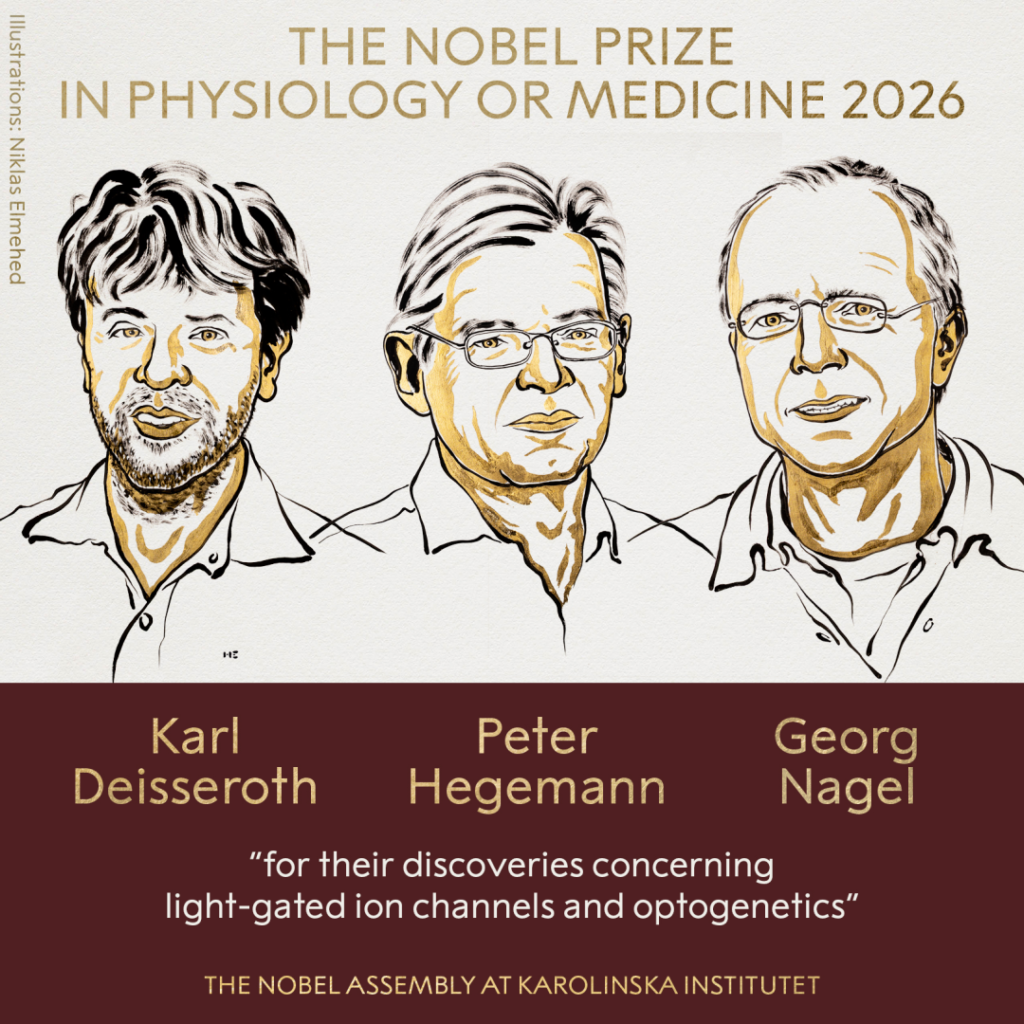
The 54‑year‑old scientist is both a neuroscience researcher and a psychiatrist. He shared the 2026 Nobel Prize in Physiology or Medicine with Peter Hegemann of Humboldt University in Berlin and Georg Nagel of the University of Würzburg.
The three laureates’ achievement is called optogenetics, a term that sounds somewhat complex but is driven by a very simple desire: can we precisely control a specific type of neuron in the brain to see exactly what it does?
For Deisseroth, this also reflects a long‑standing frustration from his clinical work.
A person with severe depression may never again feel pleasure from activities they once loved. Doctors can observe, ask about, and assess a patient’s symptoms, but it is difficult to pinpoint exactly which neural circuit in the brain is malfunctioning. People tend to describe their feelings with words like loss, hopelessness, and fear. These words help us understand each other, yet they cannot alone explain how emotions arise in the brain.
Daiceros originally hoped to become a neurosurgeon. During his psychiatry rotation in medical school, he encountered patients with severe mental disorders and gradually realized that behind these complex and genuine subjective experiences lay a wealth of unexplained neurobiological questions. He wanted to keep probing these questions, but the brain is simply too complex.
For decades, neuroscientists have had EEG, brain imaging, and various neural stimulation tools. They can tell us which brain regions become active when a particular emotion or behavior occurs. However, observing two phenomena co‑occurring does not equal establishing causality. For example, when a person feels fear, a certain brain area shows clear activity. Is that area generating the fear, or does the fear make it active? Are nearby neurons also involved?
To clarify this, researchers would ideally be able to activate a specific group of neurons in isolation and then see how the animal’s behavior changes. At the time, the tools were not precise enough—electrical stimulation affected nearby cells as well, and while drugs target specific receptors, it is difficult to ensure both the location and timing of their action are sufficiently precise.
The fine switch component that this scientist has been searching for ultimately comes from a single‑celled organism that doesn’t even have a brain.
In the 1980s, German scientist Hegeman began studying Chlamydomonas. This alga adjusts its swimming direction according to light conditions, seeking an environment suitable for its survival. How does a single‑celled organism without a nervous system perceive light, and how does it convert the light signal into a motility command?
Hegeman gradually focused his research on the alga’s photoreception mechanism. Working with Nagel and others, who specialize in membrane protein electrophysiology, he identified a key clue: channelrhodopsin. This is a protein that responds to light; when light of a specific wavelength shines on it, ion channels in the cell membrane open, allowing charged particles to flow and thereby altering the cell’s electrical activity. To verify this, the researchers also introduced the relevant gene into frog egg cells. Cells that originally lacked this photoreceptive ability, after expressing the protein, could also generate electrical responses to light. This demonstrated that photoreceptive capability can be conferred on other cells through gene expression.
A project studying how algae swim toward light suddenly found a completely different use.
Around 2004, Deisseroth, who had just set up an independent lab at Stanford University, began trying to apply this protein to neurons. If a certain type of neuron could be made to express channelrhodopsin and then be stimulated with light, there would be an opportunity to directly control the electrical activity of those cells. In 2005, he and his colleagues published a pivotal study showing that mammalian neurons expressing channelrhodopsin could generate rapid, precise electrical signals in response to light stimulation.
Optogenetics thus truly entered neuroscience. Researchers first used genetic methods to make specific cell types express light‑sensitive proteins, then used light of appropriate wavelengths to control their activity. Since then, scientists have developed a variety of light‑sensitive tools, making both activation and inhibition of neurons more controllable. Humans now have a tool that can finely test causal relationships within living neural circuits. In the past, scientists observed whether a group of neurons was active when an animal felt fear; now they can actively manipulate that group of cells and see whether fear‑related behaviors appear or change. This capability is extremely important for research on memory, reward, addiction, motor control, and more.
Optogenetics is now commonplace in neuroscience labs, but it has not yet become a mature clinical tool for treating diseases such as depression or Parkinson’s. One of the more advanced directions is restoring some visual perception for partially blind patients, which requires gene delivery and specialized optical equipment. This technology still faces challenges—safety, precise delivery, and long‑term stability—before it can be widely applied to the human brain, yet it has already changed the way neuroscience research is conducted.
The work of three Nobel laureates comes from two seemingly unrelated paths: one studying how algae sense light, the other exploring how the brain generates complex emotions and behaviors. They ultimately converge on a tiny protein. Scientific research sometimes works this way—relentlessly pursuing a question, the answer may not appear in the familiar discipline, and a piece of basic research originally driven by curiosity can become a crucial tool that another field has been waiting for.
Planting thousands of detectors in Antarctica, he waited for the universe’s reply
On Christmas Eve 1993, physicist Francis Halzen sat at the dinner table with a computer on his lap, waiting for a message from Antarctica: would the first long cable equipped with optical detection modules successfully reach the deep ice? This would determine the course of his research for decades to come. At that time, the idea of using Antarctic ice to detect cosmic particles was still a bold hypothesis that required continual verification.
Thirty‑three years later, on October 6, the Royal Swedish Academy of Sciences announced that the 2026 Nobel Prize in Physics would be awarded to Halzen, recognizing his decisive contributions to the IceCube Neutrino Observatory and the discovery of high‑energy neutrinos of astrophysical origin.
Neutrinos are almost among the most reluctant particles in the universe to interact with the outside world. They are electrically neutral, have an extremely small mass, and interact with ordinary matter with a very low probability. Every moment, a huge number of solar neutrinos pass through our bodies, and the vast majority leave no detectable trace. Yet this elusive nature makes neutrinos valuable messengers for studying the cosmos. The universe hosts some extremely violent activities, such as high‑energy processes near black holes, supernova explosions, and cosmic‑ray acceleration, which can produce particles with astonishing energies. Traditional astronomy mainly relies on electromagnetic radiation to observe these processes. However, some radiation can be absorbed or scattered by surrounding matter, and charged particles in cosmic rays are deflected by interstellar magnetic fields, deviating from their original paths.
Neutrinos happen to fill this gap. Because they are electrically neutral, they are not deflected by magnetic fields like protons, and because they interact extremely rarely with matter, they can travel from incredibly distant regions of the universe to Earth. If scientists can capture enough high‑energy neutrinos, they will have the opportunity to search for the particle accelerators hidden deep within the cosmos.
However, they are extremely difficult to catch. Even a conventional detector running continuously for a long time may not encounter enough high‑energy neutrino interaction events. To increase the chances of observation, the most straightforward approach is to give the detector a sufficiently large volume.
Therefore, Halzen did not choose to launch a telescope into space, but instead embedded thousands of detectors deep within the Antarctic ice, turning an entire cubic kilometer of ice into a tool for studying the universe. In the 1980s, he began to contemplate the possibility of using ice to detect neutrinos. In 1988, he publicly proposed, together with physicist John G. Learned, the idea of conducting related observations in Antarctica. He suggested that when a neutrino occasionally interacts with matter in the ice, it could produce a high‑speed charged particle. If this particle travels through the ice faster than light does in ice, it will generate Cherenkov radiation. Optical sensors record these faint flashes, giving researchers the opportunity to infer the particle’s trajectory.
The real engineering proved far more challenging than expected. Early researchers deployed sensors into the Antarctic ice only to discover that the upper layers contained a large number of tiny air bubbles. Light signals repeatedly scattered between the bubbles, blurring the information that could originally be used to reconstruct the particle’s direction. For detectors that rely on extremely weak light signals, this is almost a fatal problem.
The research team did not give up. They gradually discovered that deep ice below about 1400 m is purer and more transparent, and this exploration later evolved into the AMANDA experiment, eventually giving rise to the larger IceCube neutrino observatory. To build IceCube, researchers had to, during the brief Antarctic summer operation window, melt deep holes in the ice with hot water and then lower cables equipped with optical detection modules into them. After the surrounding water refroze, these detectors remained permanently embedded deep in the ice, making them difficult to remove and service like ordinary instruments.
In 2011, IceCube was completed. Five thousand one hundred sixty optical sensors are distributed along 86 cables, deployed at depths of roughly 1450 to 2450 m below the Antarctic surface, forming an astronomical facility with a detection volume of about one cubic kilometer. It lies quietly within the Antarctic ice, waiting for the occasional high‑energy neutrinos that interact with matter.
The appearance of a signal does not mean scientists can immediately declare success. Cosmic rays striking Earth’s atmosphere also produce large numbers of particles and neutrinos. Researchers must sift through massive background signals to determine which events truly have an astrophysical origin. In 2013, the IceCube team announced important evidence supporting the existence of high‑energy cosmic neutrinos. Since then, work to pinpoint specific sources has continued. In 2018, researchers combined various astronomical observations and identified the blazar TXS 0506+056 as a significant candidate neutrino source; in 2022, they found compelling evidence of high‑energy neutrino emission from the direction of the active galaxy NGC 1068. Thus, humanity’s ways of observing the universe have further expanded.
Nobel Physics Prize Committee member Olle Eriksson said in an interview, “According to the will, we cannot award the Nobel Prize to a large team with hundreds of members. But we can trace back to the original idea and confirm that Halzen played a crucial role—without him, this work might never have happened.” The Nobel Prize awarded to Halzen is also a recognition of large‑scale fundamental research engineering. From the earliest conception, to solving ice transparency, drilling, and equipment installation issues, to accumulating enough data to confirm the existence of cosmic neutrinos, the entire process spanned different technological stages and relied on the collective effort of many researchers. Turning the Antarctic ice sheet into a telescope sounds romantic. In practice, it required solving countless concrete problems, embodying the relentless dedication of countless individuals.
At 95, finally awarded the Nobel Prize, scientists have spent half a lifetime studying the “left and right hands”
October 7, the 2026 Nobel Chemistry Prize was awarded to French scientist Henri B. Kagan and Japanese scientist Kensō Soai, recognizing their discovery of nonlinear effects and autocatalysis in asymmetric organic synthesis.
To understand this research, we must start with our two hands. The left and right hands are mirror images of each other; the number, shape, and connectivity of the five fingers are the same. Yet no matter how you rotate them, the left hand can never completely coincide with the right hand. In the chemical world, many molecules exhibit a similar relationship. Two molecules may have the same chemical formula and atomic connectivity, but their spatial structures are mirror images, like left and right hands. Chemists call this property chirality, and the two mirror‑image, non‑superimposable molecules are called enantiomers. For example, proteins in living organisms are primarily composed of L‑type amino acids, while the sugars in DNA and RNA have a specific D‑type chirality. Many drugs also exist as different enantiomers, which can have distinct pharmacological effects once they enter the body. For chemists, this presents an important task: can we, during synthesis, produce as accurately as possible the specific molecule that humans need?
Behind this question lies an even older puzzle: if early chemical reactions initially showed no obvious left‑right preference, why did biological systems later develop such a pronounced chiral selection?
In the 19th century, French scientist Louis Pasteur, while studying tartaric acid crystals, discovered that some crystals exist as mirror images of each other and can rotate polarized light in different directions. Subsequently, scientists gradually recognized that many important molecules in biological systems have specific chiral preferences. However, how this preference arises has long lacked a complete explanation. In 1953, British theoretical physicist Charles Frank proposed an important model. He suggested that if one chiral molecule can promote the formation of more molecules of the same type while the opposite chiral form is suppressed, even a very slight initial difference in the reaction could be continuously amplified in subsequent processes. The theoretical idea is elegant, but realizing it in the laboratory remains a challenging problem.
In 1986, French chemist Kagan made a significant breakthrough. At that time, chemists generally believed that when two enantiomeric chiral catalysts were used, their ratio would correlate fairly directly with the enantiomeric ratio of the final product. Kagan discovered, however, that the situation was not so simple. In certain catalytic systems, different chiral molecules can form distinct combinations with the metal center. These combinations exhibit markedly different catalytic activities, which can ultimately cause the proportion of one enantiomer in the product to be far higher than the inherent chiral bias of the catalyst itself. This phenomenon is known as the nonlinear effect in asymmetric catalysis. In simple terms, a modest initial enantiomeric imbalance can be significantly amplified through the catalytic process. It made chemists realize that the relationship between the chiral composition of a catalyst and that of the product is not always a simple linear one. Kagan’s discovery opened new avenues for understanding the mechanisms of asymmetric reactions and for designing more efficient chiral synthesis methods.
Japanese chemist Kiyoshi Hasegawa later took this idea to another level. He began to wonder: what would happen if one of the chiral products formed in a reaction could itself catalyze the formation of more molecules with the same chirality? In 1995, he published an important experimental result. Hasegawa used a special organic reaction system to achieve asymmetric autocatalysis. The reaction product was not only the final molecule generated, but also could promote the continued formation of the same type of product. In the experiment at that time, the initial material had only a 2% enantiomeric excess, but after the reaction, the final product’s enantiomeric excess reached 87%. The change from 2% to 87% shows that a very weak chiral difference can be greatly amplified during a chemical reaction, which is the charm of asymmetric autocatalysis.
However, this process requires a specific reaction mechanism to support it; not all chemical reactions will automatically produce such a result. Hasegawa did not stop. In 2003, he further demonstrated that, without pre‑assigning a particular chiral direction, the tiny differences generated at the early stage of a reaction can also be amplified by autocatalysis, ultimately yielding a product highly biased toward one chirality. In the relevant experiments, the proportion of one enantiomer could reach about 99.99%. Interestingly, when the experiments were repeated, the dominant chirality was not always the same. Small random differences at the start of the reaction could also affect the final outcome.
This means that scientists have demonstrated a possible chemical mechanism in the laboratory: even when the starting point lacks an obvious chiral bias, there is still a chance for a highly asymmetric outcome to emerge through self‑reinforcement. This provides an important clue for understanding the homochirality of life and gives chemists a new tool for studying asymmetric reactions. However, this does not mean that humanity has fully solved the mystery of life’s origin. The system used by Xie He Xian‑san is an artificially designed reaction system, which still differs from the chemical processes that actually occurred on early Earth.
The two winners of this year’s chemistry prize share another noteworthy commonality: they have each been working in this field for decades. In particular, Kagan was already 95 years old when he received the award. Back in 2001, the Nobel Prize in Chemistry was awarded to three scientists in the field of asymmetric catalysis. Kagan received the Wolf Prize in Chemistry that year, but he was not included on the Nobel laureates list.
Twenty‑five years later, he finally received the Nobel Prize for another contribution of independent significance. For chemists who have long followed asymmetric catalysis, Kagan’s name is not unfamiliar. His research results have long become an essential foundation for understanding the mechanisms of related reactions, yet this Nobel recognition only arrived late in his life.
And on October 7, when the Nobel Committee called, Xie He‑Xian‑San was buying household items at a supermarket near his home in Shiki City, Saitama Prefecture, Japan.
From Kagan’s 1986 nonlinear effects to Xie’s 2003 breakthrough, the timescale of scientific research is often longer than outsiders imagine. The two scientists spent nearly two decades gradually turning a theoretical chemical hypothesis into a phenomenon that could be repeatedly observed in the laboratory. In 2026, the Nobel Prize in Chemistry was finally awarded to them, recognizing this half‑century‑long scientific relay.
The “rule‑breaking” poet turns an ancient Greek monster into a teenager
In traditional ancient Greek mythology, Geryon is a red, winged monster with three bodies who is eventually slain by the hero Heracles. But in the hands of Canadian writer Anne Carson, this monster becomes a sensitive, lonely, love‑yearning modern teenager. He takes photographs, worries about his appearance, and even falls in love with the person who hurts him. The creature, originally sketched only briefly in myth, finally gains its own inner world. The work is called Autobiography of Red, published in 1998; it reads like a novel but is primarily written in verse. Carson blends ancient Greek myth, contemporary love, coming‑of‑age experience, and poetic language to create a piece that defies easy classification.
This somewhat “rule‑breaking” writing style is precisely why Carson earned the 2026 Nobel Prize in Literature. On October 8, the Swedish Academy announced that the 2026 Nobel Prize in Literature would be awarded to Annie Carson, recognizing her bold and inventive works and how they, through a playful dialogue with the classical tradition, create new forms for contemporary literature.
Born in Toronto, Canada in 1950, Carson spent many years studying ancient Greek language and literature, as well as working in translation and teaching. In 1986, at the age of 36, Carson published the seminal work *Eros the Bittersweet*, and at 42 released her first poetry collection *Short Talks*. Many writers of the same age already had mature bodies of work, but Carson was still exploring her own literary form.
The works of this classicist often read far from stiff. She enjoys moving between different eras and genres, letting the ancient Greek poet Sappho, the Roman poet Catullus, and modern people’s love and sorrow meet in the same work.
“The Red Autobiography” is a typical example. There is a passage in the book,
“Mother’s friend Maria gave him a beautiful notebook from Japan. It has a fluorescent cover. On the cover/Grillon writes ‘Autobiography.’ Inside he lists facts. All known facts about Gerlion. Gerlion is a completely red monster. He lives on an island in the Atlantic called ‘Red Island’… his strange cows are also red. One day Hercules came/ killed him/ took the herd away… ‘Where does his inspiration come from?’ the teacher asked/ ‘Has he ever written a happy ending?’ Gerlion didn’t argue. He took back his composition paper/ returned to his seat/ wrote two words: ‘New ending.’ Then he let the world’s beautiful red breeze continue hand‑in‑hand to blow.”
Carson does not directly discuss what makes a hero or a monster, but instead invites the reader into Gertrude’s life. When a character who could only be an object of conquest begins to have a childhood, desires, shame, and pain, the moral boundaries in the story shift as well. Carson rarely rushes to give an answer. She prefers to shift perspective, allowing readers to see again the things that were once taken for granted.
Her portrayal of love also continues this reluctance to draw quick conclusions. In “The Glass Essay,” Carson writes about a woman who has experienced a breakup, traveling by train with Emily Brontë’s work, crossing a wasteland to visit her solitary mother.
An ordinary seasonal change is rendered with a sharp texture. Natural scenery and the characters’ moods permeate each other; the wasteland belongs both to Brontë’s world and to the narrator who is undergoing loss.
Carson often writes like this. She doesn’t rush to tell readers how a person should let go after a breakup. She lets seemingly insignificant details stay in the poem, allowing bodily sensations, everyday minutiae, and literary characters to gradually connect.
By the time of 2010’s Nox, Carson even began redesigning the very shape of a book. This work was created in memory of her late brother Michael. Michael had been out of touch with the family for a long time and died in Denmark in 2000. For Carson, the memories her brother left were incomplete—only scattered correspondence, photos, and unanswered questions. She reorganized these materials and placed them in a special boxed edition. When the box is opened, it reveals a long scroll that can be unfolded like an accordion. Readers encounter photos, letters, handwritten text, and translated material, none of which are arranged neatly in the conventional biographical fashion. Alongside these private memories is an elegy written by the ancient Roman poet Catullus to his deceased brother. Two experiences of loss separated by more than two thousand years become linked through literature.
When faced with death and loss, we often want a clear explanation, a complete sequence for memory. Yet the traces life leaves are frequently incomplete. Carson does not fabricate a tidy story for her brother; she preserves those unjoinable fragments, letting the absence itself become part of the work. Consequently, Nox is both a book and a unfoldable private archive.
Carson’s practice later became increasingly free. The 2016 work Float consists of 22 independent booklets, allowing readers to choose their own reading order; the 2024 piece Wrong Norma continues to blend text, drawing, and various art forms. She has also long been involved in theater, opera, and visual‑art collaborations, bringing classical texts onto contemporary stages. At times, Carson even seems reluctant to meet external expectations of a writer, treating “boredom” as her adversary. In interviews, her answers are often brief and direct. She cares only about what words actually mean and how they can be used.
This sensitivity to language also extends into her life. In recent years, Carson has spoken publicly about her Parkinson’s disease and uses boxing training to cope with physical challenges. Looking back at her decades of work, it truly lives up to her friend’s description: cool. She has always disliked letting existing categories dictate what she can do. Poetry can become a novel, books can turn into long scrolls, ancient Greek monsters can become modern teenagers—literature, for her, always holds new possibilities.
On the day she received the award, Carson was in Iceland. When faced with the news of her Nobel Prize, her first reaction was, “That sounds a bit crazy.” In the subsequent phone interview released by the Nobel Committee, Carson was already thinking about how to donate the prize money. The interviewer also asked: if someone had never read Anne Carson’s work, where should they start? Carson replied, “Start in the middle. I always say that.”
Sure, since a book can be made up of 22 pamphlets, and since the monsters of ancient Greece can rewrite their own endings, why must readers dutifully start from the first page? She always believes that a story can have more than one way of being told. Classical literature is therefore no longer just a historical relic on the bookshelf. Those verses, characters, and emotions from over two thousand years ago re-enter contemporary life through her writing.
From Apartheid to Nuremberg, she can also stop war with law
October 9, 2026, the Palace of Justice in Nuremberg, Germany, Courtroom 600.
85‑year‑old South African jurist Navi Pillay was attending an international law forum here when the news broke: she had been awarded this year’s Nobel Peace Prize. The audience rose and applauded. Pillay could hardly believe it and even joked, “But as a lawyer and judge, I still want to verify this news.” The scene seemed to place a special full stop on her legal career that has spanned more than half a century.
This venue holds special meaning for her. Over 80 years ago, after World War II ended, the major war criminals of Nazi Germany were brought here for trial. Those who once wielded immense power ultimately had to stand before the bench and bear legal responsibility for the crimes committed during the war. When Pillay was 18 and still studying in South Africa, she first learned from the Nuremberg trial records in a library that international law could hold those in power personally accountable. More than six decades later, she learned in the same courtroom that she had received the Nobel Peace Prize.
In 1941, Pyle was born in Durban, South Africa, to an Indian Tamil family. His father was a bus driver, and his mother had no formal education. At that time in South Africa, apartheid affected every aspect of life. Schools, residential areas, public facilities, and employment opportunities were all strictly segregated by race. A person’s background often determined the education they could receive and the places they could access.
Pyle realized early on that the law was not always fair. Under apartheid, discrimination was not only a matter of personal prejudice but was also codified into official legal rules. A person could be excluded from certain public spaces solely because of skin color, even if they had done no harm to anyone. This left a deep impression on the young Pyle.
She later enrolled at the University of Natal to study law, earning a Bachelor of Arts in 1963 and a Bachelor of Laws in 1965. For a woman of color who grew up under apartheid, becoming a lawyer itself meant overcoming numerous obstacles. In 1967, Pile opened her own law firm in Natal Province, becoming the first woman in the area to establish a law practice. But she soon realized that obtaining a law licence was only the first step. At that time, many anti‑apartheid activists were being arrested and imprisoned. Political prisoners faced strict restrictions, and accusations of abuse and torture were constantly emerging. Pile began providing legal assistance to anti‑apartheid activists and took part in fighting for the basic rights of political prisoners, including Nelson Mandela and others detained on Robben Island.
She faced a profoundly contradictory situation. On the one hand, a lawyer must rely on legal procedures to protect a client’s rights; on the other hand, the very system that creates inequality cloaks itself in the guise of law. Pile chose to remain within that system, seeking opportunities to change it.
After that, she helped promote the protection of political prisoners’ rights and actively addressed issues of violence against women and unequal treatment. In the 1980s, she went to Harvard University in the United States for further study, earning both a Master of Laws and a Doctor of Juridical Science. In 1994, South Africa held its first non‑racial nationwide democratic election, electing Mandela as president and formally ending the apartheid system. The following year, Mandela appointed Pilai as a judge of the South African High Court, making her the first non‑white female judge on that court.
However, Pilai’s judicial career soon faced a harsher test. That same year, she joined the International Criminal Tribunal for Rwanda established by the United Nations, beginning to try the 1994 Rwandan genocide and other serious international crimes. The tragedy occurred in 1994. In roughly one hundred days, large numbers of Tutsis and moderate Hutus were massacred, with death tolls reaching hundreds of thousands. The wounds left by war and slaughter do not disappear immediately when the fighting ends. Survivors must confront the pain of losing loved ones, and the international community must answer another difficult question: can those who ordered, organized, incited, or participated in the killings be held legally accountable?
In 1998, the International Criminal Tribunal for Rwanda issued a historic judgment against former local official Jean‑Paul Akayesu. Akayesu had served as the local administrative head of the Taba region in Rwanda. During the genocide, he was charged with inciting, participating in, or facilitating serious violent crimes against Tutsi people. In the trial, the court heard extensive witness testimony, including accounts of women who suffered rape and other sexual violence. These testimonies forced the judges to confront an issue that had previously received insufficient legal recognition: for a long time, sexual violence in war was viewed merely as a by‑product of conflict, and its role in genocide lacked clear international judicial acknowledgment.
On September 2, 1998, a trial chamber composed of three judges, including Pirie, rendered a historic verdict, finding Akayesu guilty of genocide and crimes against humanity, including rape. This judgment was the first time an international criminal tribunal explicitly recognized that when rape and other forms of sexual violence are committed with the specific intent to destroy, in whole or in part, a protected group, they can constitute acts of genocide. The decision reshaped the international legal understanding of sexual violence in war, and Pirie later emphasized that for a long time rape was treated as a spoil of war, but now it can be prosecuted as a grave international crime.
After that, Pilay continued to serve as a judge and president of the International Criminal Tribunal for Rwanda and joined the International Criminal Court in 2003. From 2008 to 2014, she also served as the United Nations High Commissioner for Human Rights. Moving from a South African law firm to the United Nations, the issues she faced became increasingly complex, but always centered on one core question: can states and those in power evade responsibility simply because they hold authority? This question still has no simple answer.
From 2021 to 2025, Pilay served as chair of the Independent International Commission of Inquiry on the Palestinian Occupied Territories and Israel, established by the UN Human Rights Council. In September 2025, the commission determined that Israel’s actions in Gaza amounted to genocide and held the Israeli leadership responsible. The Israeli government rejected this conclusion and criticized the investigation as biased. Pilay also emphasized that attacks on Israeli civilians, hostage‑taking, and other such acts must be prosecuted under the law, including alleged international crimes committed by Hamas and other Palestinian armed groups.
In international conflicts, adhering to a set of legal standards that apply to all parties is far more difficult than simply articulating principles. International criminal justice bodies can investigate, prosecute, and try cases, but they often depend on cooperation from individual states to carry out arrests and transfers. When national leaders or major geopolitical conflicts are involved, judicial processes are likely to encounter political resistance. This year, the Nobel Committee warned in its citation that the international legal order is under immense pressure and that power politics may erode public trust in law and justice. Pila’s experience, which spans the decades in which international law has tried to address these issues—from South Africa’s apartheid to Rwanda’s genocide to contemporary disputes over international jurisdiction in ongoing conflicts—shows both the breakthroughs the law can achieve and the many constraints it faces in practice.
Upon learning of the award, Pila wishes to dedicate the honor to the survivors of international crimes and to those who continue to advance international justice. Over the years, the international community has created more legal mechanisms, yet wars and atrocities have not disappeared. However, the principles from those times have always been defended by dedicated individuals. For more than half a century, Pila has worked to make the law constrain power and give victims a chance to seek justice. This year’s Nobel Peace Prize once again brings this unfinished agenda to the world’s attention.
Grand economic fluctuations, behind them are countless “people”
When the economy is sluggish, people always hope the central bank will cut interest rates. Cheaper loans should make businesses more willing to invest, and give consumers the incentive to buy houses and cars. According to this logic, once rates are lowered, the economy seems like it could gradually pick up.
Reality often falls short of expectations; even a factory that can borrow cheap money may be reluctant to expand production due to insufficient orders, and a newly unemployed person may not dare to increase consumption even if loan rates drop. More subtly, sometimes the central bank hasn’t actually acted, merely hinting at possible future rate cuts, yet the financial markets already start to shift.
Why does the same policy produce completely different outcomes?
On October 12, the 2026 Nobel Prize in Economic Sciences was awarded to Stanford University economist Robert E. Hall and Columbia University economist Michael Woodford, recognizing their contributions to establishing a microeconomic foundation for macroeconomic stabilization policy. The two will share a prize of 12 million Swedish kronor.
“Macroeconomic stability” may sound abstract, but it actually concerns familiar questions: how to reduce unemployment during a recession? How to curb inflation when prices rise too quickly? How do policies implemented by governments and central banks truly affect the economy? Hall and Woodford’s research shares a common starting point: the numbers in macroeconomics ultimately stem from the decisions of countless ordinary people. GDP consists of innumerable production and transaction entries, the unemployment rate reflects the hiring relationship between workers and firms, and price changes are inseparable from merchants’ daily pricing actions. If we fail to understand these details and only focus on aggregate figures, we can easily miss the real drivers of fluctuations.
Hall starts with a very common question: why does the unemployment rate rise during an economic recession? Many people’s first reaction is that firms lay off large numbers of workers. However, in Hall’s 2005 study, by analyzing about fifty years of U.S. labor‑market data, he discovered a noteworthy pattern. During U.S. recessions, the rise in unemployment is mainly due to job seekers finding it increasingly difficult to obtain employment, while the rate at which workers leave jobs and become unemployed does not increase by a comparable magnitude. The logic behind these two situations is fundamentally different.
Suppose a firm normally hires ten people each month; when the economy worsens, it hires only two, or even stops hiring altogether. At the same time, people still leave their positions due to normal job turnover, contract expirations, and so on. Even without sudden large‑scale layoffs, as new job opportunities dwindle, the number of unemployed can keep accumulating.
Hall therefore extends his research to hiring, wage adjustments, and various frictions in the labor market. A job requires searching, interviewing, and matching, and wages do not get renegotiated immediately just because economic conditions change. These seemingly minor real constraints can turn a modest economic shock into a much more pronounced impact on the employment market.
Woodford shifts the focus elsewhere: people’s expectations about the future. In 2003, he published *Interest and Prices*, a systematic study of how interest rates, corporate pricing, and market expectations jointly affect economic performance. His research reminds policymakers that the way central banks truly influence the economy is far more complex than a single interest‑rate adjustment. For example, a firm deciding whether to invest in a new plant not only looks at today’s financing cost but also assesses market demand in the coming years and whether rates will continue to change. A restaurant will not reprint its menu every day just because raw‑material prices fluctuate daily. Pricing decisions involve adjustment costs, and wages and contracts also exhibit stickiness. These micro‑behaviors allow monetary policy to affect real output and employment over a certain horizon and also explain why policy effects are delayed.
What’s even more interesting is that, since households and firms consider the future in advance, the central bank’s communication about future policy can also influence their current decisions. This provides an important theoretical foundation for understanding expectation management and forward guidance in modern monetary policy. Of course, being able to affect expectations does not mean the market will believe everything the central bank says. The credibility of policy, the magnitude of external shocks, and the confidence of firms and households all shape the final outcome.
The research of two economists has driven the development of modern macroeconomic models and provided central banks with theoretical tools to analyze economic fluctuations, inflation, and policy effects.
The award‑winning study for 2025 explains how technological innovation drives long‑term economic growth; the 2026 work focuses on economic fluctuations during the growth process and how policies can mitigate the shocks of recession and inflation. One concerns why the economy can keep moving forward, the other why it can suddenly slow down and how to restore stability.
In the end, there is no single switch that can be flipped at will to run the economy. Central banks can adjust interest rates, governments can enact policies, but they cannot directly decide whether each firm hires or whether each household will spend tomorrow.
Those seemingly massive economic fluctuations ultimately stem from the concrete choices of countless individuals.
Epilogue
Of course, we cannot know in advance which seemingly distant research will ultimately change our lives. Scientific exploration is inherently uncertain, and not every bold hypothesis succeeds. However, if every problem were solved only along the paths we can see right now, the number of new discoveries humanity could make would likely be far fewer.
The Nobel Prize shines a spotlight on a few laureates, but the moments that truly push research forward often occur much earlier. It might be a doctor deciding to seriously study a patient’s subjective experience, a biologist beginning to ask why algae swim toward light, a physicist waiting for experimental news from Antarctica on Christmas, or a chemist discovering that the curve plotted from reaction data is not the straight line they expected.
Many world‑changing discoveries may start as a tiny doubt or a strange idea; the important thing is that someone is willing to pursue it and keep working on it.
References
1. Nobel Prize, official 2026 Nobel Prize announcements and popular science for each award: https://www.nobelprize.org/
2. Stanford University: Report on Deisseroth receiving the Nobel Prize and his biography: https://med.stanford.edu/news/all-news/2026/10/deisseroth-nobel-prize.html
3. U.S. National Science Foundation,2026 Nobel Prize in Physics awarded for NSF IceCube neutrino discoveries, October 6, 2026 https://www.nsf.gov/mps/updates/2026-nobel-prize-physics-awarded-nsf-icecube-neutrino
4. IceCube Collaboration,Francis Halzen, IceCube principal investigator, wins 2026 Physics Nobel Prize, October 6, 2026 https://icecube.wisc.edu/news/awards/2026/10/francis-halzen-icecube-principal-investigator-wins-2026-physics-nobel-prize/
5. American Chemical Society,ACS president comments on award of 2026 Nobel Prize in Chemistry, October 7, 2026 https://www.acs.org/pressroom/newsreleases/2026/october/acs-president-comments-on-award-of-2026-nobel-prize-in-chemistry.html
6.Nature,Chemistry Nobel awarded for solving mystery of how ‘handed’ organic molecules can emerge, October 7, 2026 https://www.nature.com/articles/d41586-026-03093-0
7. Reuters, Canadian writer Anne Carson wins 2026 Nobel Prize in Literature, October 8, 2026 https://www.reuters.com/lifestyle/canadian-writer-anne-carson-wins-2026-nobel-prize-literature-2026-10-08/
8. Swedish Academy, announcement of the 2026 Nobel Prize in Literature and introduction to Annie Carson’s works: https://www.svenskaakademien.se/
9. Norwegian Nobel Committee, official award citation for the 2026 Peace Prize: https://www.nobelpeaceprize.org/articles/announcement-of-the-nobel-peace-prize-2026
10. Hall (2005): Job Loss, Job Finding, and Unemployment in the U.S. Economy Over the Past Fifty Years
11. Hall (2005): Employment Efficiency and Sticky Wages
12. Woodford (2003): Interest and Prices: Foundations of a Theory of Monetary Policy
Is AI killing “traditional companies”?
What is it that 64% of people never manage to overcome in their lifetime?
A 6 billion acquisition that made a Suzhou father and son wildly earn 94 billion
AI content enters the experience era, how does Loopit turn every idea into a playable world?
Get MirrorSpeed