// Curated Feeds 
An Honor of Kings AI team that gets trampled by the game’s built‑in bots right from the start and hasn’t won a single match.
No one expected that after the AI coach only reviewed it for five rounds, the win rate jumped from 0% straight to 100%!
No model was trained at all, and every new version of the playbook was created by the AI coach itself.
This 5v5 match is being live‑streamed at the 2026 Nanjing Physics AI and World Models Conference, with the big screen displayed at the Agnes AI (爱思科技) booth.
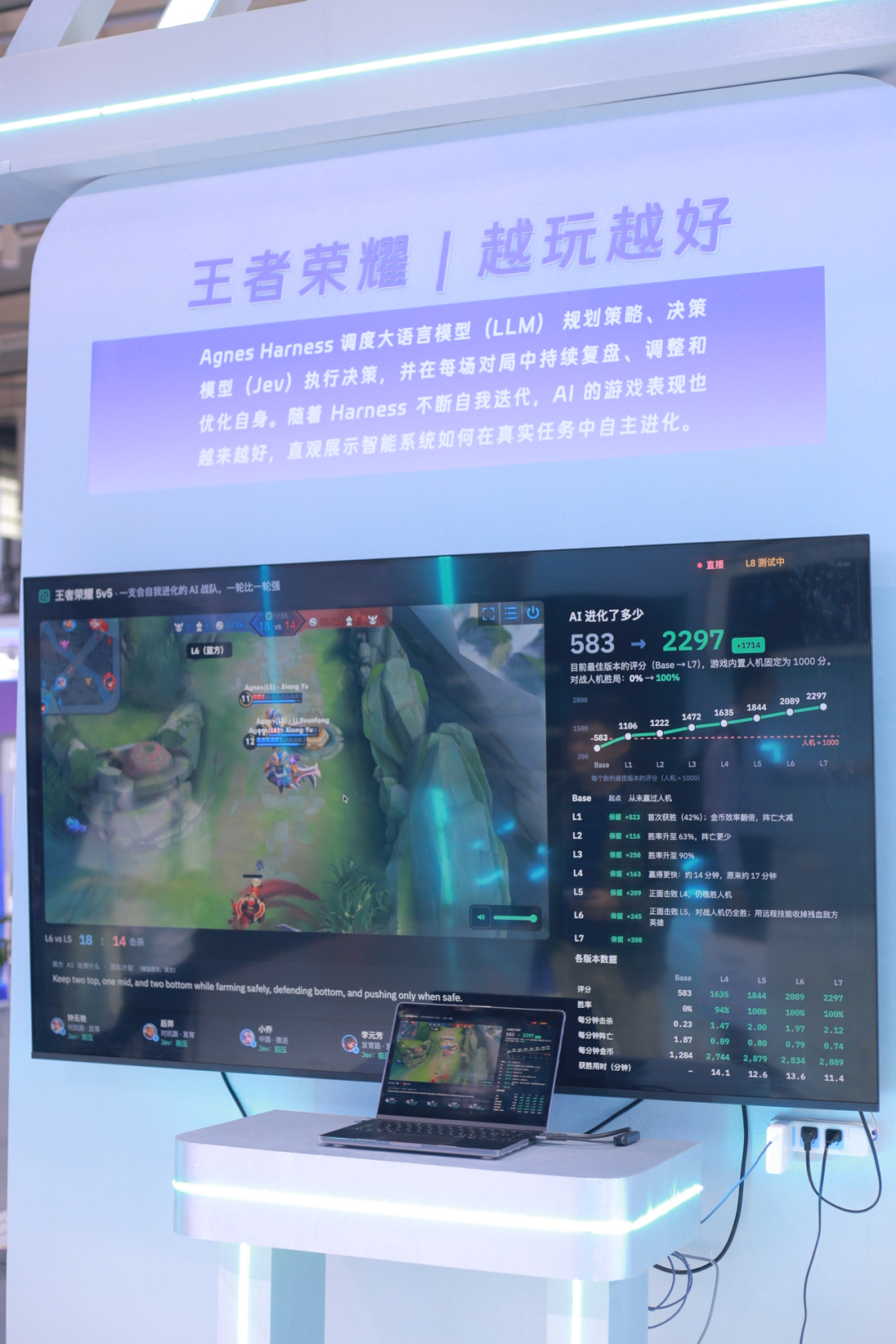
The right side shows this team’s rating and win rate for each patch
And on the adjacent screen, a simulated robotic arm is working while tweaking its own model parameters, completing an iteration in as fast as 30 minutes.
A champion team gets stronger because an AI coach rewrites tactics over and over; a robotic arm becomes more precise because the model learns while it works.These are the two paths of AI self‑evolution, and this time, iSense has achieved both simultaneously..
This approach has a name: “Universal Brain”—bringing intelligence from the digital world into the physical world!

One “brain” just isn’t enough
Equip AI with a brain, cerebellum, and a body
Think about driving: judging “traffic ahead, take a detour” relies on the brain; pressing the brake and steering hardly involves the brain, relying on the cerebellum. If you had to think for two seconds every time you pressed the brake, the car would have crashed long ago.
Today’s large models are like drivers who only think—they’re smart but respond slowly.But the physical world has no “undo” button, so being even a beat slower can lead to trouble.
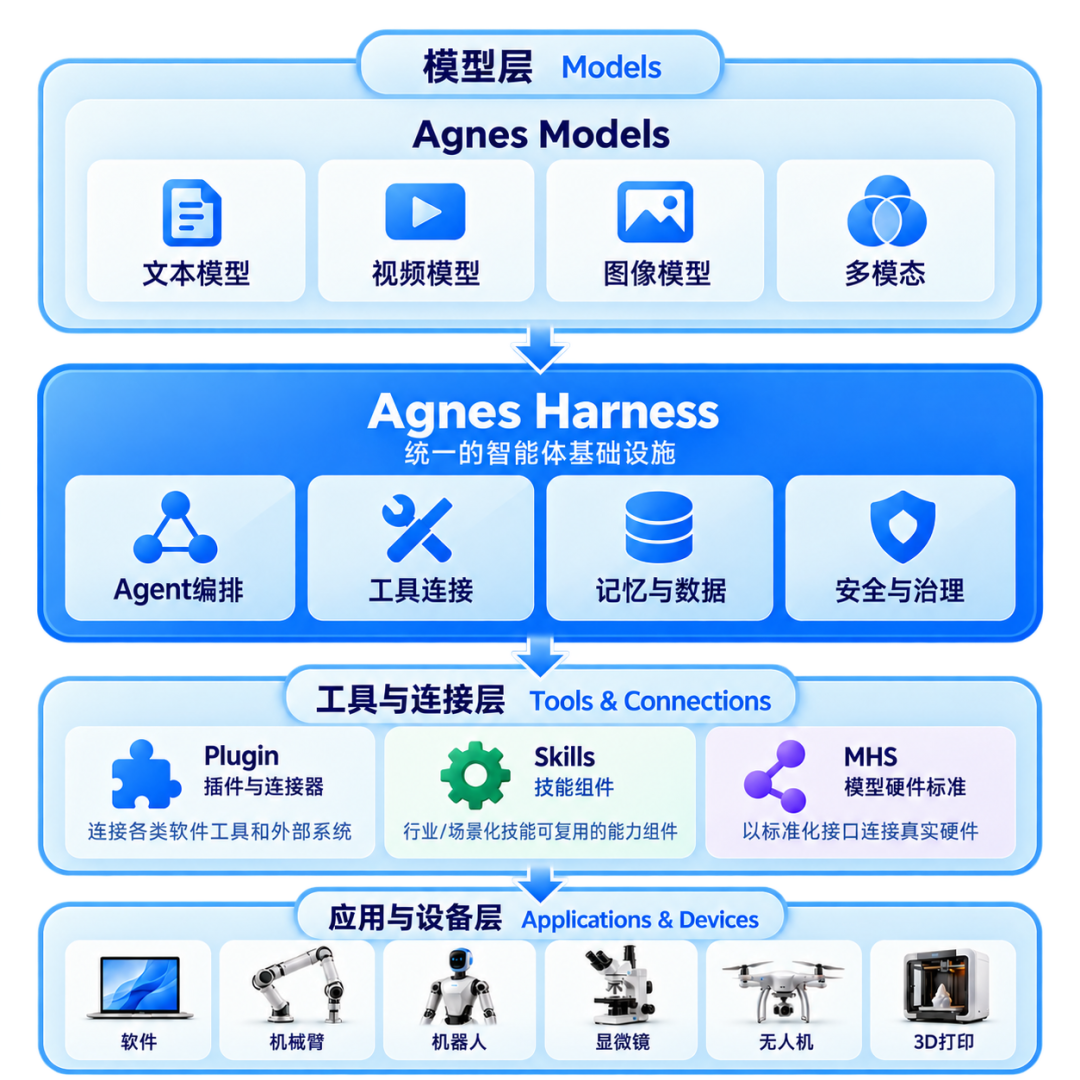
Therefore, AIS didn’t just stack a bigger model; instead, following the division of labor in the human body, it built a complete system for AI. This system is called Agnes Harness, an open‑source agent infrastructure divided into six parts:
The two evolutionary paths introduced at the beginning rely on their learning ability.
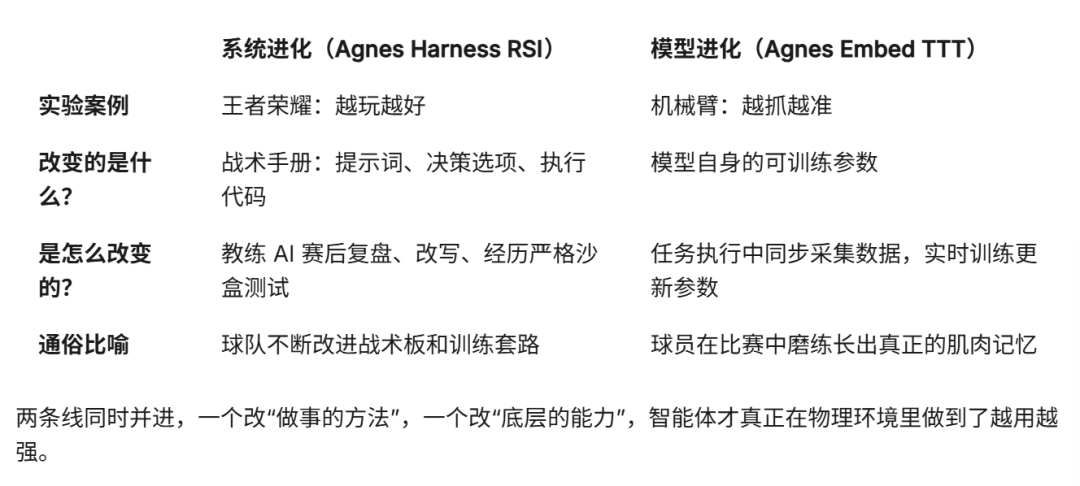
At the system level, Agnes Harness RSI lets the AI improve its own methods, such as rewriting tactics, prompts, and code, while the model itself remains unchanged; at the model level, Agnes Embed TTT enables the model to learn while working, directly updating its parameters.
Combining the two results in the “Dual-Evolution Intelligent System”.
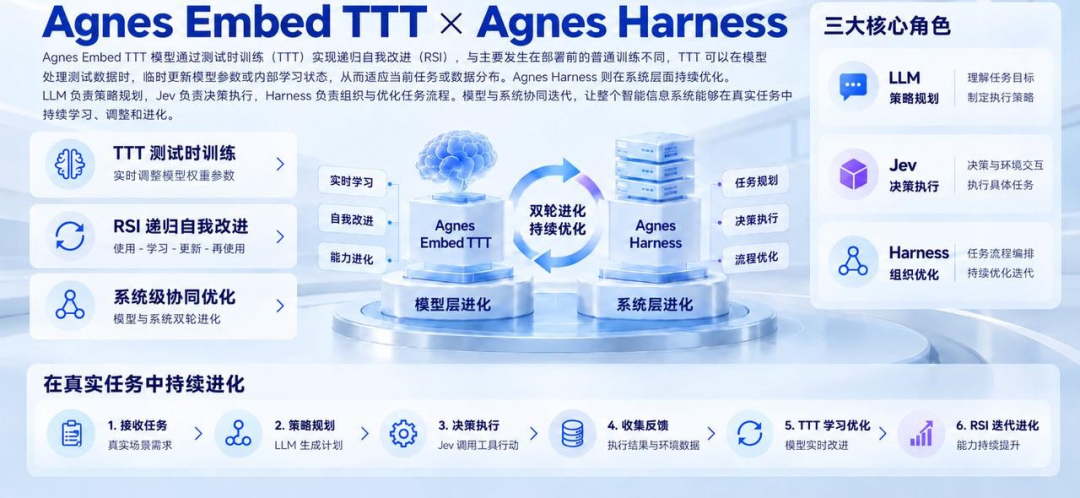
System Evolution RSI
AI Coach Review Over Five Rounds, the Team Goes From 0 Wins to a Perfect Record
The champion team at the booth copied the roster of a professional e‑sports team. On the field there is a commander (large model, sets the overall direction roughly every 30 seconds), a player (Jev, one for each hero, makes decisions roughly every 2 seconds), and a “muscle memory” responsible for positioning, basic attacks, and skill casting (tactical script, executed 5 times per second).
The coach sitting off‑stage is the upcoming Agnes 3.0 Pro. It never enters the match, only makes moves after each round ends. During review, it looks at a complete replay without the fog of war; any enemy movements that players on the field cannot see, it sees perfectly.
No matter how complete the view, the coach can only manipulate one thing: the team’s entire tactic book, including the commander’s cue words, the actions players can choose, and the code behind each action. As for the model itself, it doesn’t touch a single parameter.
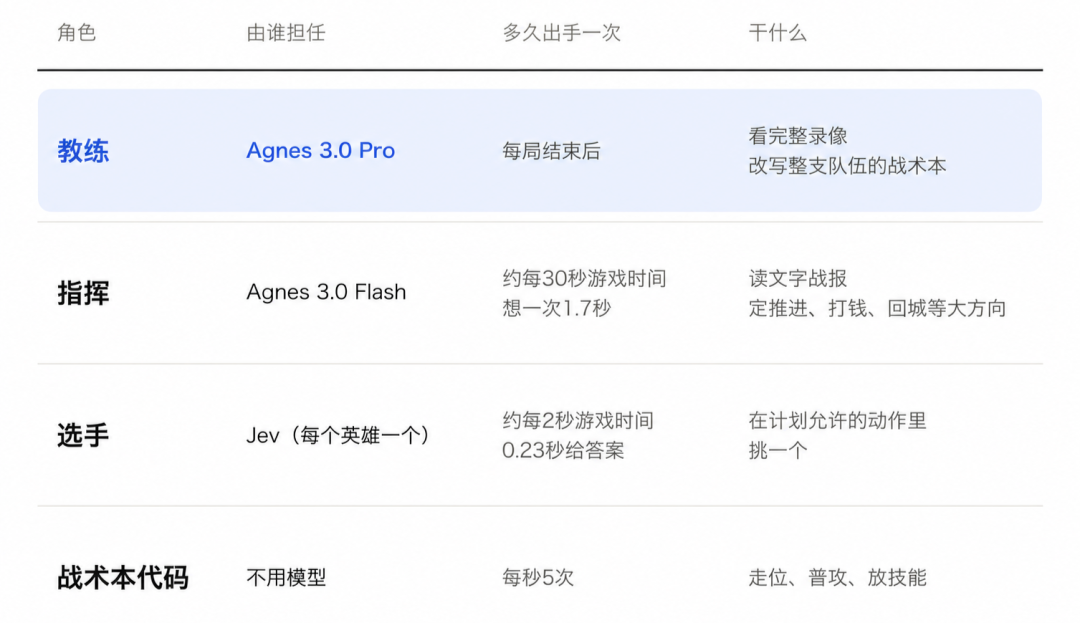
Review, revise the tactic book, test again before re‑entering, looping round after round; the AI continuously improves itself at the system level, i.e., recursive self‑improvement (RSI).
At first, this team didn’t win a single game against the AI. After the coach produced the first version of the tactic book, the team secured its first win, with a 42% win rate; the second version rose to 63%, the third to 90%. By the fourth version, the coach started aiming for faster victories, cutting a game from about 17 minutes to about 14 minutes.
By the fifth version, it finally never lost a game to the AI, achieving a 100% win rate.
The win rate hit the max, but evolution never stopped.From then on, each new version had to defeat the previous one head‑on to survive: version 5 beat version 4, version 6 beat version 5. The team on the big screen keeps evolving version by version.
Besides 5v5, Agnes also recorded complete experiments for 1v1 and 3v3 in the public report.
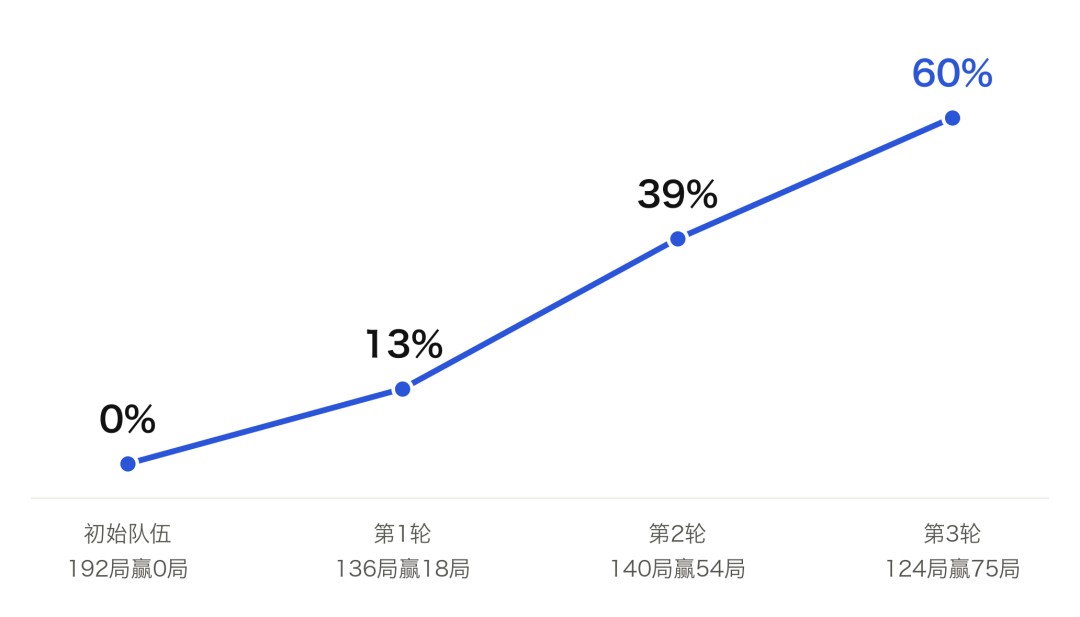
In the 3v3 set, she used a brand‑new three‑person team that brought nothing from the 1v1 lessons. In the early stage, it played 192 games and didn’t win a single one.
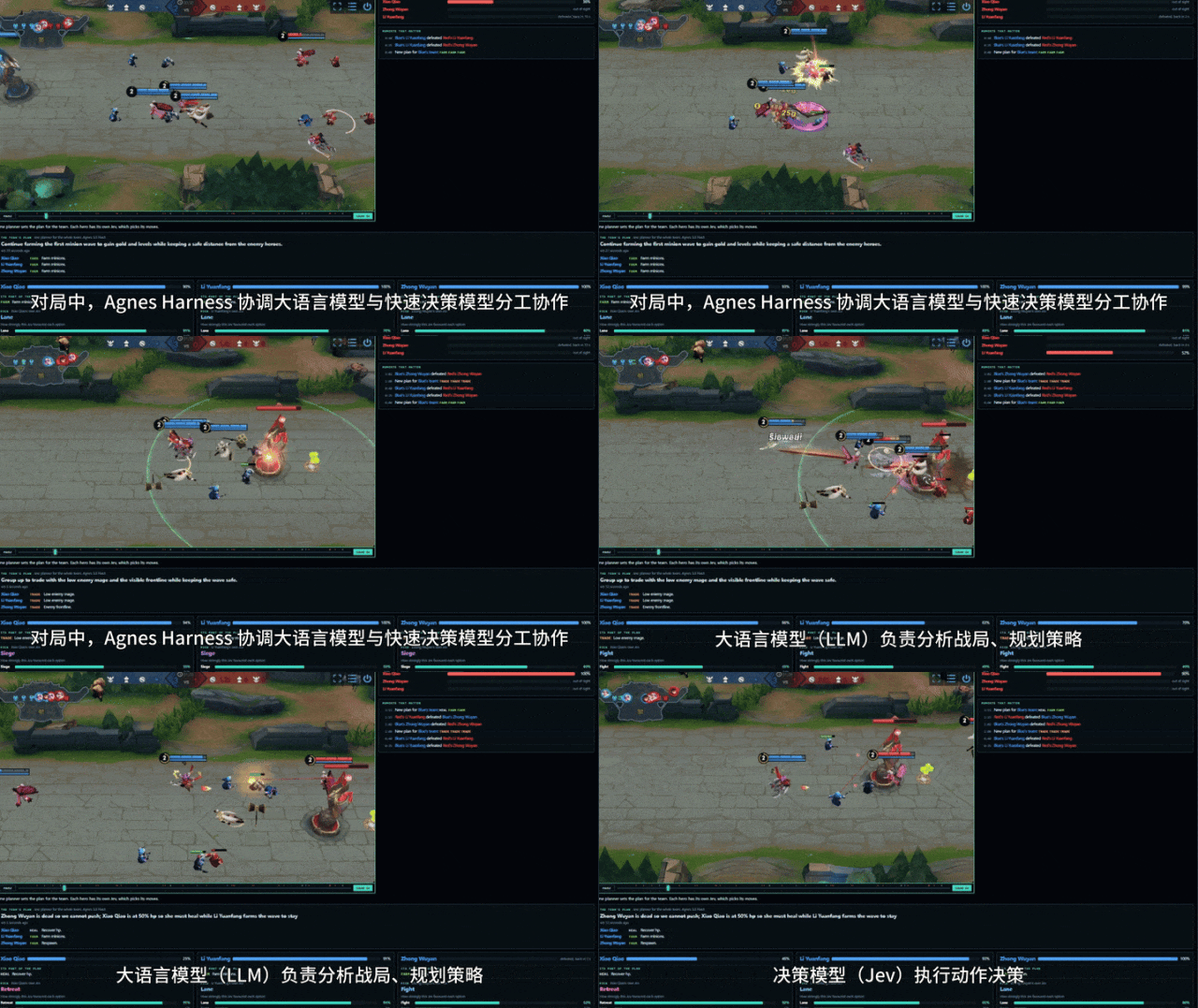
3v3 match screen, below is the commander’s plan assigned to each hero
So the AI coach started reviewing the footage. Its notes read like those of an irate real coach.
Round One: “In 79% of the survival time, the hero’s health stays above 90%, yet they stay at home.”
It turned out that out of Jev’s 36,000 decisions, 24,000 were retreats—essentially a fountain‑camping bot. The coach immediately demoted retreat to a fallback option, requiring the hero to return to lane as soon as danger passes.
Round Two: The coach noticed that when the commander shouted “retreat,” the player chose a fallback action 73% of the time. So it simply stopped allowing the commander to issue “heal” plans and instead queued a specific sequence of actions for each hero.
Round 3: Even though the situation was already “all three enemies dead, both towers down, crystal at full health,” the team’s plan was still stuck on “farming.” The coach immediately added a new rule: when the enemy is wiped, clear the minions and push the tower right away!
Thus, after three rounds, the win rate of 3v3 against the built‑in bot rose from 0 to 13%, 39%, and finally reached 60%.
In another set of 1v1 experiments, the initial tactic could only win 3%. After the coach revised it repeatedly, the best version achieved a 90% win rate.
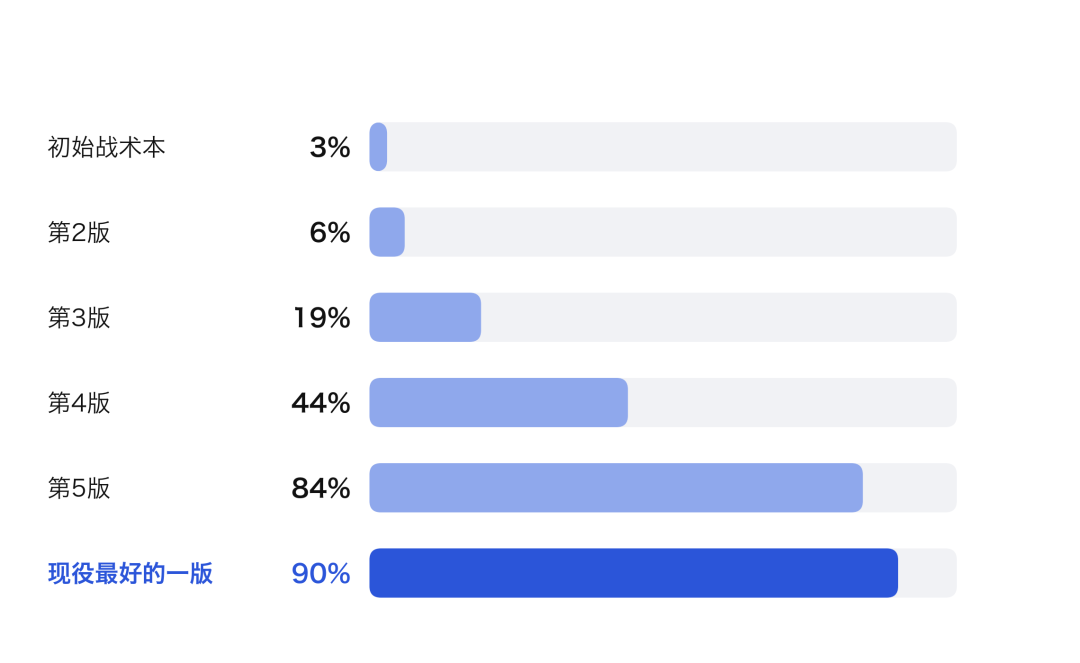
Of course, the new strategies written by the coach can’t go straight into the field. Each version must first pass the exams set by the researchers, a total of five stages: code safety check, 24 matches against the current strategy, challenge the strongest strategies from history, play with unseen heroes, and 48 matches against the built‑in Bot.These match counts and thresholds are not something the coach can change at all..
Even if you take a copy that is identical to the current strategy to tackle the stages,the pass rate is only 1.0%. So in the six‑round 1v1 experiment,the coach wrote 111 candidates, and only 4 were finally approved..
From a 3% win rate all the way to a final inspection score of 95.0 after 48 rounds, the command and coach invocation fees spent on these 1v1 experiments totalonly about $33.
Model Evolution TTT
The robotic arm develops “muscle memory,” evolving a round in as fast as 30 minutes
In Honor of Kings, the model’s parameters haven’t changed at all. But when it comes to the robotic arm, what needs to be changed is the model itself.

This is because once a model is trained and deployed, its parameters are essentially fixed, and it cannot instantly acquire new capabilities when encountering new situations during operation.
When placed on a robotic arm, the problem becomes very specific: it can’t grip securely, so you have to first collect a batch of data, stop to retrain, and then redeploy. One iteration often takes weeks, and if a grasp fails in the meantime, you still have to rely on manual parameter tuning.
iFlytek’s solution is the Agnes Embed TTT (Train‑Test‑Train) model. It incorporates data collection, training, and inference into the same task loop, allowing the robotic arm to work while the model continuously adjusts its weight parameters in real time.
On the booth demonstration is a Franka Panda robotic arm working in the MuJoCo simulation environment: moving a red block into a blue target tray; any mistake in the five steps counts as a failure.
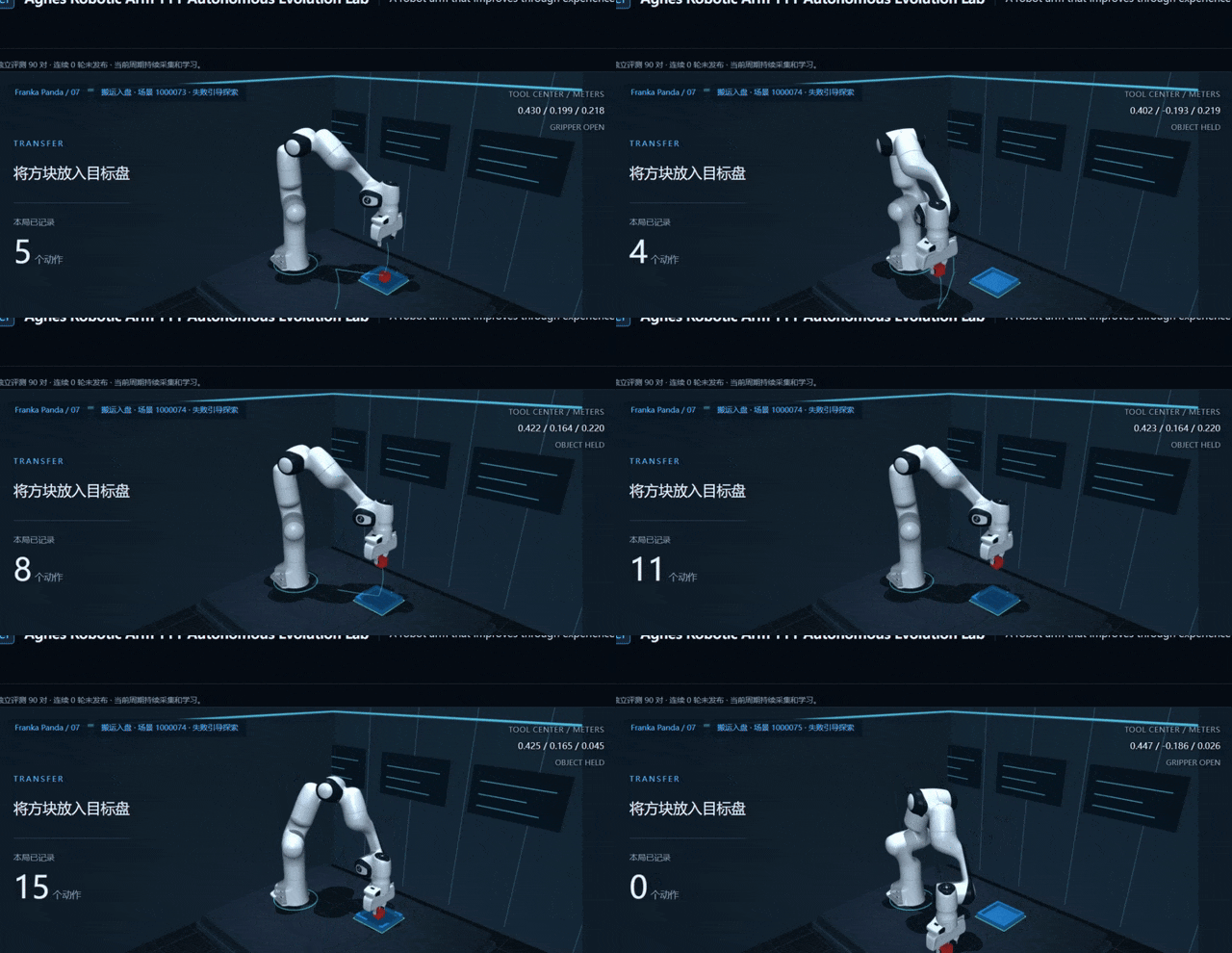
Moreover, in this experiment, Agnes Harness also evolves together with the model.
Specifically, after each round of operation by the robotic arm, the system collects its motion trajectory, discarding ineffective actions such as empty grasps or drops mid‑way, and only uses the valid steps from successful trajectories to train the model. After training, the model is evaluated on a test set.
In other words, the model relies on training to get better, while Harness is responsible for breaking down actions, scheduling the training, and providing the model with better learning conditions.
Moreover, each training session adjusts very few parameters: the 752.4M‑parameter backbone is kept frozen, only the last 7.35M‑parameter decision head is unfrozen, less than 1% of the total. The newly trained version must achieve at least a 5‑percentage‑point higher task completion rate than the current version before it can be deployed.
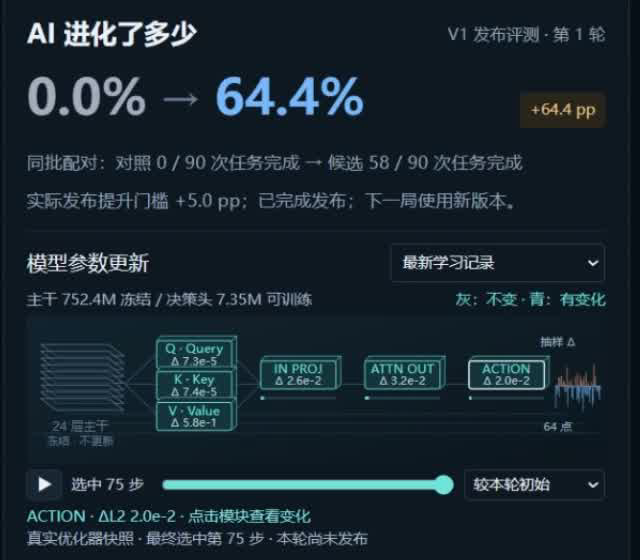
With this practice, in simulation studies,the robotic arm’s task success rate rose from about 30% to about 70%, and then to about 90%. The time for each iteration, which used to be measured in weeks, has been compressed toas fast as 30 minutes to 1 hour.
According to Assistant Professor Li Xiaofan of the National University of Singapore, the team integrated data collection, training, and inference into a single task loop, allowing the model to iterate in as little as about 30 minutes under specific experimental conditions.
Entering the Physical World
One brain simultaneously controls a robot dog, a car, and a Mars base
However, an evolving brain that wants to step out of the screen must first be connected to a “body”.
The difficulty of this process lies in the fact that the robot dog, camera, and robotic arm each use different protocols, so each new device requires rewriting the low‑level code.
To this end, Aisi has defined a set of standards called MHS (Model Hardware Standard). After a device connects, it first registers with the central hub AgnesHub, reporting its status, capabilities, and the data it can provide.
After that, large models don’t need to touch the device’s low‑level code, they can orchestrate everything using just seven generic tools (view, read, invoke, stop, etc.).
For example, in a real‑world test, the car Car01 and the robot dog Go02 were placed together. The scheduling Agent can use only the capabilities registered when the two devices connected: see, speak, perform actions, and play music.
It first activates the cameras on both devices, confirming “the two devices are facing each other, about 0.9 meters apart,” and then has them greet each other in English.
Next, the car plays “YMCA,” and the robot dog starts dancing to the beat.
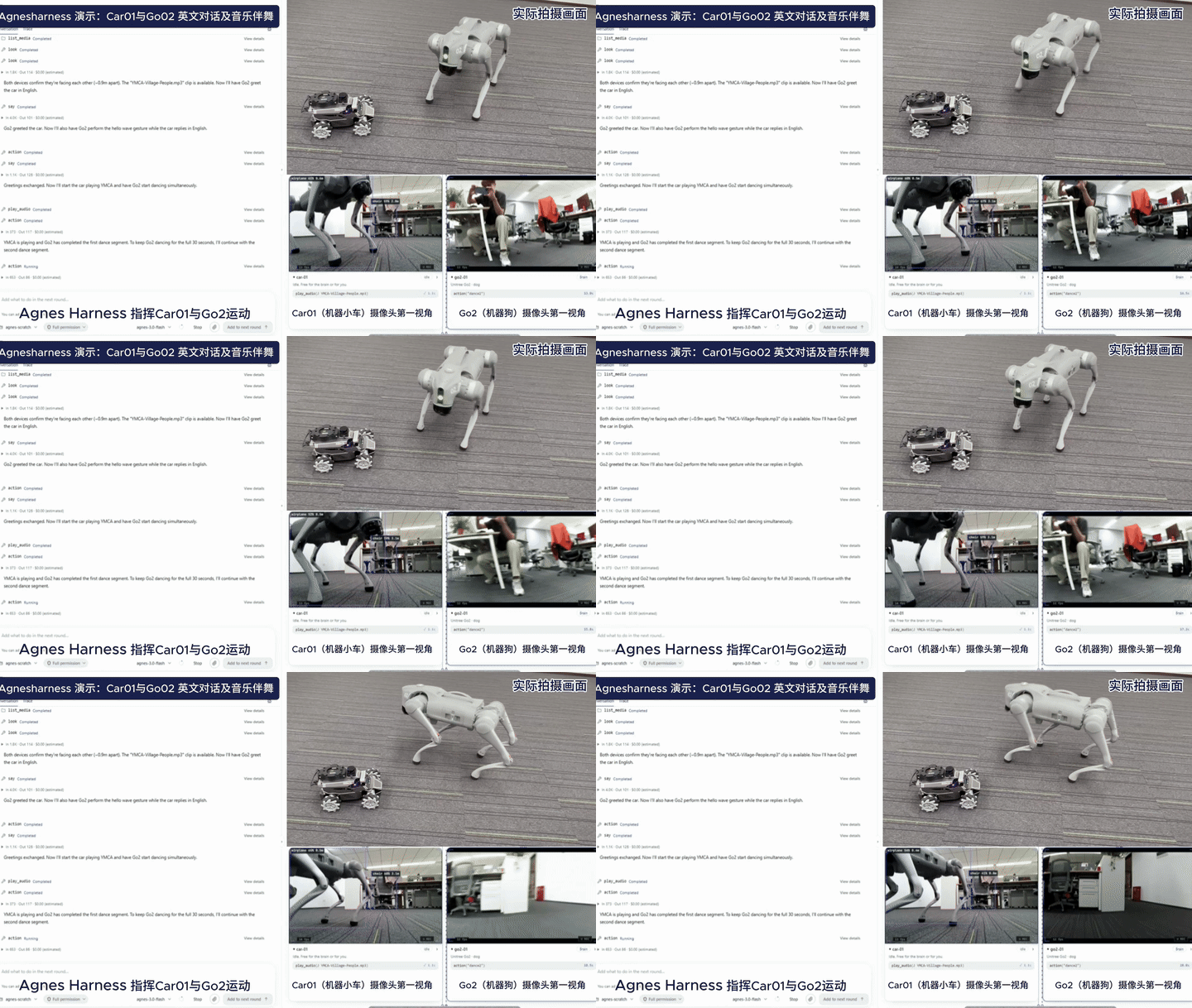
Below is the first-person view from the cameras of two devices
The same approach can also control an entire base. In the simulated Mars base Mars World,12 devices are online simultaneously, all coordinated by a single Agent.
Someone only said “the astronaut lost contact”,and the system automatically arranged a rescue: the jumper lifts off to find the person, a robot reaches the astronaut, the airlock opens the hatch, and brings the person back to the living module.
Another mission involved handling a meteorite impact. The decision‑making micro‑brain Jev took only 0.6 seconds, with an 87% confidence, and dispatched a patrol vehicle to complete the docking.
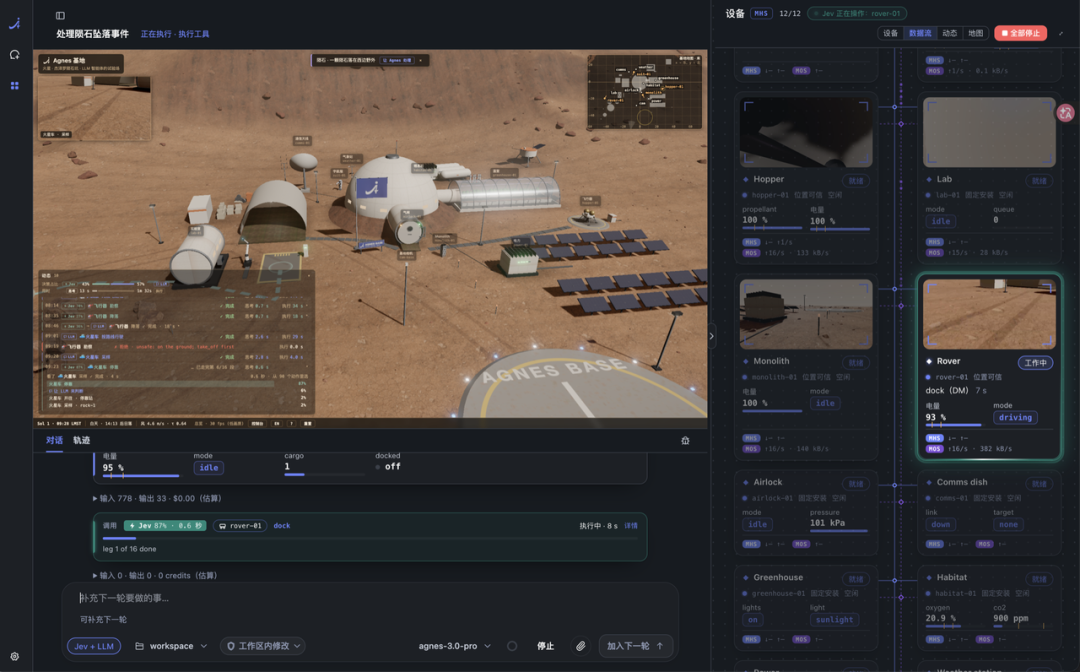
The right side shows the real-time status of 12 devices
Throughout the entire scheduling process, the user can press the “Stop All” button in the upper right corner of the interface at any time. Behind this button is a strict rule set by MHS: the device must accept a stop command in any state,and once the connection is lost, all actions must cease within 1 second.
The final safety layers, such as emergency stop and interlocks, are still handled by the device’s own controller.
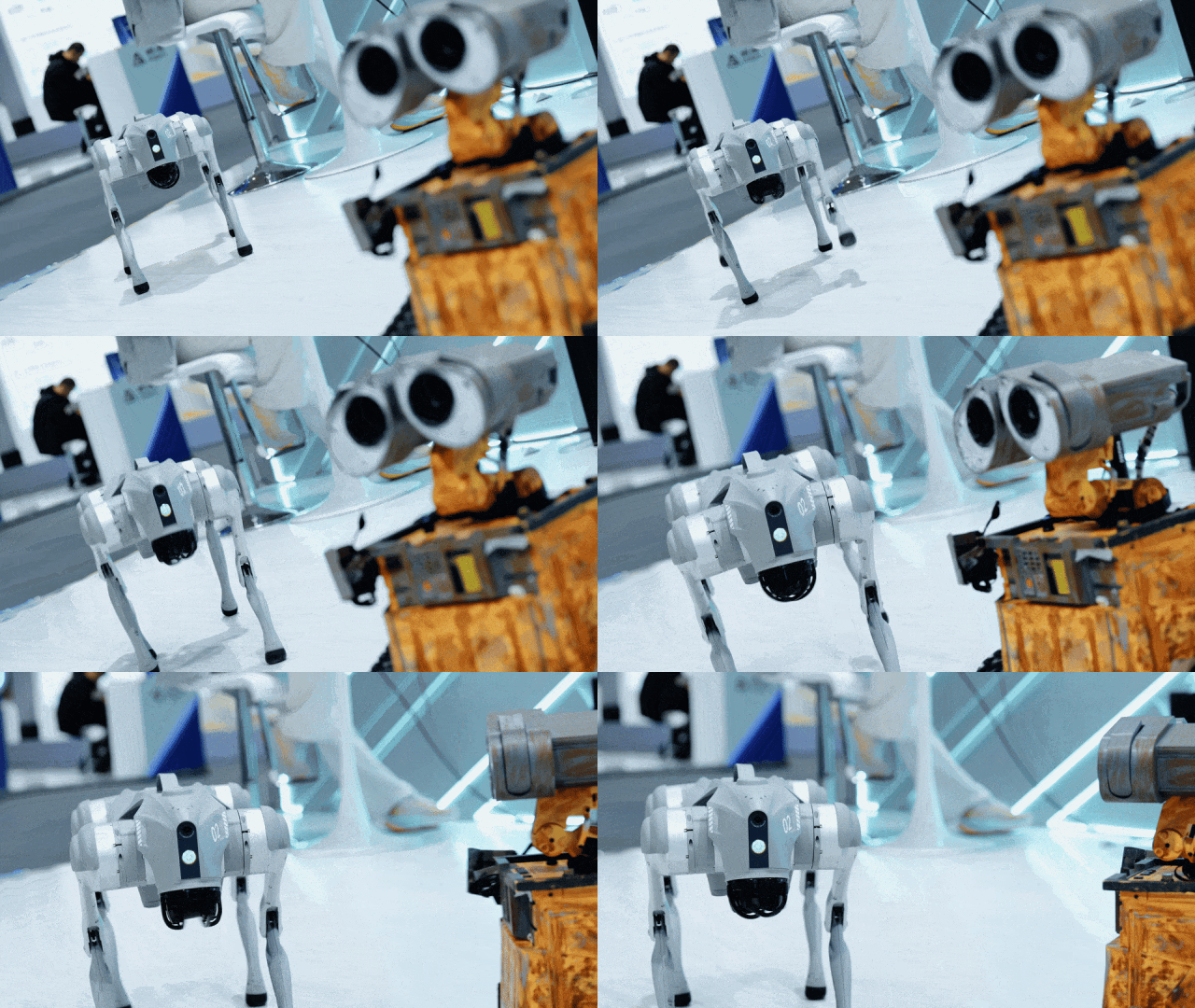
Back at the Nanjing booth, the robot dog, Wall‑E, and a dual‑arm wheeled robot,are all connected to the same Harness brain.
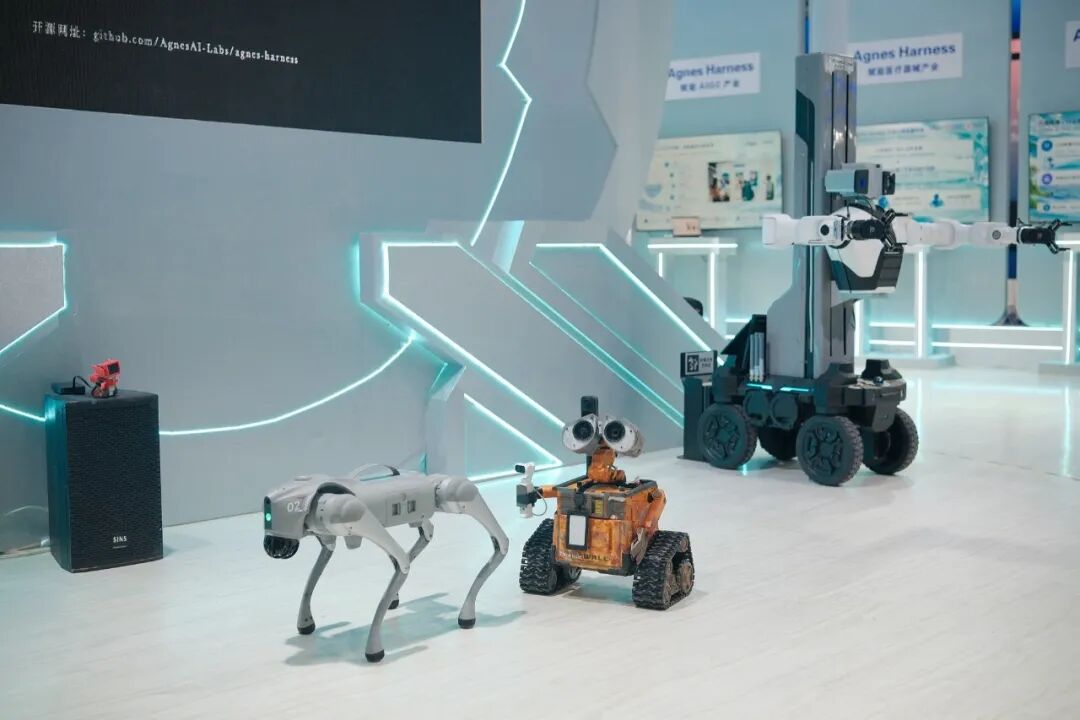
On site, someone typed the following in Agnes Harness: “Dog, go find your good friend Wall‑E, and say hello.”
Agent pulled up the robot dog’s camera, took a look, and replied, “WALL·E is right ahead, directly facing me! Walk over and get close to it.”
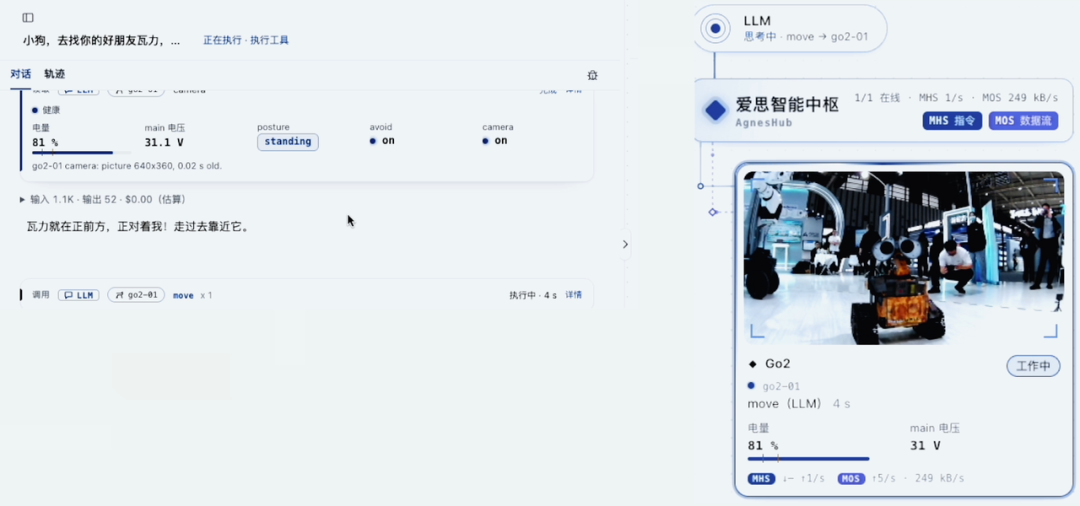
On the right is the view from the robot dog’s camera, and Wall‑E is right in the center
The robot dog walks up to Wall‑E, waves its paw, and greets loudly: “Wall‑E, hello! Long time no see, I’m the robot dog, nice to meet you!” Finally, it wrote in the mission report: “We are now standing face to face.”
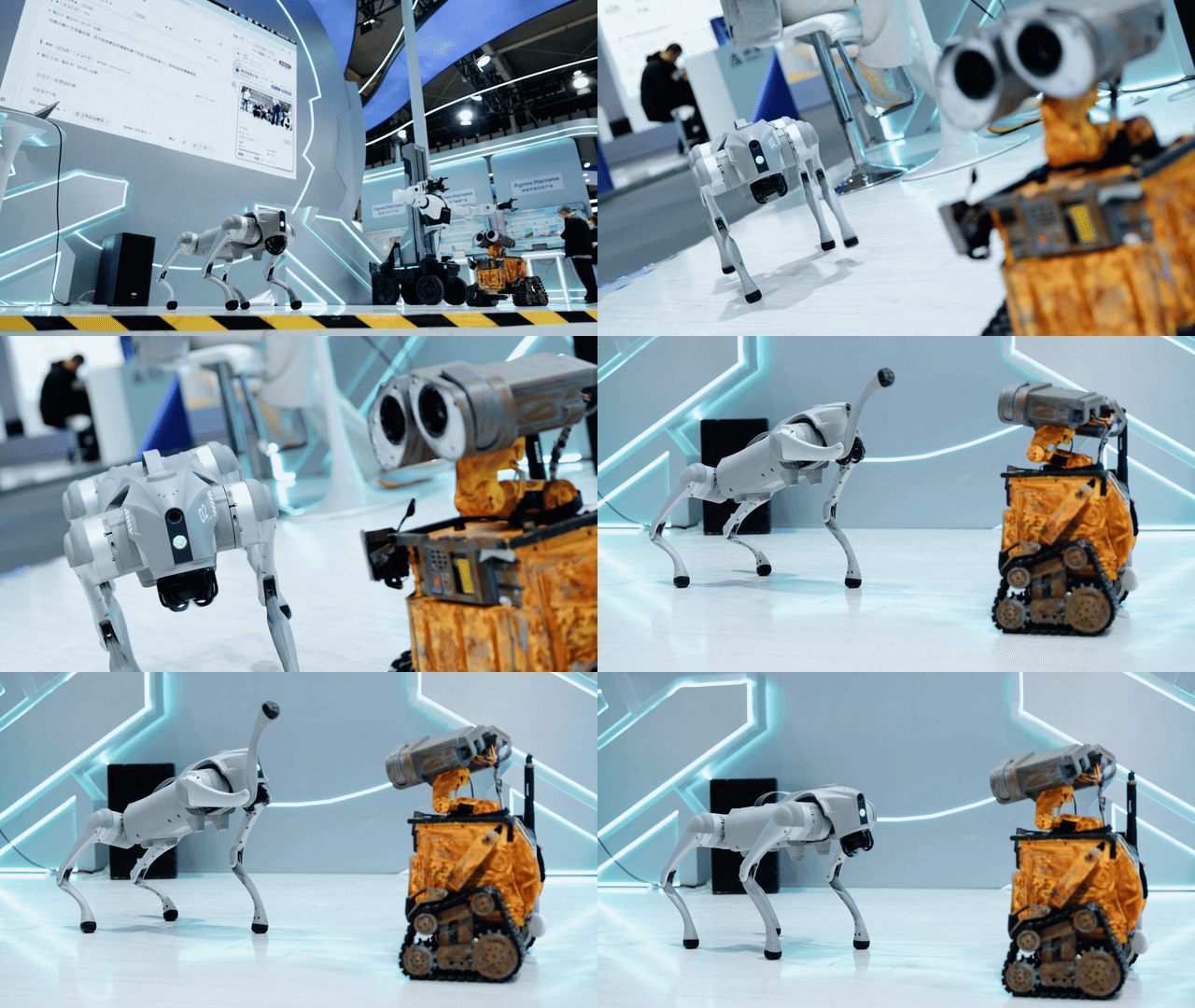
Someone added, “Let’s dance,” and it immediately performed a dance. And from finding a person, walking over, to waving a paw in greeting, every step was determined by the Agent watching the camera feed.
From the Lab to the Factory
FDE turns intelligence into real profit
Whether it’s a valley godlike play or a dancing robot dog, these scenarios are mostly just geek toys.
The key to moving AI from showmanship to business value is how to truly integrate it into enterprise workflows, solve real problems, and achieve cost reduction and efficiency gains.
This also leads to the final piece of the puzzle presented by Agnes this time: FDE(前线交付工程).
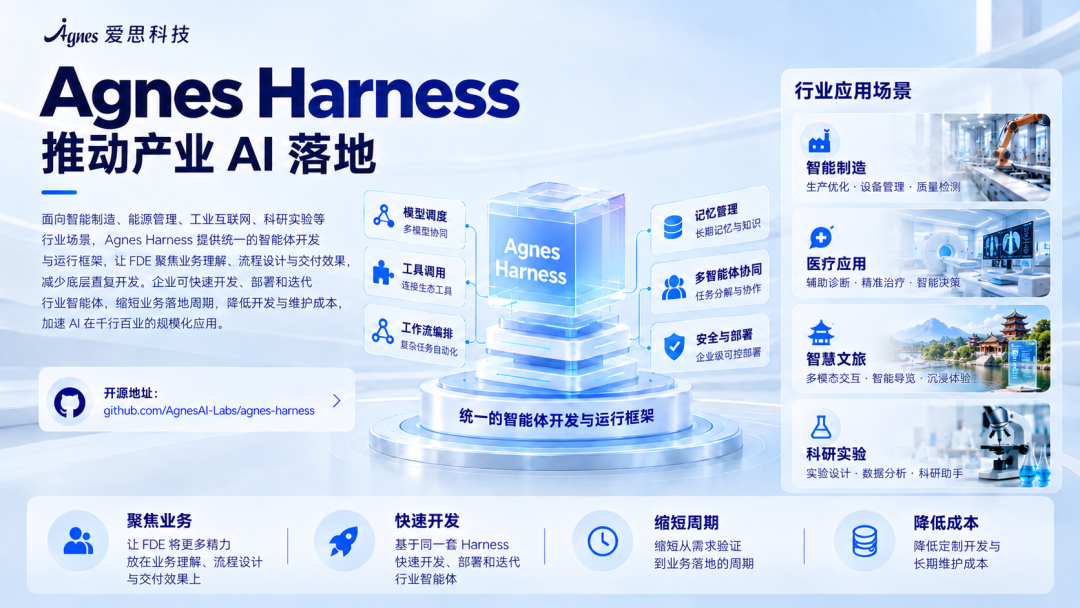
FDE engineers will go to the enterprise’s business site, turn queries into plugins, and write decision rules as Skills.
Each company’s unique aspects go into plugins, execution is handed over to Harness, and validated capabilities are solidified, so for the next project you can reuse them directly like building with LEGO.
The exhibition FDE area has three screens, showcasing cases from the AIGC, medical device, and environmental technology sectors. The title for the environmental technology screen is the most straightforward:“Turn environmental expert experience into your own AI product”.
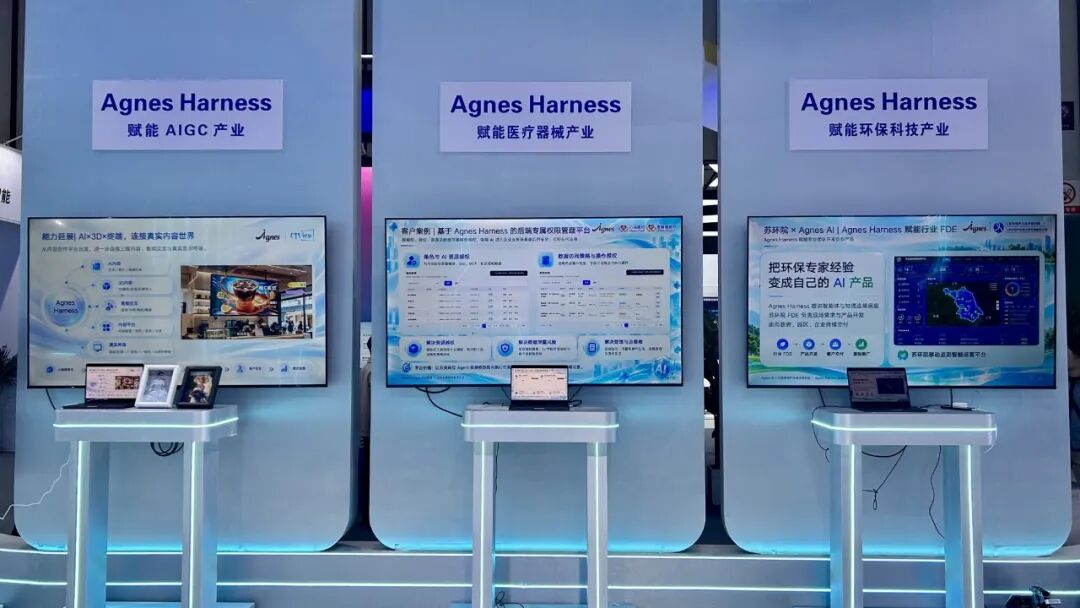
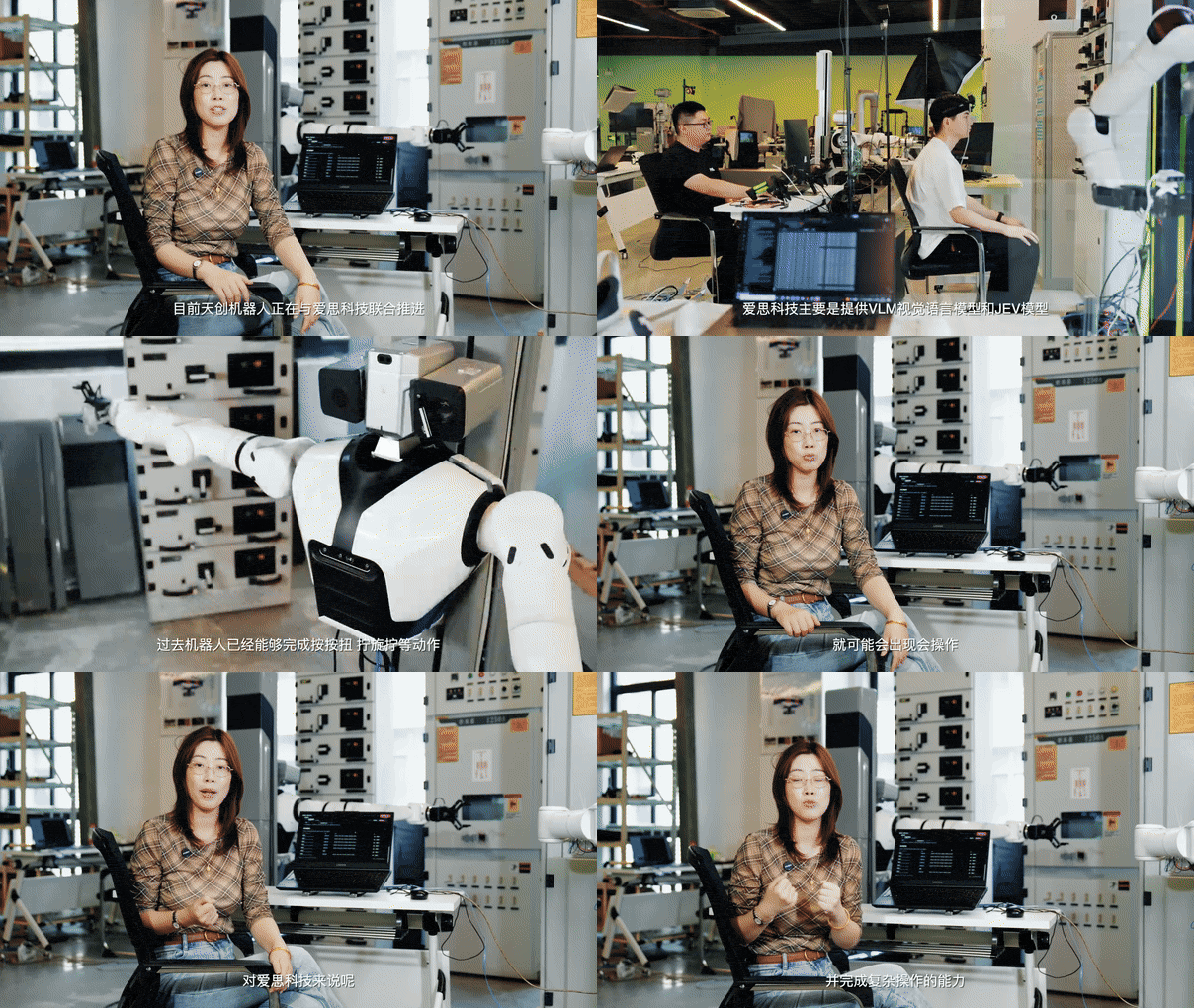
Besides these three industries, Aisi is also exploring power operation scenarios with Tianchuang Robotics. Aisi handles visual understanding and task reasoning, while Tianchuang handles hardware and motion control, and both parties are conducting validation in real environments.
In the collaboration, Agnes Harness plays the role of a “embodied brain” scheduler.
For example, you only need to issue the command “Open the distribution box at 10 am tomorrow morning,” and the robot will execute it automatically. This not only helps address the limitations of traditional embodied intelligence in understanding complex tasks, dynamic decision‑making, and cross‑device coordination, but also provides technical support for multi‑task orchestration and task execution under non‑fixed workflows, enabling robots to flexibly meet operational demands in various scenarios.
Final Note: The Essential Path to AGI
The same model has also been turned into a product that ordinary people can use directly.
On the exhibition booth are the local AI workstation “爱思办公”, the AI short drama platform Pavo, and next to them the “AI+黑客松” finals where developers build applications with Agnes.
In the view of iScience founder Yang Tong, the future creation should be a truly world‑participating intelligence.
And the foundation of all this is the model.
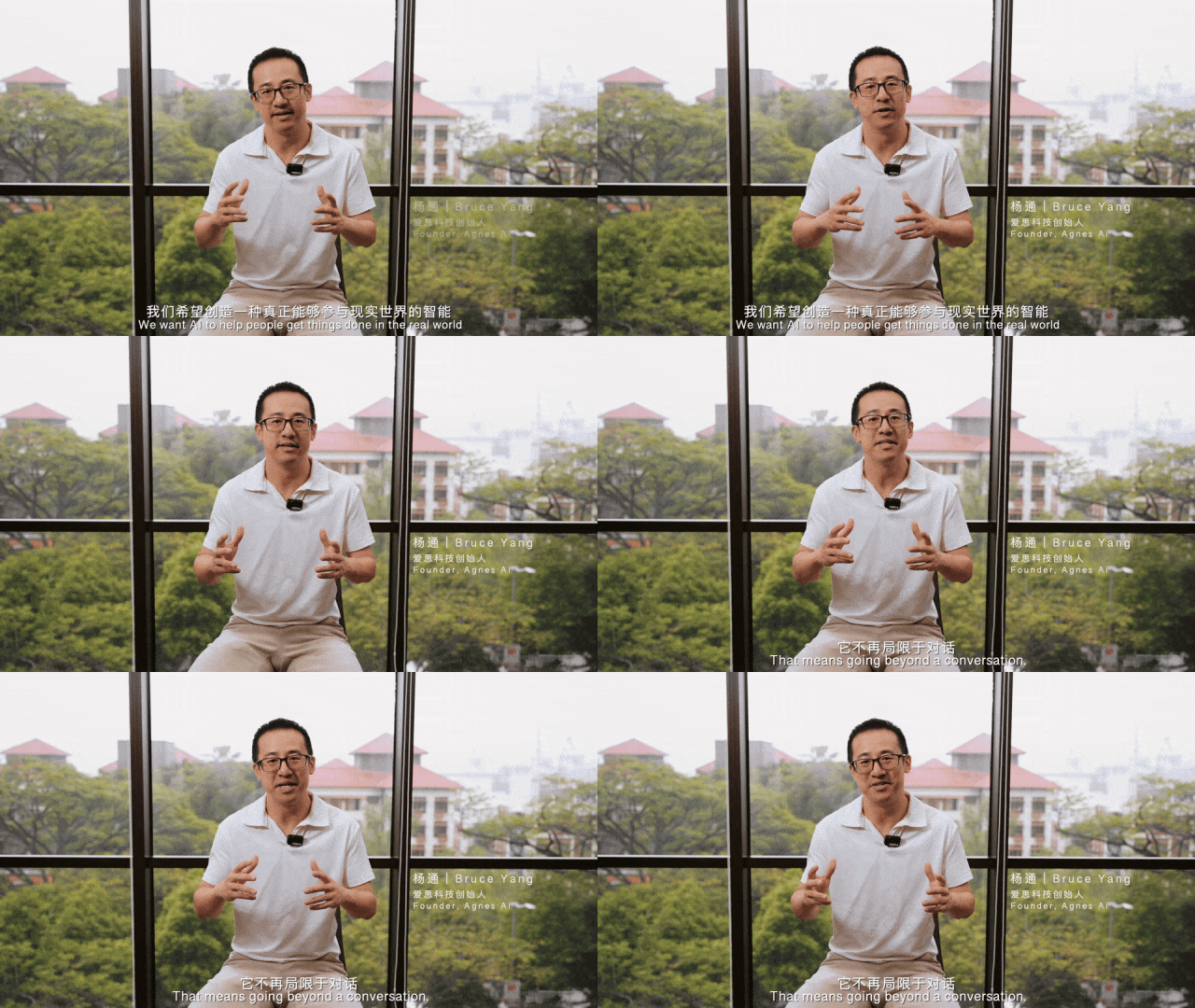
Agnes AI is a multimodal foundational model company, and from Honor of Kings to robot dogs and Mars bases, the orchestration behind them all uses its own Agnes 3.0 series.
Currently, the Agnes models have a monthly average token usage exceeding 65 trillion, including image generation of 48 million images per month and video generation lasting 168 million seconds per month.
In Agnes’s view, AGI must be rooted in physical reality. It must accumulate causal knowledge through repeated real-world grasping, handling, rescue, and delivery tasks, ultimately building its own “world model”.
The conference will end after three days, but at this booth in Nanjing, physical AI is just awakening.
Instant ASI Follow
⭐Like, share, and view – one‑click triple⭐
Turn on the star badge to lock in Xinzhiyuan’s rapid updates!

An Honor of Kings AI team, crushed by the game’s built‑in bots right from the start, hasn’t won a single match.
No one expected that after the AI coach only guided it through five review rounds, the win rate jumped from 0% straight to 100%!
No model was trained at all, and every new version of the tactics book was created by the AI coach itself.
This 5v5 match is being live‑streamed at the 2026 Nanjing Physics AI and World Models Conference, with the big screen displayed at the Agnes AI (爱思科技) booth.
The right side records this team’s rating and win rate for each version
On the neighboring screen, a simulated robotic arm is working while adjusting its model parameters, completing an iteration in as fast as 30 minutes.
The champion team gets stronger thanks to an AI coach repeatedly rewriting tactics; the robotic arm becomes more precise as the model learns while working.These are the two paths of AI self‑evolution, and this time, iThink has achieved both simultaneously.
This approach has a name, called “Universal Shared Brain”—bringing intelligence from the digital world into the physical world!
One “brain” just isn’t enough
Give AI a brain, a cerebellum, and a body
Think about driving: deciding “the road ahead is congested, take a detour” relies on the brain; pressing the brake and steering are almost reflexes, relying on the cerebellum. If you had to think for two seconds every time you pressed the brake, the car would have crashed long ago.
Today’s large models are like drivers who only think, smart but slow to react.But the physical world has no “undo” button, so being even a beat slower can cause trouble.
Therefore, AIS did not stack a larger model, but followed the human body’s division of labor to build a complete system for AI. This system is called Agnes Harness, an open‑source agent infrastructure, divided into six parts:
Self-Evolving A “Kills” Its Way into the Physical World! King’s Canyon Godslayer, From Zero to Total Victory
Self-evolving A “Kill” enters the physical world! King’s Canyon slays gods, going from zero to total victory
Content Summary
Xinzhiyuan reports: An Honor of Kings AI team was crushed by the game’s built‑in bots at the start and hadn’t won a single match. No one expected that after the AI coach reviewed only five rounds, its win rate jumped from 0% straight to 100%! Full coverage
Xinzhiyuan reports
Xinzhiyuan reports
</h3
-
Brain | LLM (Agnes 3.0 Flash, etc.): Understands questions, performs long‑term reasoning, takes about 1.7 seconds per thought. -
Cerebellum | Decision Model Jev:Make quick decisions among limited options, delivering an answer in 0.23 seconds, about 7 times faster than large models; if uncertain, hand it back to the large model. -
Reflex Arc | Workflow (工作流):Fixed standard actions are written as established processes; once the signal arrives, they trigger instantly without consuming mental effort. -
Memory and Initiative | Agent Loop (自主循环):Control context and memory, driving the cycle of “perceive, think, act” forward round by round. -
Learning Ability | RSI/TTT:RSI enables the system to improve its own methods, and TTT lets the model learn while working, getting stronger with use. -
Body | MHS (模型硬件标准):AI’s “USB interface” to the physical world, allowing robots, carts, cameras to be standardized for “plug‑in” connectivity.
-
Passed the test: directly update the model, Harness remains unchanged; -
Failed the test: Harness intervenes, breaking the grasping task into finer steps, recollecting trajectories, and then adjusting model parameters.
Edited by Aeneas Moses
Xinzhiyuan reports
Xinzhiyuan reports
-
Brain | LLM (e.g., Agnes 3.0 Flash, etc.): understands questions, performs long‑term reasoning, taking 1.7 seconds per thought. -
Cerebellum | Decision Model Jev: Quickly make a decision among limited options, delivering an answer in 0.23 seconds—about 7 times faster than large models; if uncertain, defer to the large model. -
Reflex Arc | Workflow: Fixed standard actions are written as predefined processes; once the signal arrives, they trigger instantly without consuming mental effort. -
Memory & Initiative | Agent Loop: Manage context and memory, driving the cycle of “perceive, think, act” forward repeatedly. -
Learning Ability | RSI/TTT: RSI enables the system to improve its own methods, while TTT lets the model learn while working, getting stronger with use. -
Passed: directly update the model, Harness stays unchanged; -
Failed: Harness steps in, breaks the grasping task into finer steps, recollects trajectories, and retunes the model parameters.
<li
</ul
Edited by: Aeneas Moses
Read more tech without borders — MirrorSpeed VPNFast mirror acceleration, encrypted privacy, global nodes for stable access to overseas resources.
Get MirrorSpeed
Get MirrorSpeed
Read more tech without borders — MirrorSpeed VPNFast mirror acceleration, encrypted privacy, global nodes for stable access to overseas resources.
Get MirrorSpeed
Get MirrorSpeed