IBM Achieves Chip-Level Collaboration with Four Superconducting Cables, Breaking the Qubit Crowding Curse
IBM uses four superconducting cables to achieve chip‑level collaboration, breaking the quantum‑bit crowding curse
Content Summary
Recently, scientists from IBM just used four 80‑centimeter aluminum cables to connect two large superconducting quantum chips together, setting a record average 99% quantum‑state transmission fidelity, marking a milestone in quantum computing
Recently, scientists from IBM just connected two large superconducting quantum chips with four 80‑centimeter‑long aluminum cables, setting a record average quantum‑state transfer fidelity of 99%, marking the official entry of quantum computing into a new modular assembly stage.
Previously, it was widely believed that to make a quantum computer sufficiently powerful, more qubits had to be packed onto a single chip. However, when a chip becomes too large, the fragile quantum states are highly susceptible to interference and collapse. Connecting multiple independent chips with specially designed long‑distance couplers to work cooperatively has become the necessary path to break the scaling bottleneck.
How impressive is IBM’s breakthrough really? First, we need to look at the challenges quantum computers face today. The ordinary computers we use now have transistors in their chips, processing information by the flow of electrons. Quantum computers, on the other hand, rely on qubits, which follow the strange physical laws of the microscopic world.
Qubits are extremely fragile; even a slight amount of heat or electromagnetic interference can cause them to lose their state, leading to erroneous calculations. To enable quantum computers to tackle problems that would take traditional computers forever to solve, we need to get tens of thousands of qubits working together.
However, the more qubits you cram onto a single chip, the exponentially harder it becomes to control them. It’s like a university classroom that keeps getting more and more students; when the enrollment swells to hundreds or even thousands, even if the professor uses a megaphone, the students in the back rows can’t hear clearly, and classroom discipline and interaction suffer greatly.
To bypass this quantum‑physics limit, IBM scientists took a different approach: they split the large class into several smaller ones, each taught in its own independent room, and then linked those rooms together via a campus‑wide broadcast system to achieve unified scheduling.
In this experiment, they took two processors, each with 120 qubits, and placed them in an ultra‑cold dilution refrigerator near absolute zero.At such extreme low temperatures, certain materials lose their resistance, becoming superconductors, which helps keep the qubits stable.
(Source: IBM)
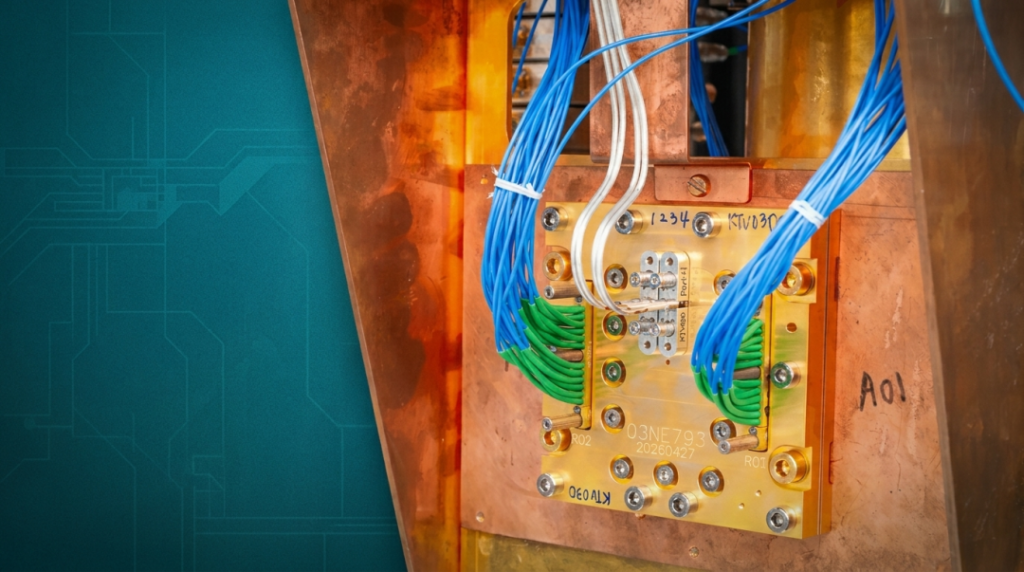
To connect these two chips, they specially designed four 80‑centimeter superconducting aluminum coaxial cables, a hardware known as a long‑distance coupler. These cables act like high‑speed highways, allowing extremely weak quantum information to shuttle between the two separate chips.
Transferring quantum information intact through the cables is a technically challenging task. Quantum states are highly susceptible to decay during transmission, much like sound that diminishes in the wind and eventually disappears into the air.
Experimental data show that these four cables not only withstand the ultra‑low‑temperature environment, but also achieve an internal quality factor of 940,000. This number represents the system’s ability to preserve energy; the higher the value, the less energy loss occurs.
Below the microwave frequency band, achieving this level of quality factor indicates that the cable performance is outstanding. The measurement results show that the average fidelity of quantum states transmitted over these cables reaches 99%, with the best-performing link achieving a transmission fidelity of 99.29%. This means that quantum information can arrive at the opposite chip intact in the vast majority of cases, a remarkable achievement in the microscopic world.
In addition to simple information transmission, the research team also used these long-distance couplers to build a communication bridge between two independent chips.They constructed a long-distance two-qubit logic gate between quantum bits in two different modules, achieving an average fidelity of 94.75%.
In quantum computing, logic gates are like basic arithmetic operations; they must be performed flawlessly to obtain correct results. This spatially spanning connection entangles qubits on two chips, which is a peculiar physical phenomenon—two qubits can instantly affect each other’s states even when far apart.
In experiments, the research team even succeeded in operating two adjacent long-distance couplers simultaneously, generating independent entangled states on the two modules. This demonstrates that these interconnects can handle multiple complex communication tasks like telephone lines, without cross‑talk.
(Source: IBM)
Another highlight of this technology is its assembly method. When assembling large quantum computers, once the chip is placed into the cryostat, the interior space becomes extremely cramped. Traditional connection methods usually require all wires to be connected before the chip is inserted, and once soldered, they are difficult to adjust.
IBM this time used a newly designed spring‑loaded cable clamp that allows press‑fit connection at room temperature after the chip is positioned. This design not only makes the installation process more flexible, but also opens up new possibilities for later removal and re‑insertion of these connections for repair.
A connection interface that can be repeatedly cooled to extremely low temperatures and warmed up without damage is crucial for building practical modular quantum computers. After all, large systems inevitably require maintenance and upgrades during operation, and if each time you have to start from scratch, the cost becomes unsustainable.
Imagine a future data center where we need tens of thousands of qubits to develop new drugs or design novel battery materials—no single chip could possibly accommodate that. This new approach of breaking a large system into multiple modules and linking them with high‑speed signal lines points to a fresh path for scaling quantum computers.
IBM has already laid out its future roadmap, and the results of this experiment can be applied directly to their upcoming Starlight quantum computer project. As scientists continue to refine the manufacturing processes and transmission precision of these cables, future quantum computers will be able to stack more modules like LEGO bricks, delivering greater computational power to tackle increasingly complex problems.
However, the current experiment is still in the research stage, and many technical details still need further refinement. For example, during assembly, how to ensure that multiple cables are arranged more tightly inside the cryostat, and how to further improve connection stability are practical issues that IBM must address next.
Nevertheless, this research has demonstrated that scaling quantum computers through modular interconnects is indeed feasible. When one approach hits a dead end, adopting a different mindset to bypass existing obstacles can sometimes lead to unexpected breakthroughs. IBM’s scientists have turned seemingly impossible concepts into reality through such trial-and-error and innovation.
As these underlying technologies are gradually refined, future quantum computers will become more reliable and will slowly move from the lab into everyday life, helping humanity achieve more breakthroughs in materials science, drug development, AI, and other fields, thereby addressing more critical issues related to survival and development.
References:
https://www.ibm.com/quantum/blog/connecting-quantum-processors-with-l-couplers
https://arxiv.org/pdf/2610.29986v1
https://quantumzeitgeist.com/l-couplers-quantum-scaling-ibms-starling/
Operations/Formatting: He Chenlong
Note: Cover/hero image generated with AI assistance
Get MirrorSpeed
Get MirrorSpeed