Kado really makes it easier to publish at top conferences! CVPR releases a compute report
Kado is indeed easier to get into top conferences! CVPR releases compute report
Content Summary
Wen Ting posted from Ao Fei Temple Qbit | Official Account QbitAI: How much GPU power do top‑conference papers really require? Just now, CVPR2026 opened this quite realistic compute ledger for the first time: among accepted papers, GPU count
Wen Ting posted from Ao Fei Temple
Qbit | Official Account QbitAI
How much GPU power do AI top‑conference papers really require?
Just now, CVPR2026 opened this quite realistic compute ledger for the first time:
For accepted papers, the median number of GPUs is 4; for rejected papers, only 2.
What’s even more disheartening is that both sides spent about 7 months on the projects, yet the accepted group burned a full 2000 hours of research compute, which is exactly 67% more than the rejected group’s 1200 hours.
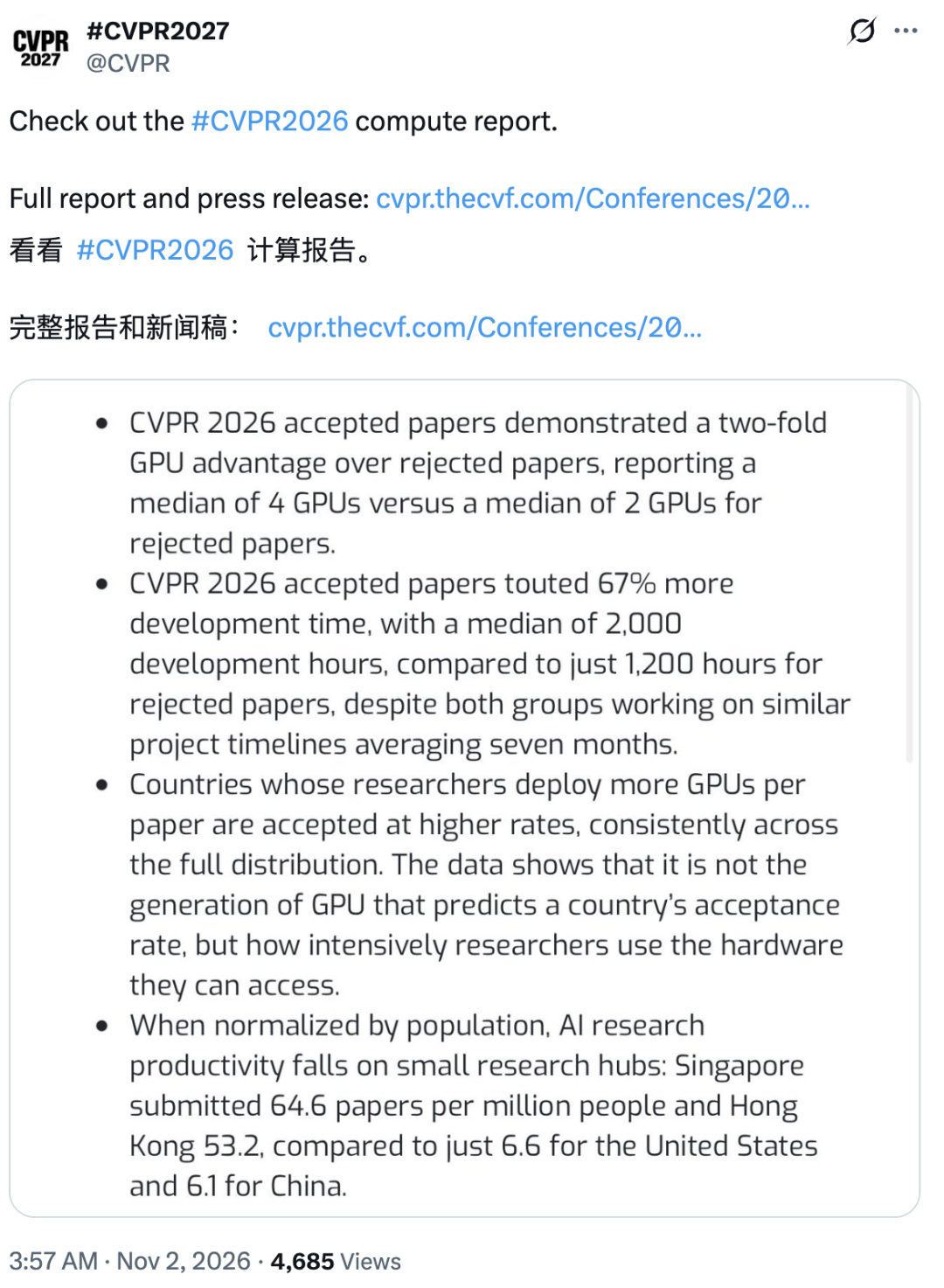 △△CVPR officially releases its first compute report
This means that nowadays, to squeeze into top AI conferences, just having a good idea is no longer enough; the number of GPUs you have and being able to run experiments more times are quietly widening the gap.
Netizen Keith couldn’t help but exclaim after reading:
It’s not surprising, but still quite concerning.
It seems that small academic labs can only band together to secure a place in the battle for computing power.
But does insufficient compute mean there’s no hope?
Not necessarily~
CVPR unveils the compute ledger of 16,034 submissions for the first time
This year, CVPR launched its compute disclosure initiative for the first time.
All contributors must first fill out a Compute Reporting Form, detailing which GPU was used, how many cards, memory size, and whether the cards are from the cloud, owned, or borrowed from a cluster.
If you’re willing to write a few more sentences, you can break down the accounting even further, such as the total GPU/CPU time the final model consumed, how many hyperparameter tweaks were made, how many ablation rounds were performed, and so on.
After collecting 16,034 compute sheets, CVPR for the first time visualized the “spectrum of GPU usage” behind AI papers.“Burned‑GPU Landscape”.
The result is that the gap in the first group is starkly obvious:
-
The median number of GPUs used in accepted papers is4, with a median per‑GPU memory of48 GB;
The median GPU count for rejected papers is only2, and the per‑GPU memory is40 GB.
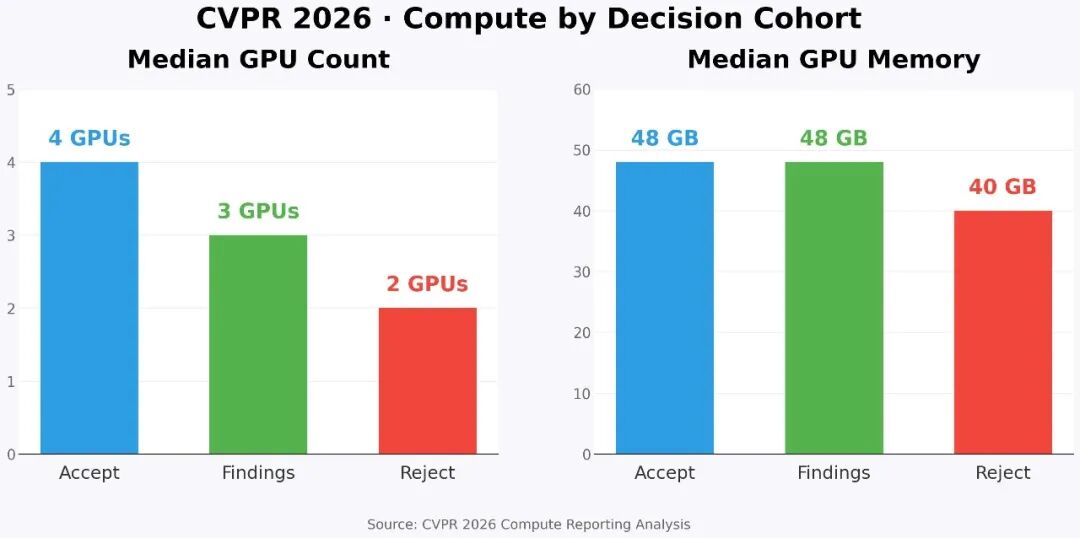 △Comparison of GPU count and VRAM for accepted, Findings, and rejected papers
Meanwhile, CVPR also uncovered the computational cost hidden behind the final results:
The median development time for the admission team reaches2000 hours, which is13.6 times the final training compute power;
The rejection team only has1200 hours, which is7.8 times the final training compute power.
Yet the project cycles of the two groups are almost the same—the median is7 months.
This means that, even with the same deadline, some people can only go down one path, while others have already traversed several side roads.
If the direction is wrong, switch it immediately;
If the parameters aren’t set correctly, run it again;
If the baseline can’t be held down, then overturn everything and start over;
As long as the card can still turn, the experiment always has another round.
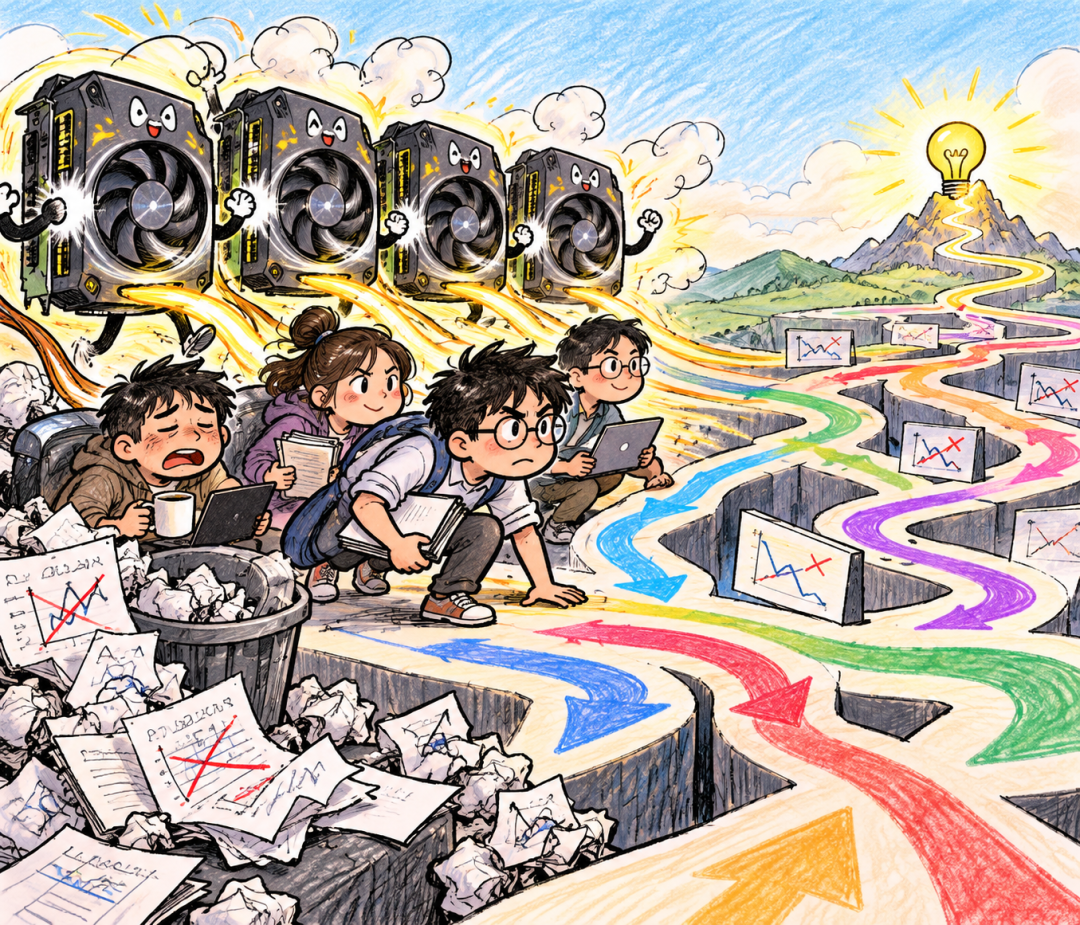 △AI drawing
And this gap still exists when looking at countries and regions.
CVPR found that the more GPUs a country’s researchers use per paper on average, the higher the overall acceptance rate tends to be;
However, rather than whether they use the latest flagship cards like H100 or H200, the factor more closely tied to acceptance rates is whether researchers can consistently mobilize enough GPUs.
That means, just having a single top‑tier GPU to dominate the scene is still not enough.
More importantly, how many GPUs do researchers actually have to keep iterating, running through those failed paths that never made it into the papers one by one.
Of course, this does not mean CVPR has secretly set a “four‑GPU admission line.”
They also gave the authors a heads‑up in advance:
The compute tables submitted by authors will only be handled by an independent committee; reviewers, area chairs, and senior area chairs cannot see them at all, and they will not be used to decide whether a paper is accepted.
Therefore, the “4 GPUs versus 2 GPUs” correlation was only derived after the paper results were released; below the median of 4 GPUs, there are many studies that were accepted with even less compute.
Some people even won the CVPR computing power award using just a consumer‑grade GPU.
A Consumer‑Grade GPU Can Also Win the CVPR Computing Power Award
This paper is called CaricHarmony, from the University of Surrey in the UK.
The problem it tackles is also very interesting:
How can we make AI exaggerate and distort a face while still preserving the core recognizability so that viewers instantly know who it is?
To strike that balance, some approaches require retraining the model or fine‑tuning it for each individual, burning through compute resources round after round.
CaricHarmony, on the other hand, tackles the problem from the angle of signal conflict, letting identity and shape follow two separate diffusion paths before merging the results via a third path.
This way, the two signals no longer have to crowd onto the same path and interfere with each other, and the model does not need to be retrained.
In the end, the CaricHarmony team, using only a consumer‑grade RTX 4090, in less than 16 seconds, managed to generate a comic that meets the requirements.
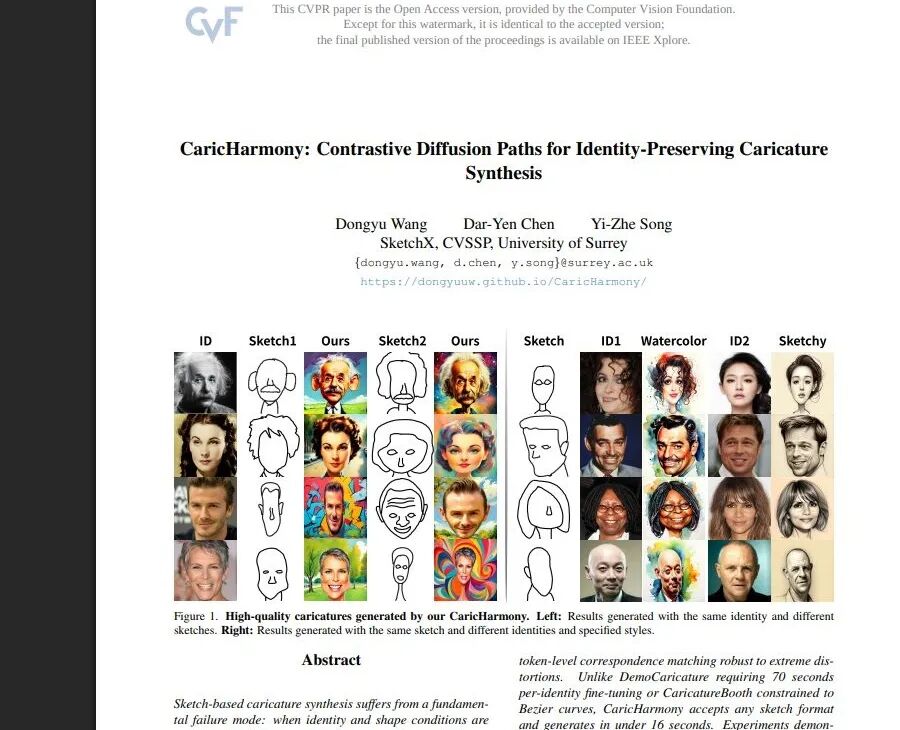 △CaricHarmony paper and some comic generation results
It is precisely this clever design that allowed CaricHarmony to stand out from over 16,000 submissions and becomeone of only 18 inaugural Compute Gold Star award papers worldwide.
 △Surrey University team receives the inaugural Compute Gold Star at CVPR
This shows that CVPR 2026 is laying out the compute accounting, not just trying to tell everyone that “more cards mean bigger wins.”
It also specifically invited those frugal card masters, who haven’t burned many cards but achieve massive gains through methodological innovation, onto the podium.
To that end, the conference introduced three new award categories at once:
-
Efficient CVPR Badge, to see who can push efficiency higher in comparable tasks;
-
Compute Gold Star, see who can achieve greater performance gains with less compute power;
-
Compute Transparency Champion, rewards those researchers who boldly make their compute ledgers and anonymous experiment logs transparently clear.
 △Specifically rewards compute‑saving innovations
From now on, “achieving the same results while using fewer GPU hours” itself has become an innovation worth noticing.
One More Thing
Actually, the top conferences that started asking “how many GPU hours did this paper consume?” have long been more than just CVPR.
NeurIPShas already incorporated compute usage into its mandatory paper checklist. Authors must not only report which CPUs, GPUs, memory, and storage were used, but also estimate how much compute each experiment—and the entire project—consumed.
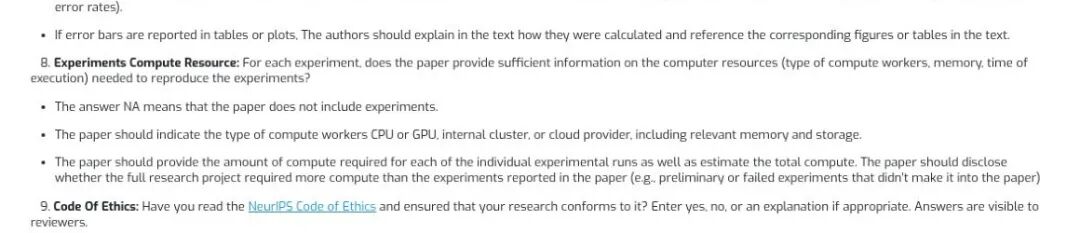 △NeurIPS Requirements
At the same time, AAAI also requires authors to submit a reproducibility checklist, clearly specifying GPU and CPU models, memory, and the relevant software and hardware environment.
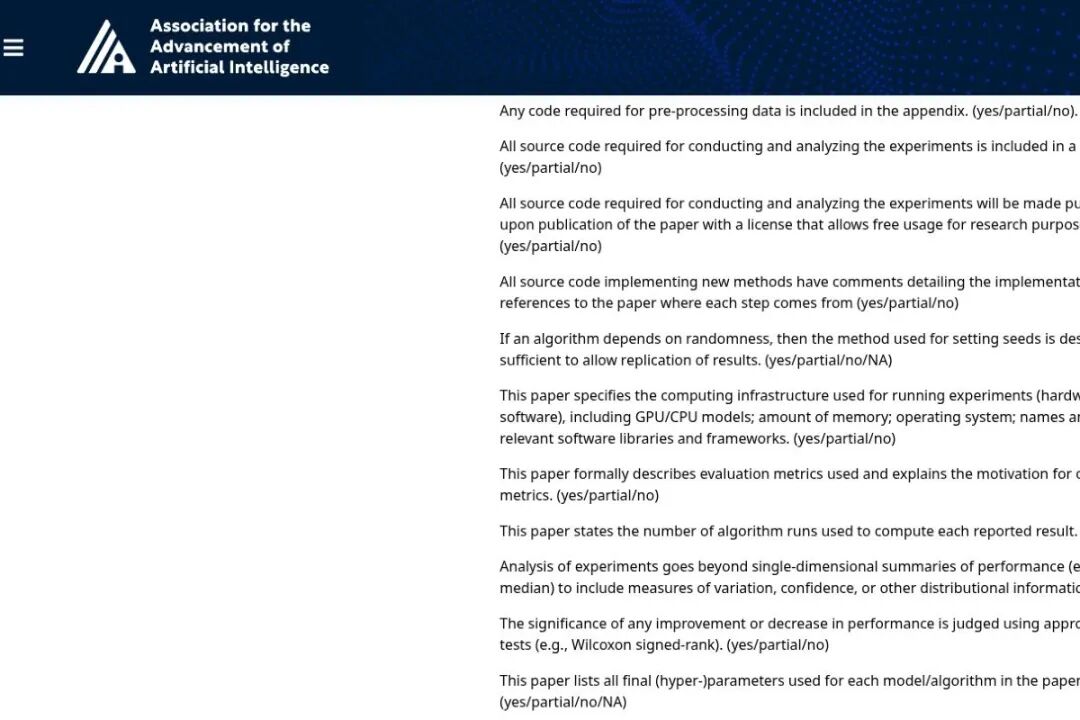 △AAAI Requirements
Now, CVPR 2026 has turned this compute budget page forward by one.
It first collected the compute data separately, then compared over ten thousand submissions together, presenting the compute gap across the entire computer vision field clearly to everyone for the first time. The conclusion is also very realistic—
Whether you have many cards or enough compute power, it’s quietly boosting papers.
Fortunately, top conferences don’t treat “having many cards” as the only answer;
“Saving cards” itself is becoming an innovation worthy of recognition.
Those who have few cards but can use each one efficiently, leveraging methodological innovation to achieve big impact, are now getting their own podium.
Reference links:
[1]https://x.com/CVPR/status/2116983085149360626
[2]https://cvpr.thecvf.com/Conferences/2026/News/ComputeReport
[3]https://computereport.github.io/cvpr2026/
[4]https://openaccess.thecvf.com/content/CVPR2026/papers/Wang_CaricHarmony_Contrastive_Diffusion_Paths_for_Identity-Preserving_Caricature_Synthesis_CVPR_2026_paper.pdf
One-click Triple Action“Like” “Share” “Heart”
Feel free to leave your thoughts in the comments!
— End —
🌟 Light Up the Star 🌟
Get MirrorSpeed
Get MirrorSpeed