封号封出23亿美元?Anthropic冲刺万亿IPOl【经纬低调分享】
Account Suspension Costs $2.3 Billion? Anthropic Pushes for a Trillion IPO【Jingwei Low-Key Share】
Content Summary
The AI stock rally is meeting a cold splash. The soon-to-be-listed Anthropic also has to face increasingly picky investors. On November 10, Anthropic officially launched its IPO roadshow, planning to price each share at $7
The AI stock rally is meeting a cold splash. The soon-to-be-listed Anthropic also has to face increasingly picky investors.
On November 10, Anthropic officially launched its IPO roadshow, planning to issue shares at $70 to $78 each, corresponding to a fully diluted valuation of up to about $1.4 trillion. Compared with the $2 trillion valuation that the market briefly discussed earlier this year, this represents a roughly 30% shrinkage.
But just as Wall Street is re‑evaluating this AI star company, its prospectus disclosed a rather subtle source of revenue.
In the first nine months of 2026, about 5% to 7% of Anthropic’s revenue came from customers later found to have violated usage policies or commercial terms. Based on approximately $33 billion in revenue for the same period, this portion amounts to $1.65 billion to $2.31 billion.
Anthropic has not disclosed how much of this revenue actually comes from Chinese users. But for Claude users in mainland China, the figure is somewhat ironic. They try every way to pay Anthropic, while constantly having to guard against their accounts being blocked.
What’s more interesting is that Claude has recently started supporting a Simplified Chinese interface, the payment page now shows a UnionPay option, and the billing region can even be set to China. Yet mainland China is still not on the official service list.
On one side, the Chinese experience is becoming increasingly refined, while on the other side, the account suspension mechanism is getting stricter. No wonder netizens joke: Anthropic finally remembered to make money from Chinese users, or are they planning to lure people in and then suspend them? This cat‑and‑mouse game between Claude and Chinese users has been going on for more than three years. Below, enjoy:
Source | Letter Rankings
In Anthropic’s publicly released IPO prospectus, a special revenue item was disclosed.
These “account suspension” revenues, Chinese netizens have clearly contributed a substantial portion.
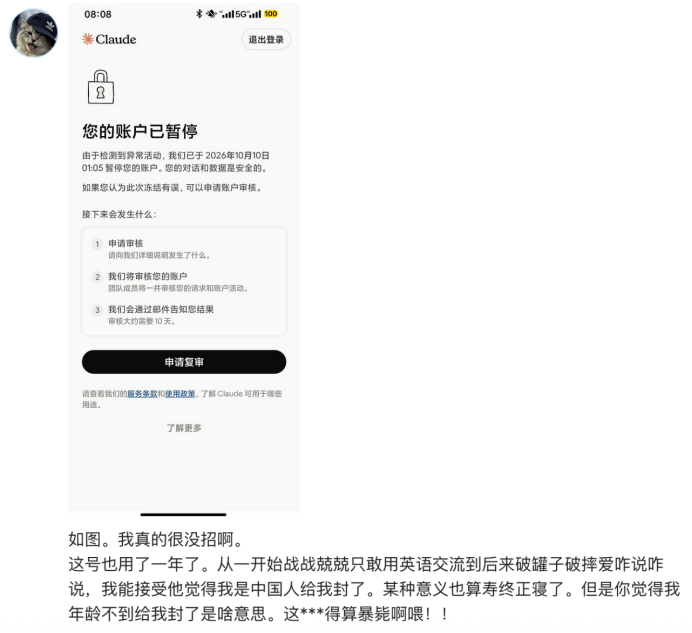
Just recently, another netizen had their Claude account suspended, and the suspension seemed rather inexplicable.
This user had been using the account for over a year, aware that mainland China is outside Claude’s service region, so they were always cautious. At first, they only dared to chat with Claude in English; after using it for a while, they grew bolder and eventually felt comfortable using Chinese.
But he didn’t expect that, in the end Claude gave the reason for the ban as:The system determined that he is under 18.
Netizens suddenly couldn’t hold back.
“I can accept that he thinks I’m Chinese and bans me—somewhat like a natural death. But you think I’m underage and ban me—what does that even mean? That’s basically a sudden death, damn!!”
Interestingly, Claude has recently introduced a series of product changes aimed at Chinese users.
Claude not only supports Simplified and Traditional Chinese interfaces, but the payment page also now offers a UnionPay option, and the billing region can even be set to China.
Some people think that Anthropic finally remembered to charge Chinese users.
Some people even joke:Could this be a plan to lure domestic users in to kill them?
01
Claude has never been available to users in mainland China from the start.
On March 14, 2023, Anthropic officially launched Claude. This AI assistant was initially available only to partners, and regular users could not register freely. On July 11, Claude 2 was released, and Anthropic finally launched the public Claude.ai website, initially available only in the United States and the United Kingdom.
Since then, Claude has gradually entered more countries and regions, but it has never included mainland China.
For mainland Chinese users who want to use Claude, the first challenge is how to actually access it.
From overseas network routes, account registration to payment methods, domestic users have gradually figured out a set of solutions. But successful registration is only the first step; the hard‑won Claude can be banned at any time.
As early as August 2024, LINUX DO had someone post an article titled “Claude Account Ban Appeal Template Filling,” specifically teaching netizens how to write an English appeal letter to Anthropic.
This guide is written quite thoroughly. From the email subject line and appeal reasons to how to explain abnormal account logins, everything is considered.
The template even includes a specially crafted line: I am a US user, but I have to use a proxy to access Claude because I am on a business trip to China.
In the comment section, some complain that appeal emails disappear without a trace, while others share successful experiences.
A few days later, a netizen posted a happy report: he recovered an old account that was registered with Gmail during the Claude 1 era.
This account hasn’t been used for eight months. Hearing that Claude has been getting banned a lot lately, he took a look and discovered his own account was also banned. So, he followed a community‑shared appeal template and wrote a short letter to Anthropic, and surprisingly it actually worked.
He also posted the restored conversation history, which stopped at eight months ago.
However, even though the account has been recovered, he still feels uneasy and can’t help but sigh that now he only dares to play at the relay station.
By 2025, the tug‑of‑war between Chinese users and Claude over account bans has spawned all kinds of laugh‑and‑cry stories.
In January 2025, LINUX DO user NoobNoob experienced a baffling account suspension.
He has been using Claude for over a year and is a long‑term paying Pro user. After his old account was suspended, he wrote an appeal email to Anthropic while simultaneously registering a new account.
The new account used the previous network line and payment card, and successfully activated a Pro membership.
Just a minute after activation, the new account was blocked, and the subscription fee was automatically refunded.
Just as he was about to give up Claude and switch to Gemini, his old account suddenly got the appeal approved.
Anthropic sent an apology notice, and he resubscribed using the same network line and payment card, and this time everything worked fine.
After all the hassle, he still couldn’t figure it out and could only sigh, “It’s so confusing, I can’t understand what’s going on with Claude.”
There are many similar experiences.
Someone’s Claude account was banned after six months, a newly registered account didn’t even survive a month; someone who hadn’t logged into Claude for over half a year suddenly received a ban notice; and others using the same computer and network saw completely different outcomes for their accounts.
Appealing is also a kind of mysticism. Some people wait months without a reply, while others just write a single sentence “I use it for coding.” and successfully recover their accounts.
Ordinary users cannot figure out Claude’s account suspension rules, while Anthropic keeps adding new hurdles.
In April 2026, Anthropic began “checking accounts” for some Claude users, requiring them to submit government‑issued documents such as passports or driver’s licenses to complete identity verification.
As a result, after the new threshold emerged, the account business surrounding Claude also upgraded.
On June 26, the U.S. magazine *Wired* published a survey specifically studying how Chinese users bypass Anthropic’s regional restrictions. The report found that a market has formed around Claude’s access limitations, ranging from Claude accounts on Taobao and Xianyu, to account trading on Telegram, to API relay stations that forward Claude requests for domestic users.
After identity verification was introduced, pre‑verified accounts even started appearing on Telegram, claiming they had already passed the verification.
Facing these ever‑emerging tactics, Anthropic also told Wired that the company is employing constantly evolving detection systems, including authentication, and specifically identifying and combating proxy networks that provide access to Claude.
Authorities are busy tightening restrictions, while Chinese netizens continue to figure out how to protect their accounts.
A myriad of “account‑retention mysticism” has gradually spread.
Some people study IP addresses and payment cards, some worry that computer time zones, system languages, and browser fonts reveal their location, and others have identified a pattern that using Claude at 5 a.m. often leads to account bans.
Recently, even the technical report released by Anthropic itself has become a subject of netizen research.
Beijing time October 13, Anthropic published an anti‑distillation technical article, detailing how the company identifies and blocks other entities from large‑scale extraction of Claude’s capabilities.
According to official disclosures, the new system uses a two-stage classifier to detect requests for specific distillation behaviors, with a false positive rate below 0.1%; for accounts that continuously attempt to extract model inference content, Anthropic may limit their usage quota or even ban the account outright.
The article also notes that Anthropic has already banned tens of thousands of accounts related to distillation, with some accounts being blocked less than two hours after starting the activity.
As a result, Chinese netizens immediately began reverse engineering.
Less than four hours after the article was published, the AI blogger Guicang posted:Anthropic disclosed how it performs anti-distillation, which also, to some extent, tells ordinary users how to avoid getting banned.
In 2023, Chinese netizens were still figuring out how to use Claude; in 2024, they began sharing appeal templates; by 2026, even Anthropic’s own anti‑distillation technical report could be read by netizens as a guide to avoid account bans.
Three years later, Claude’s usage barrier keeps rising, and domestic users have an increasing number of ways to cope.
This cat-and-mouse game surrounding Claude’s ban is clearly far from over.
02
Speaking of why Claude has never been opened to mainland China, we have to mention Anthropic’s CEO Amodei.
Interestingly, he worked at Baidu over a decade ago.
In 2014, Amodi joined Baidu’s Silicon Valley AI Lab, working with Andrew Ng to research deep learning and speech recognition.
At that time, he also helped develop Baidu’s Deep Speech 2 speech recognition system and was the first author of the related paper. This system could recognize English and Mandarin, and was a representative end-to-end deep learning speech recognition achievement at the time.
More than a decade ago, Amodei was still researching at Baidu how to make AI understand Mandarin; today, the Anthropic he leads still does not make Claude available to users in mainland China.
This inevitably makes people curious:What exactly did he experience at Baidu back then?
Coincidentally, in June this year, a Bloomberg host actually asked Amody in person: Did your experience at Baidu affect your later view of China?
Amody explained that he worked there for only a year, and his stint at Baidu was not the main reason for his later stance. He is more concerned about the risks posed by increasingly powerful AI, including mass surveillance and violations of personal privacy.
Amodei has long been concerned about AI risks. In 2021, he co‑founded Anthropic with his sister Daniela and others, hoping to build a company that places greater emphasis on AI safety.
In his view, AI safety means not only preventing models from going out of control, but also preventing advanced technologies from falling into the hands of those he believes could misuse them.
In October 2024, Amody published the renowned long essay “Machines of Loving Grace,” depicting the tremendous advances AI could bring to fields such as medicine, economics, and scientific research, while also warning that advanced AI might be used for surveillance, information manipulation, and other dangerous purposes.
He therefore advocates setting limits on the diffusion and use of advanced AI technologies.
By early 2025, with the sudden rise of DeepSeek, these discussions, originally focused on long‑term risks, now had a more concrete target.
In January, DeepSeek‑R1 caused a sensation in Silicon Valley. Amodei promptly published an article titled 《On DeepSeek and Export Controls》, acknowledging DeepSeek’s technological progress but arguing that its cost advantage has been overstated, that advanced chips remain important, and further emphasizing the necessity of restricting technology diffusion.
However, Amody does not advocate completely depriving Chinese users of the opportunity to enjoy AI technology achievements.
In February 2025, during an interview with ChinaTalk, the host asked a fairly direct question: China accounts for about one‑sixth of the world’s population. On one hand you hope AI will benefit all humanity, yet on the other you support restricting China’s access to advanced AI capabilities. Aren’t those two positions contradictory?
Amodei does not see a contradiction. He gave an example that AI services could be offered to China via API for beneficial work such as drug discovery and energy production, while restricting high‑risk uses like the military.
However, when it comes to Claude’s actual usage policy, this line is drawn quite strictly.
On September 4, 2025, Anthropic announced further expanding service restrictions for unsupported regions.
Previously, Claude already restricted users in mainland China and other regions from directly using the service; this time Anthropic has extended the restriction to the ownership structure behind companies. Even if a company is registered overseas, as long as more than 50% of its equity is directly or indirectly held by enterprises in China or other unsupported regions, it also cannot use Claude.
This means that Anthropic is no longer satisfied with merely checking where users access Claude; it now also investigates who actually controls the enterprise.
On February 23, Anthropic directly named DeepSeek, Moon’s Dark Side, and MiniMax, accusing the three Chinese AI companies of using about 24,000 fraudulent accounts to interact with Claude over 16 million times, extracting model capabilities without authorization.
It should be noted that the above attributions and data are all disclosed by Anthropic itself.
According to Anthropic, large‑scale distillation could enable competitors to replicate parts of Claude’s capabilities at a lower cost. Preventing the extraction of model capabilities relates not only to the AI safety it emphasizes but also to its own commercial interests.
From restricting service regions, to scrutinizing corporate ownership, to upgrading anti‑distillation systems, the defenses Anthropic builds around Claude are becoming increasingly stringent. However, for ordinary users in mainland China, this grand security concept applied to them means only one thing:
Even if you’re willing to pay, you still can’t use Claude in mainland China through official channels.
03
Over the years, the scale of Anthropic’s account bans has become increasingly astonishing.
However, even Anthropic’s strict restrictions couldn’t make Claude disappear from the Chinese internet. The story of Claude not recognizing Chinese people has even become a meme.
For example, a rather outrageous chat screenshot has been circulating online recently.
There are many similar memes, and even the Chinese‑familiar “adjusted holiday” can become a reason for Claude to be banned.
Of course, these are all netizens’ jokes and should not be taken as real account bans.
But for domestic users who have studied network routes, computer time zones, and even dare not chat with Claude in Chinese, this kind of joke is somewhat painful.
Jokes aside, Claude really hasn’t blocked all mainland Chinese users.
Although there are many account suspension stories online, many domestic users have been using Claude for several years, and their accounts remain perfectly fine.
In October this year, V2EX user vislearn shared a rather unconventional “account protection tip”: protect nothing.
His computer’s time zone is Shanghai, the system language is Chinese, and Claude’s memory even explicitly says “the user is from mainland China,” yet his three accounts work perfectly fine.
He even insulted Anthropic once, and Claude just deleted that part of the conversation without banning the account.
Some users have also found that if you just treat Claude as an ordinary chat assistant, without involving complex technical tasks, it doesn’t seem to be that easy to trigger an account ban.
But then again, if it’s just casual conversation, why must you use Claude?
For many domestic developers, Claude’s truly irreplaceable appeal lies in its performance on complex tasks such as programming and agents. In particular, Claude Code has become an indispensable tool in the daily work of many developers.
Ironically, programming, agents, and complex reasoning capabilities are also core assets into which Anthropic has poured extensive R&D resources and strives to prevent competitors from replicating through large‑scale distillation.
Although ordinary developers using Claude Code normally is a different matter from large‑scale model extraction capabilities, this also puts Anthropic in a rather delicate dilemma: the harder it works to protect Claude’s technical advantage, the more these capabilities attract users willing to pay for them, even those who try to bypass regional restrictions.
On October 8, Claude quietly added Simplified Chinese and Traditional Chinese interfaces, and the payment page even briefly displayed a UnionPay option.
Mainland China is still not on the official service list, but Claude has already begun offering an increasingly refined Chinese user experience.
No wonder some netizens can’t help but joke: Anthropic finally remembered to charge Chinese users, or are they planning to lure people in and then block them?
Since Claude was first launched in 2023, more than three years have passed, and mainland Chinese users still haven’t seen an official release.
The meme about it loving to get banned was actually used first.
Is AI killing “traditional companies”?
What is it that 64% of people never manage to overcome in their lifetime?
A 6‑billion acquisition that made a Suzhou father and son earn 94 billion
AI content enters the experience era—how does Loopit turn every idea into a playable world?
Get MirrorSpeed
Get MirrorSpeed