Tsinghua‑Affiliated Team’s 20‑Year Battle Breaks Through 71% Blind Spot, Creating the Most Powerful Deep‑Sea AI Brain
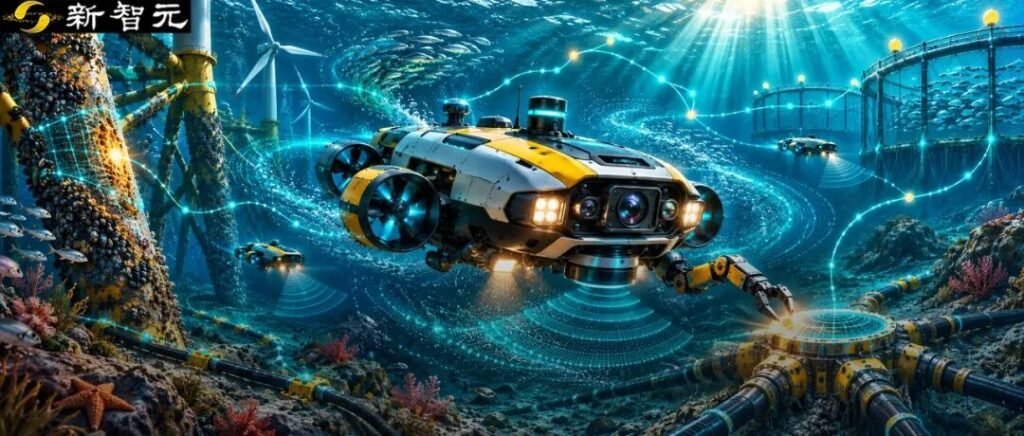
Tsinghua-affiliated team has been grinding for 20 years! Breaking through 71% blind spots, the strongest deep‑sea AI brain is born
Summary
Xinzhiyuan reports AI is going underwater. Recently, Shenzhen startup Lingyuan Intelligence completed a seed round of financing worth tens of millions. This company isn’t competing on who can dive deeper or build a tougher hull. What it aims to create is the “brain” of underwater equipment.
Xinzhiyuan reports
Xinzhiyuan reports
AI is going offshore.
Recently, Shenzhen startup Lingyuan Intelligence completed a ten‑million‑level seed round financing.
This company doesn’t compete on who can dive deeper or build a tougher shell. What it aims to create is the “brain” of underwater equipment.
The effect it wants can be summed up in one sentence:
Deploy the machine, let it operate without a human watching the screen, have it return on its own after completing the task, and deliver a report on “what was seen and where the problems are.”
Instead of the way it is today, the traditional method is not only costly and risky—requiring personnel on the surface and daring divers underwater—but also yields only “dead data,” making subsequent analysis a bottomless pit.
The core breakthrough of Lingyuan Intelligence lies in: not only eliminating the high cost of human risk, but also achieving a one‑step transition from “just collecting data” to “delivering analysis results directly.”
Underwater robot autonomous operation 3D animation
Sounds obvious?
But underwater, almost no one has managed to achieve this yet.
The Earth’s surface is about 71% covered by oceans, and humanity’s knowledge of what lies beneath the surface is less than one percent.
AI has learned to see, to speak, to walk, yet it has never truly “dive down.”
What Lingyuan Intelligence aims to do is let AI for the first time operate underwater without human hands, completing tasks in places humans can’t reach.
This year, embodied intelligence is one of the hottest buzzwords in the investment world.
Everyone is trying to get AI out of the screen. But the furthest they’ve gone is still on land, or a few hundred meters above it.
In other words,AI in the physical world has achieved a “2‑D rollout” but has not yet achieved a “3‑D immersion”.
The hardest dimension in three dimensions is water.
Difficulty doesn’t mean no demand. On the contrary, demand beneath the sea surface is exploding.
“Maritime power” and “deep‑sea technology” are repeatedly written into plans. Offshore wind farms, cross‑sea corridors, submarine cables, and deep‑sea aquaculture are shifting focus from “construction” to “maintenance”.
Construction is a one‑off effort; maintenance lasts for decades without pause.
And within this long‑term operation bill, the most expensive and hardest to scale item is “people getting into the water”.
These jobs are numerous, expensive, and dangerous. Today, they either rely on people going down themselves, or on a machine tethered by a single cable, with a person on the boat watching the operation without ever looking away.
Whoever can turn “people going underwater” into “machines going underwater on their own” will lock down the steepest cost segment of the entire industry chain.
Hardware is the entry ticket, intelligence is the pricing power.Pressure-resistant housings and thrusters can be compared, and the ability to “just drop it and let it work on its own” is hard to replicate.
Why does AI that runs smoothly on land fail as soon as it goes underwater?
Imagine this: you’re blindfolded, driving in murky water.
Navigation has no signal because there is no GPS underwater. The eyes can’t see clearly because light attenuates rapidly with turbidity. The ears only hear echoes, as sonar gets distorted in reverberation.
Even worse, the eyes say go left, the ears say go right—you have to decide which to trust.
This is the first hurdle, perceptual distortion. Mature perception models that work on land basically fail when transferred to water.
The second hurdle, scarce data.
Data from land robots can be collected repeatedly in the lab. Every piece of underwater data requires an actual sea trip: a vessel, personnel, and waiting for a suitable window.
Paired samples that align sound, image, and motion are naturally scarce. The gap between simulation and reality remains unbridged, and each group’s data remains isolated.
The third hurdle, large models don’t understand water physics.
When general-purpose large models are applied underwater, they exhibit “decision hallucinations”: the task decomposition looks perfect, but the actions are physically impossible to execute.
The brain that plans at the top level and the hands and feet that control at the bottom level have long been two separate systems, and the gap in between has never been filled.
The fourth hurdle, relies entirely on the craftsmanship of seasoned experts.
Today’s underwater operations heavily depend on manual micro‑manipulation; the quality of the work hinges on the operator’s personal experience. To move from “human‑assisted” to “fully autonomous,” the entire control and decision‑making chain must be rebuilt from scratch.
There is also a most fundamental, yet counter‑intuitive issue:
Every movement of the machine underwater is the result of the overlap of 「the water current pushing it and its own motion」.
These two factors are inseparable; the machine thinks it is moving forward, but in fact it is being pushed sideways by the current.
When it comes to light, all the experience accumulated on land becomes completely irrelevant.
Dynamic Demonstration of Underwater World Model
Four hurdles stacked together form a high wall.
Throwing money can’t smooth it out, even adopting a general large model can’t get around it. To get over it, the team must simultaneouslyunderstandunderwater engineering, physical modeling, and actually have been at sea.
The higher the wall, the earlier you arrive, the more valuable the time window becomes.
Facing this wall, Lingyuan Intelligence chose a very pragmatic path:
Instead of competing on hardware, they focus on “enabling machines to make decisions underwater”
This is the most valuable part of the whole endeavor, and also the one that few have mastered.
Others compare depth, pressure resistance, thrust power, but hardly anyone systematically provides the intelligence of “how to get the job done once you’re underwater.”
Therefore, Lingyuan positions itself as the universal intelligent foundation layer for underwater equipment, essentially an AI Infra layer.
For example: while others build various “bodies,” Lingyuan builds the “brain” that works for all bodies.
This choice is backed by a very clear accounting.
Whole machines are isolated projects, sold one at a time. The intelligent layer is different; it can be billed repeatedly, generating continuous compounding returns.
A single whole-machine project has a ceiling, but the infrastructure layer does not.
Historically, each emergence of an AI Infra layer has reshuffled the distribution of industry value. Many build applications, few build the foundation.
Underwater intelligence is stuck at a unique stage today: Demand has already surged and concentrated, but the foundation is still absent.
At this stage, pioneers gain not only market share but also the right to define. They define what a “capable underwater machine” is, and they also decide whose “brain” underwater equipment should procure.
The low‑altitude economy has already been baked into valuation models, but deep‑sea intelligence has not. The gap between them is a generational opportunity.
Whoever builds this foundation first will become the indispensable layer for underwater equipment.
Lingyuan Intelligence builds a closed-loop system for underwater autonomous models
So what can this “brain” actually do? The core lies in two things.
The first: stay stable.
Water is not air. Currents, swells, and undercurrents change every second; traditional equipment drifts and loses position when encountering strong flow, relying on humans to correct it bit by bit.
Lingyuan gives machinespredictive capability: they know which way the flow will go, which direction they will be pushed, and the machine calculates and responds on its own.
The second thing, do it yourself.
Stability is only the starting point. In Lingyuan’s system, the machine decides which path to take, where to hover, and how to act.
When it encounters an unfamiliar situation, it judges on its own: whether to bypass it or retreat first.
Comparing the two makes it clear:
In the past, a cable, a vessel, and an operator constantly staring at a screen could only serve a single machine.
Now, a person only needs to provide a target, without issuing every step. The operator has shifted from “hands” to “command,” one person can manage multiple machines simultaneously.
From a capital perspective, this is a “removal of labor constraints.”
Previously, underwater operations couldn’t scale because senior operators were too scarce. Once that bottleneck is eased, the serviceable scale is reopened.
Only things that can be scaled deserve a valuation.
Devices that used to require constant human monitoring can now work on their own.
Underwater AI cannot be built by just pulling together a team temporarily.
The core team of Lingyuan Intelligence comes from Hong Kong University of Science and Technology, Tsinghua University, and Georgia Institute of Technology, covering the entire chain of technology development, productization, and commercial operation, and is one of the earliest domestic startups focusing on underwater unmanned systems.
Their accumulation in underwater intelligence can be traced back nearly twenty years.
They have gone down for strong‑current operations at the Gulf of Mexico oil‑spill site. They have also done ocean‑front tracking between the Atlantic and Pacific.
This team’s time in the water predates when capital noticed this field by more than a decade.
Money can make a company move faster, but it can’t conjure twenty years of sea‑trial experience out of thin air.
This also explains why the money in this round comes from a special group of people.
The investors in this tens‑of‑millions seed round are entrepreneurs who have been deeply embedded in manufacturing for decades.
These people are always picky about hard tech: they don’t listen to stories, they only look at whether it can be implemented, whether it can enter real scenarios, and whether it can become genuine productive force.
Underwater, concepts are worthless; only every hour spent in the water counts.
When the most pragmatic people start paying for the most cutting‑edge thing, it usually means the question has shifted from “can it be done?” to “who will do it.”
In the past two years, the entire AI industry has been chasing “human‑like” capabilities.
Chatting, drawing, walking, dancing.
But “being human‑like” is a proposition of the demonstration era, “Replacing humans” is the proposition of the infrastructure era. Demonstrations can be replicated; infrastructure can only be occupied.
The previous generation of infrastructure was built on steel and concrete. The next generation is intelligence that can operate reliably even when no one is present.
AI not only needs to enter the physical world, but also must be able to work autonomously in places where humans cannot reach.
This is precisely the question Lingyuan Intelligence aims to answer.
Just like the saying the team has always adhered to:
Intelligence is sparked by people, and goes where there is no one.
Edited by: YHluck
Get MirrorSpeed
Get MirrorSpeed