From Micro to Macro: Beyond the Nobel Prize in Economics, How Else Can We Understand the Economic World?
Publication time: 14 Oct, 2026 12:03 AM
Source column: MirrorSpeed CN
Original site: WeChat Official Account – Jizhi Club
Summary
Lead: On October 12, 2026, the Nobel Prize in Economics was awarded to Robert E. Hall and Michael Woodford, recognizing
On October 12, 2026, the Nobel Prize in Economics was awarded to Robert E. Hall and Michael Woodford, recognizing their microfoundations for macroeconomic stabilization policy. Woodford’s 2003 monograph Interest and Prices established the framework for quantitative analysis of monetary policy using the New Keynesian DSGE model. Hall provided key microfoundations for this framework from the perspectives of consumption expectations and labor‑market frictions. At the same time, J. Doyne Farmer’s book Understanding Chaos [1] also mentions the aforementioned standard economic models in several chapters. However, Farmer focuses more on the limitations of these models and offers possible alternatives from complex economics. The Chinese edition of this book has just been published by CITIC, translated by the Jizhi Club, with translators community members Tao Ruyi, Sun Lu, and Fang Yiwen.
Keywords: macroeconomics, complex economics, bounded rationality, business cycles
Wang Runsheng| Proofreading
What does the Nobel Prize honor
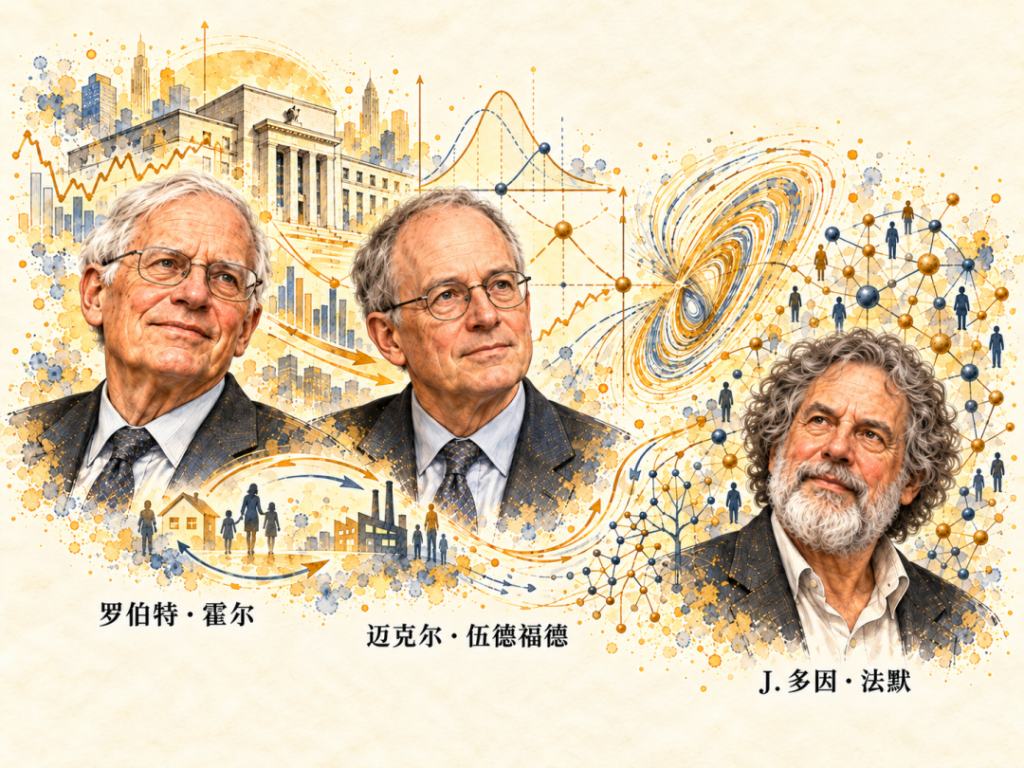
Just yesterday afternoon (October 12, 2026), the Royal Swedish Academy of Sciences awarded the 2026 Nobel Prize in Economic Sciences to Robert E. Hall of Stanford University and Michael Woodford of Columbia University, recognizing their work in laying a microeconomic foundation for macroeconomic stability[2].
Image source: Nobel Foundation
Hall’s 1978 work discussed a long‑standing problem in macroeconomics. Household consumption is the largest component of GDP, but consumption depends on households’ expectations of future income, and expectations are unobservable. In the past, economists have tried to find regularities in consumption changes from various economic indicators. Hall’s idea was: if people plan consumption in advance based on available information, then the impact of that information on future consumption should already be reflected in current consumption decisions. He expressed this conclusion as the random walk hypothesis for consumption[3]; this work later became an important starting point for macro consumption theory.
Another strand of Hall’s work focuses on the labor market. He studied how frictions in the labor market affect fluctuations in employment and unemployment, and how monetary policy is transmitted to the real economy through the labor market[5]. For example, in analyzing U.S. unemployment fluctuations over the past several decades, he found that during recessions the rise in the unemployment rate is mainly not because more people lose their existing jobs, but because the unemployed find it harder to secure new jobs.
Another Nobel laureate, Woodford, contributed by systematically applying the Dynamic Stochastic General Equilibrium (DSGE) model to monetary policy analysis[6]. DSGE is a more general framework; in 1982, Finn Kydland and Edward Prescott, represented by the Real Business Cycle (RBC) model, advanced this class of models; the two later received the 2004 Nobel Prize in Economics[7]. Woodford further used this framework to study monetary policy, especially how, under clear economic mechanisms and welfare criteria, the central bank should set interest rates.
In 2003, Woodford published the monograph Interest and Prices. The model presented in the book consists of three core equations that describe agents’ intertemporal decisions, the evolution of inflation, and how the central bank sets interest rates, covering the interaction among consumption, inflation, and interest‑rate policy. Nobel‑related popular material describes this model as “the prototype for all the New Keynesian models that have followed in its footsteps.” For central banks, such models provide a tool to repeatedly simulate policy outcomes: what happens to the economy and inflation if rates are cut? How should rates be adjusted if inflation persistently exceeds the target? Real economies are, of course, far more complex than the models, but the models at least offer a clear, calculable, and testable analytical framework.
Image source: https://press.princeton.edu/
An aside story: In 1993, Woodford and another economist José Scheinkman co‑authored a small model with Per Bak, marking the first attempt to introduce self‑organized criticality into economic systems[8]. Bak is the originator of the self‑organized criticality theory. He used a sandpile to illustrate the mechanism: grains of sand continuously fall, and the pile gradually approaches a critical state. At that point, adding even a single grain can trigger an avalanche. Avalanches vary in size, and their size distribution often follows a power‑law pattern. Subsequent research has shown that self‑organized criticality is widespread in natural and social systems (see wiki.swarma.org for details). The paper they collaborated on applied a similar mechanism to a multi‑layer supply‑chain network, allowing local inventory shocks to propagate nonlinearly between upstream and downstream nodes, so that tiny disturbances can accumulate into fluctuations of the overall economy.
After presenting this framework, the Nobel popular‑science material concluded with a line: “Quite simply, there are no other viable alternatives.”
Recently, the Chinese translation of J. Doyne Farmer’s book “Understanding Chaos,” authored by researchers from Oxford University and the Santa Fe Institute, was published. The book also references the aforementioned standard macroeconomic models in several chapters. However, Farmer focuses more on the limitations of these models and, in the book, presents possible alternatives from the field of complex economics.
Understanding Chaos: Better Economic Theory, Better Understanding of the World
Translated by the JiZhi Club
Translated by Tao Ruyi, Sun Lu, Fang Yiwen
CITIC Publishing Group, September 2026
Brief Overview of Standard Economics
The foundational assumptions of mainstream economics can be summarized as the following three pillars:
The first pillar is utility maximization. Economics assumes that agents can assign utility scores to different choices based on their preferences. When facing uncertainty, agents multiply the utility of each possible outcome by its probability, sum these to obtain expected utility, and finally choose the option with the highest expected utility.
The second pillar is equilibrium. Léon Walras abstracted the formation of market prices as a trial process: imagine an auctioneer continuously adjusting bids while buyers and sellers submit their demand and supply quantities at each price; the price adjusts until supply equals demand. Alfred Marshall further linked utility maximization with market equilibrium: starting from consumer preferences and producer decisions, one can derive demand and supply curves and thus determine the market equilibrium price. Since then, equilibrium has gradually become a key starting point for economic modeling.
The third element is the agent’s belief about the future, i.e., how economic agents form expectations. Currently, a profoundly influential approach in macroeconomics is rational expectations. John Muth introduced this concept in 1961, emphasizing that agents’ expectations are not arbitrary guesses but are based on an understanding of the economic mechanism and use available information to form judgments. Rational expectations does not mean that everyone can accurately predict the future; rather, it means that their expectations are systematically consistent with the economic laws described by the model.
Combining utility maximization, market equilibrium, and rational expectations forms a benchmark description in economics known as the Neoclassical framework. Within this framework, households decide consumption, saving, and labor supply based on preferences and budget constraints; firms decide investment, hiring, and output based on production technology and costs; market prices coordinate individual decisions through supply‑demand interactions, bringing the market to equilibrium. Traditional benchmark models also typically assume perfect competition and that information and transactions involve no significant frictions.
Since then, economists have continuously added a time dimension and real‑world mechanisms to this static framework. Solow introduced capital accumulation into growth models[9]; the Ramsey–Cass–Koopmans model (RCK) further endogenized savings decisions; Kydland and Prescott proposed the real business cycle model (RBC), incorporating stochastic shocks into dynamic general‑equilibrium analysis and using technology shocks to explain economic fluctuations. The stagflation of the 1970s and subsequent research prompted economists to further consider price rigidity, market power, credit constraints, and labor‑market frictions, leading to the development of New Keynesian models. Although RBC and New Keynesian models offer different explanations for the mechanisms of economic fluctuations, both are important branches within the dynamic stochastic general equilibrium (DSGE) framework.
However, these extensions do not change the basic modeling logic of the standard framework: agents typically act according to predetermined optimality rules, form consistent expectations about the future, and economic outcomes are characterized by equilibrium conditions. To keep the models tractable, researchers must simplify behavior and market mechanisms. For example, Calvo pricing assumes that firms can adjust prices only when a specific random opportunity arises[10]; Rotemberg pricing assumes that adjusting prices incurs a cost[11]. Both capture price rigidity in different ways and, under the usual linearization setting, yield the New Keynesian Phillips curve. These specifications enable the models to analyze the transmission mechanisms of monetary policy.
Everything looks flourishing, but Farmer believes that the standard economics framework still has two noteworthy limitations:
First, behavioral assumptions: although behavioral economics has amassed abundant evidence on real-world decision biases, systematically incorporating bounded rationality and actual decision rules into macro policy models remains a challenge.
Second, uncertainty: standard models usually can provide clear descriptions of various possible scenarios and their probability distributions, but economic agents in reality sometimes neither know the probabilities of future events nor can enumerate all possible scenarios. In other words, standard models excel at analyzing economic dynamics given behavioral rules and probability structures, but may not fully capture the complex dynamics arising from behavioral adaptation, agent interaction, and fundamental uncertainty.
Complex Economics: Another Approach to Solving Problems
Bounded Rationality Starting with Simon
In 1955, Herbert Simon introduced the concept of bounded rationality [12]. He argued that humans’ ability to handle complex problems is far insufficient to support the full rationality assumed by standard economics. In reality, people usually do not exhaust all options, calculate every possible outcome, and then choose the utility‑maximizing plan; they more often use limited information and simple heuristics to find a sufficiently good choice.
For example, a real‑estate agent might initially set a house price slightly above the expected sale price; if it doesn’t sell, the price is gradually reduced until a buyer is found. This process does not require the agent to possess complete market information or solve a complex optimization problem; they simply adjust their expectations based on feedback. Psychology calls this the aspiration‑level adaptation mechanism.
These rules are easy to understand and can be directly encoded into computer programs. Simon later received the Nobel Prize in Economics for this work, and the idea of bounded rationality gradually entered behavioral and macroeconomic research. However, systematically incorporating such behavioral mechanisms into the mainstream macroeconomic modeling framework remains challenging.
The crux of the issue is not whether economists acknowledge that real people have cognitive limitations, but how to translate those limitations into analyzable, computable models and further explain how individual behavior jointly determines macroeconomic dynamics. However, converting such rules into solvable mathematical equations is extremely difficult, and this precisely constitutes a methodological obstacle in mainstream economics: if researchers insist on organizing models with optimization and equilibrium, they may have to exclude decision mechanisms that are harder to describe in this language yet closer to actual behavior.
Moreover, and more importantly, for real‑world problems, optimization calculations cannot eliminate the uncertainty of input information. Take the portfolio selection scenario as an example: Harry Markowitz’s portfolio theory can compute the optimal asset mix for a given risk level when expected returns, risk, and asset correlations are specified[13]. However, even tiny errors in the estimation of expected returns or risk can cause the optimal portfolio to change dramatically. A formula that performs well under known parameters may not yield good results in the unknown, real environment.
This story introduces a standard that Fama repeatedly emphasizes:The value of a model should not be judged solely by how well it fits existing data, but also by whether it can predict events that have not yet occurred. A complex model may explain the past well, yet fail to generalize to the future because of parameter estimation errors and over‑fitting; a simple heuristic may not fully explain history, but it can have better out‑of‑sample performance. For Fama, whether a model withstands the test of real data is more important than whether it is formally elegant or analytically tractable.
Fama proposes large‑scale agent‑based models as a viable alternative (or complement) to standard economics: researchers directly simulate the behavior of many agents and their interactions, rather than solving for each agent’s optimal behavior. His team simulated one hundred thousand distinct households in a housing market model and ran it on an ordinary laptop. Of course, this approach also faces computational challenges, but it at least shows that abandoning the pursuit of a global optimum can sometimes enable researchers to handle larger, more behaviorally diverse systems.
How macro‑level complex behavior endogenously emerges: the case of “where business cycles come from”
In standard macroeconomic models, economic fluctuations are often explained as the result of rational agents adjusting to a new environment after changes in technology, policy, or other external factors. While Farmer does not deny the importance of external shocks, he argues that interactions within the economic system itself can also generate persistent, irregular fluctuations, meaning that business cycles can be endogenous to the interactions among economic agents.
Farmer’s Oxford‑supervised student Yuki Asano once made an insightful modification to the RCK model[14]. The traditional RCK model usually describes the whole economy with a single representative rational household and derives saving and consumption decisions by optimization. Asano replaced this representative household with thousands of heterogeneous, bounded‑rational households living in a social network. Periodically, households observe their neighbors’ consumption and saving behavior and imitate the saving rate of the neighbor with the highest consumption level, with a small amount of random error. In other words, each household does not need to know the socially optimal saving rate; it only needs to watch those around it, especially those who appear to be doing better, and then adjust its own behavior.
A key parameter in the model is social interaction time, i.e., the average interval at which households adjust their savings rate by imitating neighbors. Different interaction frequencies lead the economy to different states: when interaction is too frequent, the economy may fall into poverty; as the interaction interval lengthens, the savings rate and wealth gradually rise; under certain conditions, the average savings rate can even approach the level corresponding to the golden rule, which is the capital accumulation state that maximizes long‑run per‑capita consumption.
However, when the savings rate approaches this seemingly ideal level, the model exhibits an unexpected phenomenon: output and average savings rate begin to fluctuate irregularly, and the economy shows dynamics reminiscent of business cycles; at the same time, household wealth gradually polarizes, forming relatively affluent and poor groups.
This result challenges a common intuition: even if individual behavioral rules are very simple, collective behavior can be highly complex; even if every household tries to learn from successful neighbors, the entire economy may not converge to a stable, ideal state. Macro fluctuations may not be the result of external shocks breaking equilibrium, but rather dynamics endogenously generated as micro agents continuously adapt to each other’s behavior.
Famer also introduces more advanced game theory work in the book, showing that the system’s stable state depends on the complexity and intensity of competition in the game, meaning equilibrium is not an inevitable endpoint. Interested readers can consult the original text [1,15].
Back to this year’s Nobel Prize in Economics. The work of Hall and Woodford allows economists to start from micro‑level decisions and build quantitative models that analyze the macroeconomy and monetary policy. The success of this framework is evident to all, and it provides an important tool for central banks’ policy analysis.
But the success of a theory does not mean it has exhausted all possible ways of understanding reality. The challenge raised by Farmer in *Understanding Chaos* questions the boundaries of these macro theories.
In this sense, the complex economics advocated by Farmer is trying to establish another quantitative research program: based on behavioral rules that are closer to reality, using computational simulations to study macro dynamics, and testing the models with empirical data and out‑of‑sample forecasts. Its divergence from standard economics concerns how we should construct economic theory and what kind of theory truly has the capacity to explain the real world.
Standard models and complex economics represent two different research starting points: one derives how the economy works from optimal behavior and equilibrium; the other observes how macro patterns emerge from concrete behavioral rules and agent interactions. Their value ultimately must be tested against explanations and predictions of reality.
References
[1] Farmer, J. Doyne. Making Sense of Chaos: A Better Economics for a Better World. New Haven: Yale University Press, 2024.
[2] The Royal Swedish Academy of Sciences. “The Prize in Economic Sciences 2026: The Laureates Have Helped Us Smooth Out the Economy’s Peaks and Troughs.” October 12, 2026. https://www.kva.se/en/news/the-prize-in-economic-sciences-2026/
[3] Hall, Robert E. “Stochastic Implications of the Life Cycle-Permanent Income Hypothesis: Theory and Evidence.” Journal of Political Economy 86, no. 6 (1978): 971–987. https://doi.org/10.1086/260724
[4] Hall, Robert E., and Frederic S. Mishkin. “The Sensitivity of Consumption to Transitory Income: Estimates from Panel Data on Households.” Econometrica 50, no. 2 (1982): 461–481. https://doi.org/10.2307/1912638
[5] Hall, Robert E. “Job Loss, Job Finding, and Unemployment in the U.S. Economy over the Past Fifty Years.” NBER Macroeconomics Annual 20 (2005): 101–137. https://doi.org/10.1086/ma.20.3585415
[6] Woodford, Michael. Interest and Prices: Foundations of a Theory of Monetary Policy. Princeton: Princeton University Press, 2003.
[7] Kydland, Finn E., and Edward C. Prescott. “Time to Build and Aggregate Fluctuations.” Econometrica 50, no. 6 (1982): 1345–1370.
[8] Bak, Per, Kan Chen, José Scheinkman, and Michael Woodford. “Aggregate Fluctuations from Independent Sectoral Shocks: Self-Organized Criticality in a Model of Production and Inventory Dynamics.” Ricerche Economiche 47 (1993): 3–30. Working paper version: NBER Working Paper No. 4241, 1992. https://doi.org/10.3386/w4241
[9] Solow, Robert M. “A Contribution to the Theory of Economic Growth.” The Quarterly Journal of Economics 70, no. 1 (1956): 65–94. https://doi.org/10.2307/1884513
[10] Calvo, Guillermo A. “Staggered Prices in a Utility-Maximizing Framework.” Journal of Monetary Economics 12, no. 3 (1983): 383–398.
[11] Rotemberg, Julio J. “Sticky Prices in the United States.” Journal of Political Economy 90, no. 6 (1982): 1187–1211. https://doi.org/10.1086/261117
[12] Simon, Herbert A. “A Behavioral Model of Rational Choice.” The Quarterly Journal of Economics 69, no. 1 (1955): 99–118. https://doi.org/10.2307/1884852
[13] Markowitz, Harry. “Portfolio Selection.” The Journal of Finance 7, no. 1 (1952): 77–91. https://doi.org/10.2307/2975974
[14] Asano, Yuki M., Jakob J. Kolb, Jobst Heitzig, and J. Doyne Farmer. “Emergent Inequality and Business Cycles in a Simple Behavioral Macroeconomic Model.” Proceedings of the National Academy of Sciences 118, no. 27 (2021): e2025721118. https://doi.org/10.1073/pnas.2025721118
[15]Pangallo, M., T. Heinrich, and J. D. Farmer. 2019. “Best Reply Structure and Equilibrium Convergence in Generic Games.” Science Advances 5 (2): eaat1328. https://doi.org/10.1126/sciadv.aat1328.
Jizhi New Translation, Joint Reading of New Books: Understanding Chaos
— Better economic theory, better understanding of the world
Why do localized economic fluctuations evolve into a crisis that sweeps the globe? This is precisely the question that Understanding Chaos seeks to answer. This reading group uses J. Doyne Farmer’s book as a thread to reinterpret the economy from the perspective of complex systems. Financial crises, climate change, and automation continuously test the explanatory power of traditional models. According to Farmer, the economy is not a static system moving toward equilibrium, but a complex system that continuously evolves through the interaction of boundedly rational, heterogeneous agents; with agent‑based modeling and computer simulation, we can observe how micro‑level behavior gives rise to macro‑level emergence. We will discuss model assumptions, feedback, and emergence, and, together with financial stability and the green transition, examine the application potential and predictive limits of complex economics.
“Understanding Chaos” is translated by the JiZhi Club. This new book reading initiative is jointly launched by the JiZhi Club and three translators: doctoral student Tao Ruyi from Beijing Normal University, doctoral student Sun Lu from Macau University of Science and Technology, and master’s student Fang Yiwen from Beijing Normal University. The reading group will run online every Saturday from 19:30 to 21:30 starting on October 31, 2026, for about 10 weeks, featuring main presentations, discussions, and post‑session video recordings. Applicants who wish to engage in deeper discussions are welcome to apply to become a session speaker.
For details, see today’s two items: Jizhi New Translation, New Book Reading|《Understanding Chaos — Better Economic Theory, Better Understanding of the World》
Click “Read Original”, sign up for the book club
Feed URL: https://decemberpei.cyou/rssbox/wechat-jizhijvlebu.xml
Feed description:
WeChat Official Account – Jizhi Club
Feed icon:
Feed favicon: https://www.google.com/s2/favicons?domain=https%3A%2F%2Fwww.decemberpei.cyou%2Frssbox%2F
Crawl task ID: 164