In-Depth Discussion of Personal Agents: The “Most Internet” AI Proposition
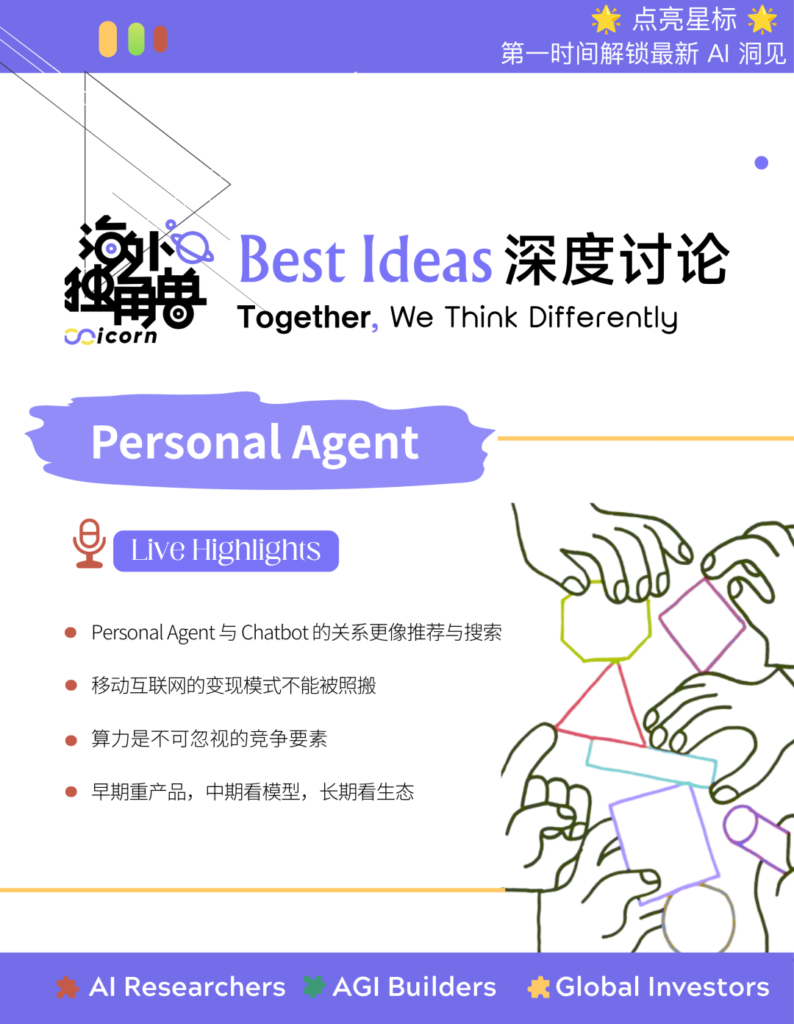
In-Depth Discussion of Personal Agent: The “Most Internet” AI Proposition
Summary
Personal Agent is the hottest AI topic in Q4 this year: Meta’s Muse, OpenAI’s Dots, Instinct, and Anthropic
Personal Agent is the hottest AI field in Q4 this year: Meta’s Muse, OpenAI’s Dots, Instinct, and Anthropic’s newly launched Claude Duet, bringing big companies, AI labs, and startups to compete on the same stage.
It is also the AI proposition most reminiscent of the internet: if users start handing their needs to agents, the user entry points, traffic allocation, and transaction loops will all be reorganized.
However, considering that the single‑user service cost of a Personal Agent is far higher than that of traditional Internet products, it may also fail from a product or business‑model perspective.
Today’s imagination of Personal Agents will inevitably be limited by our past knowledge and experience. Looking at the evolution of PCs—from Palm and Windows Mobile to the iPhone—we finally found a truly mass‑market mobile computing experience. Personal Agents are just beginning, and the whole field also needs an “iPhone moment,” that is, a personal intelligence product form that ordinary people can naturally and continuously use.
Below is our compilation of viewpoints on the Personal Agent topic Best Ideas discussion.
Insight 01
What’s new in this round of Personal Agent?
1.Compared with chatbots, the key advancement of a personal agent is being “more proactive and capable of getting things done.” Previously, interactions were mainly users asking questions and AI providing information; but after connecting services like Gmail, obtaining user context and permissions, the agent can now proactively handle tasks on the user’s behalf.
2.The relationship between a personal agent and a chatbot may be more like that between recommendation and search.The appeal of a Personal Agent to users lies in its proactiveness. In many chatbots, users don’t know what they can ask the AI to do, and it’s hard to articulate their needs clearly. If users have to ask a question each time, usage is limited, but when the Agent has proactive capabilities, this problem can be effectively solved.
3.At the beginning of the year, the explosive popularity of OpenClaw and personal agent formed a single narrative; the most important advancement of personal agent is its productization and cloud hosting, which alleviates the burden of setup, configuration, and maintenance for ordinary users, making it more “out‑of‑the‑box”.
4.For example, Meta’s Muse essentially puts a continuously running cloud environment, a connector that links accounts and services, reusable skills, and backend multi‑agent collaboration into a single product. Users can assign tasks to Muse directly on their phone without having to set up each of these components individually.
5.Meta AI product lead Nat Friedman also explicitly noted that Muse’s product design drew considerable inspiration from OpenClaw.
6.The product changes that model improvements bring to personal agents are very important: advances in the model’s ability to execute long tasks, invoke tools, and follow instructions make personal agents become usable. If future models with tens of billions or hundreds of billions of parameters can handle long tasks well, they could bring user growth to personal agents similar to what GPT‑4o experienced in its debut year.
7.Grok Bot and Muse cannot be compared head‑to‑head:
•Grok Bot is more like a one‑person company (OPC) or a work assistant for a small U.S. business. It can operate applications, browse the web, and invoke tools to handle specific tasks for owners or employees. Users can also integrate tools such as Codex into the cloud computer hosted by Grok Bot, and then simply assign tasks to Grok Bot, which will call the appropriate tools to execute them.
•However, personal agents, especially Muse, clearly optimize everyday scenarios better. In some users’ firsthand experiences, Muse can handle tasks such as shopping, bargaining with sellers on Facebook, and insurance within 10 minutes, whereas other agents often take 20 to 30 minutes.
8.As the functional boundaries of these two products continue to evolve, many of their capabilities now overlap, for example, Muse launched an enterprise version last month. By adding connectors and skills for small businesses within the Muse App, it positions itself as an AI business assistant that can read operational data and execute tasks across software.
9.If a personal agent can get voice, cross‑device usage, proactive interaction, and personal scenario optimization right, it can still make the product feel very different.
Insight 02
Product Usage Experience
10.Based on users’ direct experience, people generally use personal agents for repetitive and complex information processing and retrieval tasks, with shopping and personal finance tasks being the scenarios where the value of personal agent products is most felt.
11.“Regular restocking” may be the relatively clear scenario for personal agents at present: the fresh groceries purchased weekly are similar, the goal is clear, repeating orders takes time, and it can be completely handed over to the agent to handle.
12.Moreover, AI’s strength in information retrieval and comparison can also be externalized to the shopping experience. For example, a user who usually shops on Amazon was helped by an Agent to discover Best Buy, which they hadn’t considered before, ultimately leading to a purchase.
13.Personal finance matters: tax filing, insurance, product subscription management, etc. These tasks typically feature cumbersome processes, but because they involve real money, users have historically had to spend a lot of time handling them. Moreover, in these scenarios, a personal agent can both save users time and deliver tangible benefits, giving this use case far more imaginative potential than ordinary shopping scenarios.
14.Based on the above, from a developer’s perspective, determining whether a task is worth assigning to an agent cannot rely solely on the cost of the agent executing the task; it must also consider how much communication, paperwork time, and hassle it saves the user.
15.The product experience mentioned earlier primarily targets overseas markets. Domestic personal‑agent products first have to confront integration challenges; a closed ecosystem and an under‑developed API landscape make it harder for independent agents to access account data, and achieving the ability to perform subsequent actions on behalf of users is a significant hurdle.
16.As a typical B2C application, the product persona of a personal agent may also be one of the factors influencing whether ordinary people are willing to try a personal agent. Muse feels more approachable, making people unfamiliar with AI more willing to try it. In contrast, Instinct, based on iMessage, lacks a clear persona, and the images of Grok Bot and ChatGPT’s dots are more pixelated or geometric in design.
Insight 03
Personal Agent Needs Its Own “iPhone Moment”
17.AI products have already amassed a massive user base; after deduplication, products such as ChatGPT, Claude, Gemini are estimated to have about 600 million daily active users, which is already a fairly meaningful number, whereas today’s top products like Facebook have roughly 2 billion DAU.
18.This trend directly changes traffic allocation: when users hand their needs to an agent, which searches across platforms, compares options, and completes the purchase, the range of choices—previously limited by personal attention and habits—can expand. For example, a user who usually shops only on Amazon might have the agent discover channels like Best Buy that they hadn’t considered before. This shift could also compress business models that rely on information asymmetry for profit.
19.Based on Muse’s early user base, a “Facebook‑level opportunity” is also foreseeable: from an estimation perspective, after just over a month since launch, Muse reached roughly 3 million DAU, with each daily active user initiating more than 10 prompts per day. Although traffic from Meta’s suite of apps contributed about 60%–70%, Muse’s metrics remain a crucial signal validating the demand for Personal Agents.
20.However, the practical bottlenecks of Personal Agents are also quite evident:
•Today, users may still need to use Muse for 2–3 weeks before gradually reaching heavy‑usage status;
•According to Sensor Tower data, among iOS and Android new install users in 81 countries in September,Muse’s open rate on the first day after installation was higher than ChatGPT, but by the 14th day it fell below ChatGPT;
•One possibility is that ordinary people don’t have that many things worth delegating to a personal agent, meaning the size of the population that can continuously provide background such as email, professional information, code repositories, and keep presenting high‑value tasks remains to be discussed.
21.However, Personal Agent‑type products have also begun addressing the task of helping users “discover needs.” Take Muse as an example:
•Muse uses Goals to store users’ long‑term objectives, and uses ideas to provide new task suggestions; the aim is to enable users, after completing one task, to find the next worthwhile thing to assign.
•According to research estimates, Currently, only about 10% of interactions are initiated by the agent first (when the agent initiates proactively, it is usually based on the user’s recent plans, visited locations, or search history), while 90% are still initiated by the user.
22.Of course, the data displayed by users may not reflect their true needs. From recommending content to proactively taking concrete actions, the product faces greater challenges, so achieving proactivity will be a gradual process.
23.However, there is still a voice questioning whether the current market hype around Personal Agents stems from the public’s imagination of personal assistants, and whether agents within enterprises are actually more likely than consumer‑grade personal agents to generate trillion‑dollar companies:
•Enterprises have a clearer source of tasks;
•Business records, internal communication information, and new items in processes can all provide the agent with tasks to handle;
•As long as a few people in the team can propose valuable tasks and set up processes, they can encourage other members to adopt them, rather than requiring everyone to constantly generate new tasks.
24.People often imagine the future based on existing product forms:Today’s vision of Personal AI might resemble the early attempts to put a PC on a small screen, paired with a keyboard and a stylus, yet it didn’t directly yield a truly mass‑market mobile computing experience until the iPhone made it possible. This evolution also shows that finding a product form that allows ordinary people to naturally and continuously use Personal AI may take longer than expected.
25.The impact of a long time window is not that it is more tolerant of laggards, but that it also torments the leaders: they need to build ecosystems, continuously retain users, and even persist in investment while incurring losses, ultimately crossing the inflection point.
Insight 04
What drives product capability improvement
Model
26.What’s worth watching next is whether the model can further lower the barrier to using personal agents, making them as noticeably easier to use as coding agents.
27.Design benchmarks around individual tasks, and then fine‑tune the model based on performance, which can greatly improve the agent’s handling of these tasks. AutomationBench in office scenarios provides a reference: in a simulated enterprise environment, let the agent complete cross‑application tasks via API, and then verify whether the required actions actually take effect.
Swipe left or right to view more charts
28.Meta’s agent model Muse Wonder emphasizes active memory and active focus capabilities, which correspond to retaining important context across conversations and continuously executing around the goal in long tasks.
29.Muse currently still uses conventional tools such as search to read memory, and provides relevant content as needed before model inference. If this retrieval and information provision work is already done, what improvements can training the model’s memory capability still bring?
Context
30.Ordinary users may not care which model is used behind the scenes; they care more about how the product works. People are starting to discuss product experience more, and the importance of the product itself is rising.
31.Some users also think that, in the long run, obtaining personal user information is more important than using SOTA models, and the model may even be the least important component in a personal agent.
•By analogy to a computer, changing the CPU will alter performance and the software that can be used, but as long as the existing data and state remain, the user will still feel it’s their own computer.
•Therefore, compared to coding tools that keep the main artifacts and project status in the code repository, a personal agent not only needs to retain the results of individual tasks but also must persistently store user data and task progress, and have accounts and identities that can access external services.
32.But an agent having access to the user’s background information does not mean it understands what result the user wants. For example, when a user switches between Claude Code and Codex, they may find that even if the new agent inherits the background information the previous agent had, the new agent might still not grasp the user’s real needs.
33.Even if the agent understands the result the user wants, it still needs to distinguish which actions it can perform on its own and which ones require asking the user first.
•For example, reading an email, drafting a reply, and sending an email directly have different consequences.
•Writing code allows you to verify results by running and testing, but personal tasks often lack such clear verification methods. If every step requires user confirmation, the user still has to spend effort monitoring; if the agent handles everything autonomously, it may send the wrong messages or make commitments that are hard to retract.
34.To enable an agent to perform specialized tasks well, another division of labor is envisioned: a primary agent that holds personal identity, memory, goals, and permissions calls on specialized agents for programming, legal, health, or financial tasks as needed.
•For example, in a programming task, a developer uses DeepSeek V4.1 Flash to drive Hermes and installs Codex CLI on the same computer. When code needs to be written or bugs need fixing, they let Hermes draft the task list first, then hand it over to Codex for execution.
35.Personal agent: early focus on product, mid-term on models, long-term on ecosystem.
Ecosystem
36.The domestic and international ecosystems differ greatly, and this disparity limits the gap in Personal Agent product experiences between the home market and overseas:
•In the domestic market, personal information, payments, and lifestyle services are more concentrated within super apps, making it difficult for standalone products to access that personal data.
•Many services in the United States are still centered around PC web pages; agents can operate the web via a browser and already provide a good experience.
37.But even if the agent can technically operate web pages, the platform may still restrict its access. For example, in September this year, Amazon blocked Muse, preventing it from shopping on behalf of users.
•One explanation is that platforms are unwilling to let new entry points hijack user relationships and business benefits. Therefore, if the agent service provider can negotiate profit sharing with the platform after cooperation, the resistance to ecosystem integration may lessen.
38.In addition to integrating with major platform ecosystems, agents can also connect directly with merchants. For example, Luckin has provided MCP services, supporting agents to search stores, select products, and place orders, with key steps still requiring user confirmation and payment.
39.The industry is also trying to establish a universal access protocol.Meta and Sierra are working with Instinct, Shopify, Stripe, Walmart and other companies to develop the Personal Agent Protocol, allowing users to decide which permissions to grant to agents, and enterprises to decide which actions agents are allowed to perform.
40.However, even if payment or agent interoperability protocols are opened, they may not solve all integration issues. When an agent is actually executed, it still needs to handle personal data access, account authorization, and how user devices cooperate with the cloud to perform tasks while protecting privacy.
41.These ecosystem integration challenges also give rise to a startup idea: could a dedicated service provider help agents integrate with different platforms and obtain data access authorization from the platforms? Perhaps both big companies and startup teams could try to offer such services, but whether it can become a viable business remains uncertain.
Insight 05
Cost Estimation
42.The cost of a personal agent includes model inference, runtime environment, and external identity configuration. Estimates of personal agent service costs vary widely among individuals.
•Some industry insiders estimate that Muse and Instinct cost about $1 to $5 per user per day.
•According to Morgan Stanley estimates,If a user consumes 5% to 10% of their token quota each week, Muse costs about $10 to $18 per month per user, with CPU sandbox costs around $5 to $8.
43.After OpenClaw went viral, a team that had tried to commercialize a personal agent shared the costs of building and running the product at that time:
•Equip each agent with an independent compute environment and a reliable network identity; each user requires at least about $50 per month (excluding tokens): The team initially tried Mac Mini, found it expensive and hard to scale, but after switching to a desktop virtual machine they discovered that even at AWS enterprise pricing it still costs $10 to $15 per month. According to the team’s plan at the time, a Gmail account used for registering external services cost an additional $14 per month, and together with phone, credit card and other identity configurations, the fixed expenses were already significant.
•Token costs vary with model type and user usage intensity. In the early stage, the team used the best model available for the personal agent, and calculations showed that heavy users could consume about $1000 worth of tokens per month.
•Overall, when users normally use the personal agent product, including token and compute resources, each user costs about $50 to $100 per month, which was already the lowest tier at that time.
44.In addition to cost, the team also faced issues with scaling access: some websites restrict registration, and it is difficult to standardize the configuration of the many emails, phone numbers, and credit card identities required for a large number of agents. Therefore, increasing the budget does not necessarily enable serving more users.
45.However, when estimating costs, it is important to distinguish between usage scenarios and resource configurations:
•In enterprise scenarios, a finance team of 20 can share a single virtual machine, and a product‑research team of 80 can split the cost of two or one high‑spec virtual machine.
•VM resources can also be oversold, meaning the total resources allocated to multiple virtual machines can exceed the physical machine’s actual resources, with CPU being oversold at a higher ratio than memory;
•In addition, a work agent may run for ten to twenty hours a day,a typical personal assistant might only receive a dozen or so requests per day, so its cost should not be estimated using the long‑running model applied to work agents.
46.Considering that a recent reason for the surge in personal agent products is that more teams are now able to produce models close to SOTA level.Therefore, vendors that own their own models and compute resources can also try to distill smaller models to further control the operating costs of agents.
47.Ecosystem openness may reduce the execution cost of a single task, but more reliable fulfillment may also bring more tasks. After the model price drops, agents can also invest more inference to discover demand, so a lower unit cost does not mean the total token consumption decreases.
48.In addition to the currently popular cloud solutions, some have suggested that as local model capabilities and runtime efficiency improve, part of the agent tasks could be delegated to local models on user devices. However, this approach raises a question: which tasks can be handed off to local models and which still need to invoke cloud models?
49.Models can run locally, but for ordinary users there is still the cost of device maintenance, so services for the masses may still be cloud‑based, while those with sensitive data or special requirements will choose local solutions; the two may coexist for a long time.
50.By 2027‑2028, advances in technology, supply chains, and market demand may further lower the barrier to local deployment, making on‑premise agent devices easier to roll out. By then, these devices could become standard products that can be purchased and used directly, much like enterprise laser printers.
Insight 06
What pricing model is best suited for Personal Agent
51.The biggest difference between AI applications and mobile internet lies in marginal cost. The per‑user service cost of a personal agent may be 2–3 orders of magnitude higher than that of traditional internet services, so conventional internet business models may no longer work.
52.Subscription models are the pricing method for most Agent products, especially productivity‑type products, but Muse already offers a free service. Therefore, for personal agents, achieving short‑term growth through consumer‑level subscriptions is very difficult in today’s competitive environment.
53.However, while subscription models face competition from free products, they may better align with the goal of personal assistants saving users’ attention.
54.However, users who are willing to spend money to save time and value results may accept usage‑based charging, result‑based payment, or revenue sharing:
•For users: Suppose the agent helps the user save $1,000 in insurance premiums, then it can charge a fee from the savings;
•For counterparties: The business model of independent personal agents like Instinct can be summarized as an “AI Ctrip”, connecting users with external service providers, completing service purchases, and the agent service provider sharing revenue from the transaction.
•However, some people question the revenue from transaction sharing, because high‑value intents with clear commercial purposes such as shopping in ChatGPT account for only about 5%.
Note: David Dugan, head of OpenAI’s global advertising solutions, publicly stated in June 2026 that about 20% of ChatGPT queries have “direct commercial intent”.
Using Muse as an example: How does a free service break even?
55.Muse offers a free personal assistant service, which is very appealing to the average user; some even compare Muse’s launch to the debut of Gmail:What was once an unaffordable personal assistant service for most people now has the chance to become part of everyday life.
56.However, whether Muse can continue to offer free services in the long term depends on the revenue streams it can secure. Some believe that advertising revenue from Muse Feed is promising, as users of a life assistant may be more willing to accept ads and commercial recommendations. In contrast, users handling work tasks with ChatGPT or Claude tend to react negatively to commercial recommendations inserted into answers.
57.However, as mentioned earlier, if serving a single Muse user costs at least $10 to $20 per month, then even if Muse reaches the per‑user revenue levels of Meta’s other mature applications, it may still not cover the costs.
•Meta’s Q2 2026 earnings report shows that the ARPP (average revenue per person per quarter) of Meta’s apps is $16.86, equivalent to about $5.62 per month, which includes advertising and other revenue from apps such as Facebook, Instagram, etc.
•Therefore, Muse might first need to reduce the monthly service cost per user by another order of magnitude, down to about $1 to $2, so that revenue can cover costs before proceeding with model and product improvements.
58.Some also believe that the tasks users assign to Muse can more directly reflect user needs, and if this information helps Meta increase revenue from its existing advertising business, the additional revenue can subsidize Muse’s service costs.
Note: Meta publicly pledged in the Muse blog release that Muse will not share user conversations or data in the virtual machine with the advertising system.
Insight 07
Who has the advantage: big companies, AI labs, or independent teams?
Big Companies
Meta & Google
59.Meta and Google are viewed favorably, first because of their advantages in identity authentication, foundational models, and user base. More importantly, it’s their computing power reserves: in the Personal Agent competition, only vendors with ample computing resources can continuously offer free services and attract users.
60.Company brand can affect whether users are willing to link accounts; for example, a Muse user said that compared to Instinct, he is more willing to grant account permissions to Meta.
61.Google’s advantage stems primarily from Gmail: many formal overseas matters are handled via email, and the mailbox not only retains historical correspondence but also continuously provides new tasks to a personal agent.
62.Pixel and Android also give Google an entry point at the device layer, allowing integrated optimization of the user experience from hardware to software, rather than relying solely on software collaborations with phone manufacturers.
63.However, how many resources Google will invest in a personal agent also depends on business priorities and compute allocation:
•Google’s external customers, search recommendations, DeepMind, and cloud services are all consuming compute, so consumer‑grade agents have a lower priority;
•But search is originally a step for the agent to complete tasks, so personal agents are actually closely tied to Google’s core search business. If computational power supply increases in the future, Google may raise the priority of personal agents;
Apple
64.Smartphones represented by the iPhone are truly mass‑market personal computing devices, continuously handling users’ schedules, locations, communications, and service records. Therefore, device platforms such as Apple cannot be ignored in the competition for Personal Agents.
65.A neutral platform role is also Apple’s advantage:
•As the platform provider, it may find it easier to coordinate developers and service providers, allowing agents to integrate more services, and service providers may be more willing to cooperate;
•Apple’s closed ecosystem also gives Apple greater ability to require developers to open services to agents according to unified rules.
•In contrast, Google runs its own apps and services and competes with some partners, so partners may be reluctant to hand over user entry points to it; moreover, the Android ecosystem is more open, making it harder for Google to uniformly require developer cooperation.
66.However, whether OS permissions play an irreplaceable role remains debated. Some also argue that Apple and existing phone and device manufacturers will not become the most important players in personal agents, because there is currently no task that can only be completed with OS permissions and cannot be done by a cloud agent. Moreover, an app is merely the current entry point for users to use an agent. If in the future agents can proactively act on behalf of users, and users no longer need to use a specific app to access them, the importance of existing app and device entry points may diminish.
•In response to this view, some added that a few identity‑verification scenarios still rely on physical devices: certain verifications must be completed with physical devices at specific times and locations, and some website logins require using the front camera for facial scanning or the rear camera for QR‑code scanning, tasks that a cloud agent cannot perform.
OpenAI
67.OpenAI, like the major internet companies, has a massive user base and cutting‑edge models, although the current interaction experience of dots is not the best.
Independent Team
68.Those who are more optimistic about independent teams believe that a startup team’s motivation to build a product comes from their desire to do it well, while large companies may only follow up after spotting a commercial opportunity. In this view, the product form of personal agents will continue to evolve, the team needs to keep investing and making product choices, and why they wanted to do this in the first place is crucial.
69.There are also different ideas about where small teams should start.
•Scenario 1: Professional needs can already be met by adding AI features to domain‑specific tools, so there is no need to create a dedicated personal agent.
•Scenario 2: A personal agent can be combined with hardware, with hardware serving as a medium to understand user conditions and let users encounter and use the product, potentially offering a unique user experience in fields such as education and health.
Further Reading
›
›
›
›
›