Jizhi Valley Offline Event | From Gödel’s Theorem to Autogenesis Theory: Complex Systems and Self‑Reference
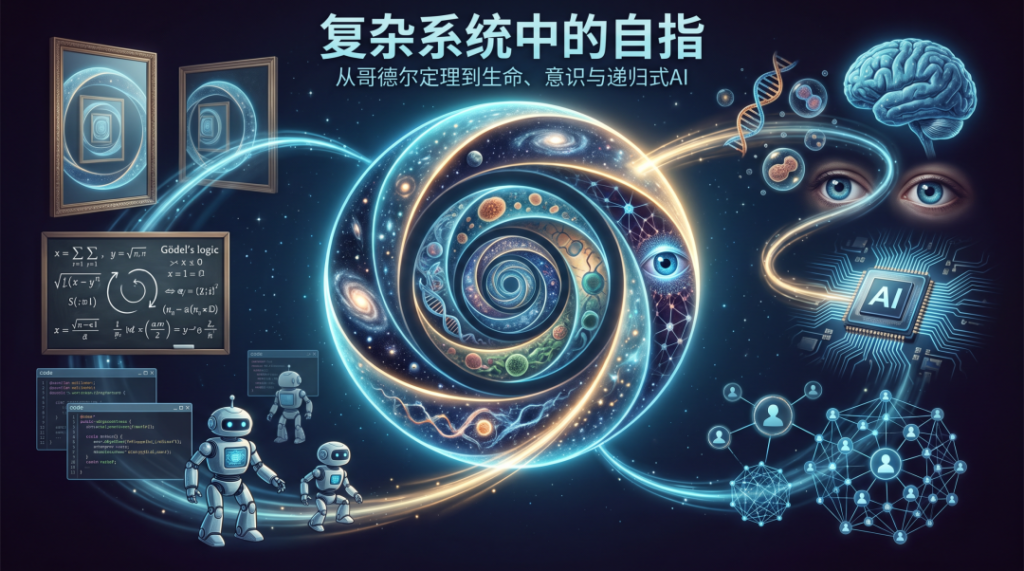
Jizhi Valley Offline Session | From Gödel’s Theorem to Self-Creation Theory: Complex Systems and Self‑Reference…
Summary
Lead: The origin of life, the problem of consciousness, machines self‑replicating, recursively self‑improving AI, societies self‑creating… Almost every major issue in complex systems is tied to self‑reference.
Introduction
The origin of life, the problem of consciousness, machines self‑replicating, recursively self‑improving AI, self‑creating social systems… Almost every major issue in complex systems is related to self‑reference. So, what exactly is self‑reference? What is its mathematical essence? Why does every major breakthrough in complex systems involve self‑reference? I will explain self‑reference thoroughly over the next two reading sessions. First, I will show you a variety of self‑reference forms, including linguistic self‑reference, mathematical self‑reference, programmatic self‑reference, as well as self‑reference in painting, storytelling, and more; then I will let you see how this magical self‑reference works in Gödel’s theorem proof and in von Neumann’s construction of self‑replicating automata. In the next session, I will reveal the core mathematical form of self‑reference—the Kleene Second Recursion Theorem. Finally, I will demonstrate how to understand the origin of life, the consciousness problem, free will, AI’s recursive self‑improvement, and other major puzzles from the perspective of self‑reference.The event is located in Beijing Mentougou • Jizhi Valley, and everyone is welcome to join on‑site for an in‑depth experience.
To systematically review the latest advances in self-reference and AI, Professor Zhang Jiang from the School of Systems Science at Beijing Normal University and founder of the Jizhi Club, together with PhD student Li Xiaojian from Tsinghua University’s School of Artificial Intelligence, have launched the “Self-Reference and AI: From Large Model Self-Improvement to Consciousness Research” reading group. The group will bring together researchers and explorers interested in this topic to study cutting‑edge literature and exchange research ideas. The reading group will run online every Saturday from 14:00 to 16:00 starting September 5, 2026, for about ten weeks, featuring presentations, discussions, and post‑session video recordings. Researchers in related fields and anyone with interdisciplinary interest are warmly invited to join.
Report Overview
Report Overview
Share Outline
Share Outline
-
What is self-reference? -
Self-reference in mathematics -
Gödel’s theorem -
Gödel’s proof -
Self-reference in programs -
Turing Halting Problem -
Theory of Self-replicating Automata -
Quine Programs that Print Their Own Source Code -
Commonalities in Self-reference -
Self-reference in Complex Systems -
Autopoiesis Theory -
Luhmann’s Sociological Systems Theory -
Self-awareness -
Free Will -
Recursive Self-improvement of AI
</ul
Keywords
Speaker Introduction
Speaker Introduction
References
-
Zhang, J.; Yuan, B.; Zhang, Q. Self-Referential Introspection in Large Language Models: The Critical Threshold for Recursive Self-Improvement. Entropy 2026, 28, 951. https://doi.org/10.3390/e28090951 -
Hou Shida Douglas Richard Hofstadter. Gödel, Escher, Bach. Commercial Press, 1997
</h3
Event Preview
Sign up for the reading group: “Self-reference and AI”
Sign up for the reading group: “Self-reference and AI”
Professor Zhang Jiang from the School of Systems Science, Beijing Normal University, and founder of the JiZhi Club, together with PhD student Li Xiaojian from the School of Artificial Intelligence, Tsinghua University, jointly launched“Self-Reference and AI: From Recursive Self-Improvement to AI Consciousness Research” reading group, organizing researchers and explorers interested in this topic to jointly study cutting‑edge literature and exchange research ideas.
The reading group will run online every Saturday from 14:00 to 16:00 starting August 29, 2026, for an estimated 8–10 weeks, featuring presentations, discussions, and post‑session video recordings. Researchers in related fields and interdisciplinary enthusiasts are warmly invited to join.
Scan the QR code in the poster to register for the reading group
Registration Method:
Step 1: Scan the QR code with WeChat to fill in registration information.
(Scan QR code to register)
Step 2: After filling in the information, pay to register. If you need to use Alipay, please go to the reading club page on a PC to sign up and pay:
Step 3: Add the operations assistant on WeChat and join the corresponding themed reading club community (WeChat group).
PS:
We encourage in‑depth discussions on complex systems, artificial intelligence, and related specific issues. To ensure discussion quality, please avoid posting content that is off‑topic from this session’s reading club theme, lacks empirical basis, or is overly abstract philosophical speculation.
If the discussion content clearly deviates from the topic and does not adjust after a reminder from the host, we will have to remove that member from the discussion group to maintain the overall learning environment, and proportionally refund the unparticipated portion based on their actual participation progress.
Thank you for your understanding and cooperation. Let’s work together to create a focused, in‑depth, and rewarding collaborative learning space.
Resources Available After Joining the Community
Full access includes: online Q&A, recorded playback, material sharing, community interaction, information synchronization, co‑creation tasks for earning points, and more.
Special Refund and Incentive Mechanism
We offer two ways for your investment to receive tangible returns:
-
Task Completion Refund Path
Claim and successfully complete any two subtitle tasks, and you will receive a full refund of the registration fee, plus an exclusive Jizhi merchandise reward.
Operational Growth Incentive Path
After successfully completing a subtitle task, you can apply to become an Operations Assistant. Once the reading club project is completed successfully, the tuition fee will be refunded. Outstanding performers also have the opportunity to receive an additional scholarship.
Recommended Reading
Recommended Reading
1. “Self-reference and AI” reading group recommended reading material
Scan the QR code below to go to the Jizhi BanTu website to read the article: “Self-reference and AI: From Large Model Self-improvement to Consciousness Research”, the reading material recommended by the book club.
2. Recommended past public account content
Self-reference — The golden band connecting graphics and substrate
Consciousness Machine? — AI Perspective (Six)
An Introduction to “Consciousness Machine”: How to Give Large Language Models Self-Awareness?
Causal Emergence Season 6 — Dynamics, Causal Abstraction, and Information Decomposition
Causal Emergence Season 7 — From Theory to Practice