Google‑Removed Hasabis Reverses Its Stance on AGI
Google-Removed Hasabis Changes Its Stance on AGI
Summary
Cheng Qian posted from Ao Fei Temple Quantum Bit | Official Account QbitAI “AGI will fully arrive within 2–3 years.” Hasabis has changed its attitude toward AGI. Although—AGI next door arrived last month, but in the past
Cheng Qian posted from Ao Fei Temple
Quantum Bit | Official Account QbitAI
“AGI will fully arrive within 2–3 years.”
Hasabis has changed its attitude toward AGI.
Although— the AGI next doorarrived last month, but for a long time, the chairman of Google DeepMind has been as steady as a mountain: it’s definitely not possible now, at least another 5-10 years.
At the beginning of this year, his stance noticeably softened, shrinking the timeline to 3-5 years.
In the latest long-form interview just released by The Wall Street Journal, Hassabis said plainly:
It’s happening soon; the timeline I predicted keeps moving forward.
Re‑evaluating the AGI Turning Point
There is reason to believe that Hassabis’sAGI lies on an alternate timeline.
He thinks that now the whole industry is just using static test sets like GPQA, AIME, SWE-bench to climb the rankings, which at best counts as performance optimization on narrow tasks, and does not constitute true general intelligence.
True AGI must possess the full dimensional cognitive scope of the human brain and, most critically, be capable of original thought.
So in February this year, Hassabis proposed the famous Einstein Test:
Only feed the AI all human scientific knowledge before 1901, and then see if this AI can, without any external prompts, independently derive the groundbreaking works Einstein published in his 1905 “miracle year”—including special relativity, the photoelectric effect, Brownian motion, and the famous mass‑energy equation E=mc^2.
Only by passing this new‑era Turing test does it deserve the “G” (General, universal) in AGI.
To achieve this true intelligence, Hassabis has set up a two-step strategy since the first day DeepMind was founded:
Step one, solve intelligence.
That is, AGI.
Step two, solve everything else.**
Refuse to limit AI to low‑dimensional tool functions like writing emails or making PPTs; instead, redirect it fully toward solving humanity’s unsolved scientific mysteries.
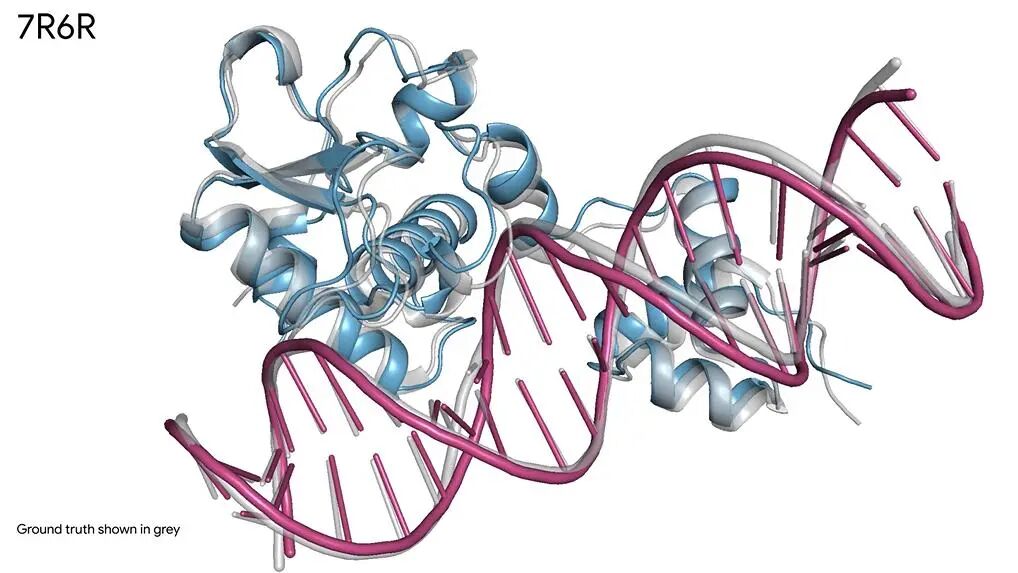 △AlphaFold predicts the molecular complex structure formed by proteins and DNA; blue and pink are the predicted results, gray is the experimentally measured true structure
Standing at the Foot of the Singularity Mountain
Technology is accelerating at light speed, but the real‑world readiness is terrifying.
Hassabis points out that the public is nowhere near prepared for the societal value reshaping, economic distribution logic, and human existence that could follow the arrival of AGI.
Faced with such a drastic transformation, regulators worldwide are rushing to enact various bills.
But Hassabis is not very convinced by these bills:
Regulating things we haven’t even fully understood yet is completely wrong. You will almost inevitably end up with misguided regulation, and misguided regulation is more harmful than a lack of regulation.
In his view, the public’s anxiety and even resistance toward super‑AI stem from the fact that many AI applications they see remain superficial.
To truly alleviate the public’s fear of super‑AI,we can’t stay trapped in the binary opposition of “AI will destroy the world” versus “AI will create a utopia.”
The most effective way for ordinary people to wholeheartedly embrace AI isto have AI genuinely cure major diseases.
When patients are given a new lease on life by AI‑designed drugs, all abstract fears will dissolve on their own.
At that point, the public will naturally understand the true value of this technology.
After the recent reorganization, he officially took on the role of Alphabet Chief Scientist and DeepMind Chairman, delegating the routine complex operations and management tasks.
According to Google, Hassabis will thereafter devote more effort to the AGI strategy and scientific research, while continuing to lead the AI drug discovery company Isomorphic Labs.
He hopes that after AGI arrives, he can sit down with this AGI and the world’s top scientists to derive the next generation of physics theory after relativity, fully unraveling the mysteries of the universe.
Has AGI Actually Arrived?
All I can say is, the Buddha (doge).
After all, there’s a pervasive “boy who cried wolf” paradox everywhere now, making it hard for ordinary people to truly know how far frontier AI has progressed.
OpenAI President Greg Brockman said on September 3 at the launch of GPT-6 Astra:“Humanity has entered the AGI era.”
When asked on his September 6 podcast “How many more years until AGI?” Jensen Huang blurted out“I think it’s now.”
Although he later rushed to patch it, saying that letting tens of thousands of agents autonomously create a trillion‑dollar NVIDIA is still a zero probability.
Elon Musk has repeatedly predicted on social platforms that the smartest humanswill be surpassed by AI this year or next.
Anthropic CEO Dario believes the AGI inflection point shouldbe between 2026 and 2027.
AI godfather Hinton still insists in his September 24 interview thatASI may still require 5–10 years.
Andrew Ng says, “I don’t know when it will arrive, but if you try to benchmark it now,you definitely won’t be able to tell that it hasn’t arrived.”
Yang Likun remains silent—“the best case” is “within 5 years,” “promising,” and “proving” that we are “on the right track.”
Alright.
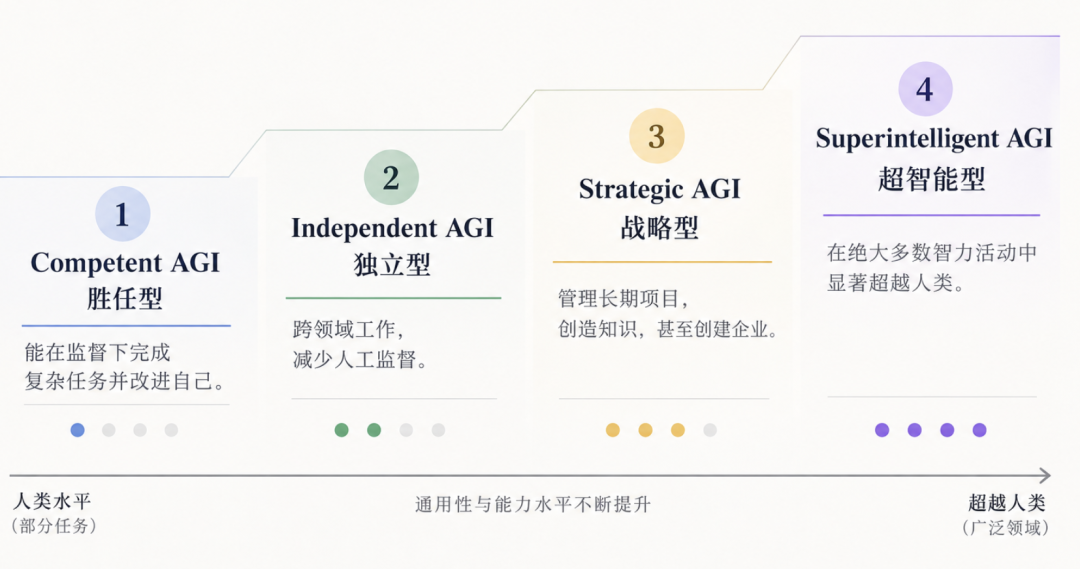
The reason it’s so hard to explain may be that AGI is unlikely to appear suddenly at a specific time; it is more like a capability that develops gradually.
 △Image generated by AI
Moreover, up to now, there is still no globally unified definition of AGI…
One-click triple“Like” “Share” “Heart”
Feel free to leave your thoughts in the comments!
— End —
🌟 Light up the star 🌟
Get MirrorSpeed
Get MirrorSpeed