Interpretable Prediction of Urban Population Flow | Computational Demography Reading Group #7
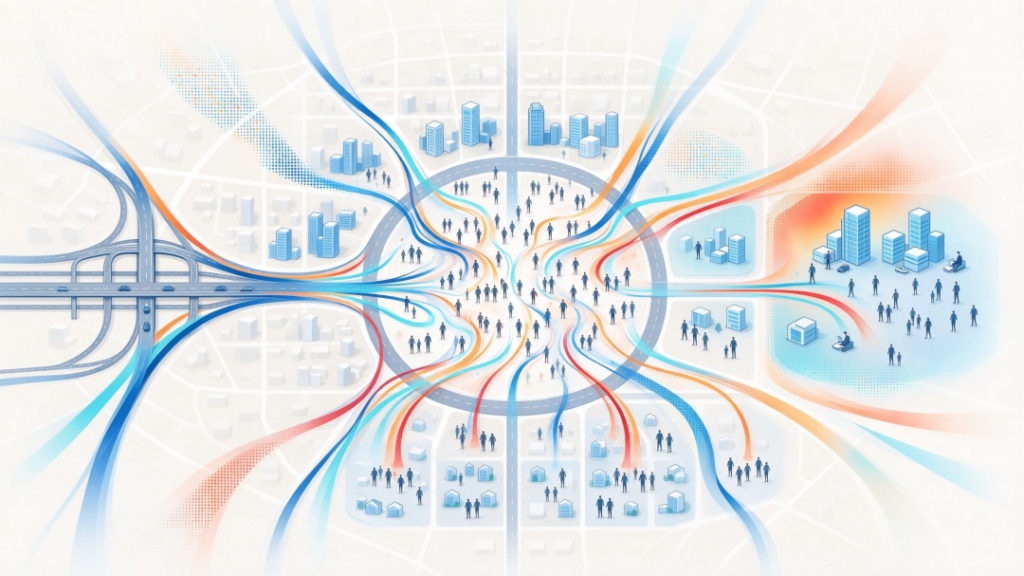
Explainable Prediction of Urban Population Mobility | Computational Demography Book Club Episode 7
Summary
Lead: Daily travel in cities provides a concrete entry point for computational demography to study population movement and its spatiotemporal patterns. In this episode, the 7th session of the Computational Demography Book Club, Meituan intelligent decision algorithm researcher Ji Jiahao will use urban traffic forecasting as an example to introduce how
Introduction
Daily travel in cities provides a concrete entry point for computational demography to study population movement and its spatiotemporal patterns. In this 7th session of the Computational Demography Book Club, Meituan intelligent decision‑algorithm researcher Ji Jiahao uses urban traffic forecasting as an example to show how to combine crowd‑movement mechanisms with deep learning, exploring how to leverage urban mobility data to improve prediction accuracy while offering clearer explanations of mobility changes.
To systematically review the latest advances in the field of demography, Sanhe Lian Tong Technology and Jizhi Club jointly launched the “Computational Demography: Fertility, Education, Mobility, and Aging from a Complex Systems Perspective” reading group. Professors Li Handong and Cui Xuefeng from the School of Systems Science, Beijing Normal University, serve as co‑initiators. The group brings together researchers and explorers interested in this topic to study cutting‑edge literature and exchange research ideas.
The reading group will be held online every Thursday from 19:30 to 21:30 starting September 17, 2026, lasting about 10 weeks, including a main presentation and discussion, and will provide video recordings after the sessions. We sincerely invite researchers in related fields and those with interdisciplinary interests to participate.
Report Overview
Everyday travel in cities provides a concrete entry point for demographic research on population mobility and its spatiotemporal patterns. This talk uses urban traffic forecasting as an example to show how to combine mobility mechanisms with deep learning: describing inter‑area flows and their evolution on the road network with potential fields and continuity equations, handling environmental changes such as weather and holidays through causal modeling, and discussing from an information‑theoretic perspective when “decompose first, then predict” is more effective. Around these topics, we explore how to leverage urban mobility data to improve forecasting accuracy while offering clearer explanations of mobility changes.
Share Outline
Urban Population Mobility Forecast: Limits of Data‑Driven Approaches
-
Observing urban mobility through traffic data
-
Beyond prediction accuracy: interpretability and environmental adaptability
Potential fields and continuity equations: from regional flow to network evolution
-
Describing inter‑regional flow with potential fields
-
Characterizing dynamic evolution on road networks with continuity equations
-
Predictive Performance and Explainability of Potential Fields
Causal Modeling: Robust Prediction under Environmental Changes
-
Distribution shifts caused by weather, holidays, etc.
-
Confounder representation based on basis vectors
-
Predictive performance in unknown environments
Decomposed Forecasting: When “Decompose First, Predict Later” Is More Effective
-
Modeling challenges from mixed travel modes
-
Component independence principle from an information-theoretic perspective
-
Graph Decomposition Learning Framework and Experimental Validation
Core Concepts
Spacetime Potential Field: Borrowing from field theory, using the “potential difference” between regions to describe flow direction and intensity.
Neural Differential Equations: combine differential equations with neural networks to describe the continuous evolution of traffic flow.
Causal Representation Learning: distinguish relatively stable spatiotemporal relationships from the influence of external environmental factors.
Decomposed Forecasting: split complex spatiotemporal patterns into relatively independent components, forecast each separately, and then recombine.
Speaker Introduction
Speaker: Ji Jiahao, Meituan Intelligent Decision Algorithm Researcher, Ph.D. from Beihang University, twice participated in overseas research through national government-sponsored programs. Research interests include AI4OR, spatiotemporal data mining, explainable AI, and urban computing. Serves as a member of the Federation Committee of the Chinese Association of Automation, co-authored the international standard IEEE P2894 on explainable artificial intelligence, and co-founded the JiZhi Academic Community “Urban Science Reading Club.” Recipient of the ACM SIGSPATIAL China Chapter Outstanding Paper nomination award. Authored one academic monograph, published 18 scholarly papers, with representative works appearing in top CCF A‑rank AI and data mining venues such as IEEE TPAMI, IEEE TKDE, ACM SIGKDD, AAAI, etc., accumulating over 1,100 citations.
References
-
JI J, WANG J, MOU Y, et al. How to break it down for building it up? Theory-guided graph decomposition learning for spatiotemporal traffic prediction[J]. IEEE Transactions on Pattern Analysis and Machine Intelligence, 2026, 48(5): 5442-5459.
-
JI J, ZHANG W, WANG J, et al. Seeing the unseen: Learning basis confounder representations for robust traffic prediction[C]//Proceedings of the 31st ACM SIGKDD Conference on Knowledge Discovery and Data Mining V.1. 2025: 577-588.
-
WANG J, JI J, JIANG Z, et al. Traffic flow prediction based on spatiotemporal potential energy fields[J]. IEEE Transactions on Knowledge and Data Engineering, 2023, 35(9): 9073-9087.
-
JI J, WANG J, JIANG Z, et al. STDEN: Towards physics-guided neural networks for traffic flow prediction[C]//Proceedings of the AAAI Conference on Artificial Intelligence. 2022, 36(4): 4048-4056.
Event Preview
Event Preview
Live Broadcast Information
Sign up for the reading group: “Computational Demography”
Registration Method
Join the community to enjoy core resources
Special Refund and Incentive Mechanism
-
Task Completion Refund Path Claim and successfully complete any two subtitle tasks, and you will receive a full refund of the registration fee, plus an exclusive JiZhi merchandise reward. -
Operational Growth Incentive Path After successfully completing one subtitle task, you can apply to become an operations assistant. Upon the successful completion of the reading club project, the tuition will be refunded. Outstanding performers may also have the chance to receive an additional scholarship.
Recommended Reading
Get MirrorSpeed
Get MirrorSpeed