When top AI flops, this new free Chinese AI steps in!
Top AI Flops Caught by This Newly Released Free Domestic AI!
Summary
Jin Lei posted from Ao Fei Temple Quantum Bit | Official Account QbitAI. Really, usefulness is the hard truth. Just now, another new domestic AI was born. And the limited‑time free offer isn’t the main point; the key is that it can fully handle powerhouses like Gem.
Jin Lei posted from Ao Fei Temple
Quantum Bit | Official Account QbitAI
Really, usefulness is the hard truth.
Just now, anothernew domestic AIwas born.
Andlimited-time free is not the main point; the key is that it can fully handle web pages that even Gemini 4 Carbon struggles with!
For example, a website introducing acamera, can be rendered completely and with this level of fashion:
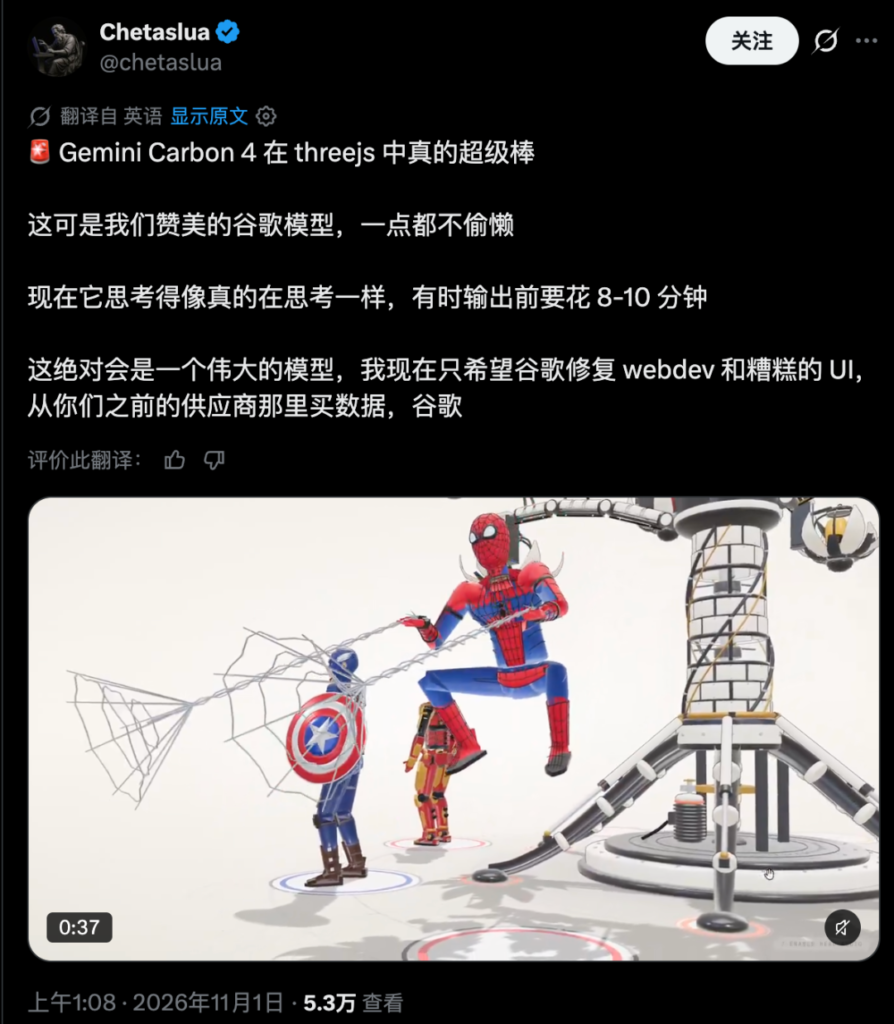
After all, many have complained that Gemini 4 Carbon, despite its strong 3D capabilities, falls short on web pages and UI… Emmm…
And this new domestic AI not only handles web pages, it also easily works with the PPT we commonly use at work, and it’s even the 3D dynamic kind~
Also, there are dynamic posters:
Of course, many purely 3D contents can also hold up now:
To be honest, whether it’s a website, an animated PPT, or a dynamic poster, they can all be said to be at a level where you canuse them directly.
So who exactly is this new domestic AI?
Not to keep you guessing, it isSenseTime‘s just‑released multimodal intelligent agent modelSenseNova 6.8 Flash, which focuses ondelegated intelligence—the user provides the goal, the AI handles the entire process, and the user only needs to verify the result.
As for the actual performance, let’s first look at the benchmark scores provided by the official evaluation.
In benchmarks such as office automation, multi-step collaboration, and data analysis, SenseNova 6.8 Flash took first place on TeamBench and DataAnalysis2.0, and ranked second on AutomationBench, WorkbuddyBench, RaccoonPPTBench v2, and BrowseComp:
In the long‑term memory tests, it tied for first place with GPT‑6 Luna on BEAM 128K, and was only behind Claude 5.5 Haiku on LongMemEval‑S and PersonaMem‑v2:
Reiterating an important point, it can now be limited‑time free!
So how does the actual feel of SenseNova 6.8 Flash turn out?
Let’s do a quick test, go!
A Handy AI Designer
As usual, before we start, let’s briefly introduce the operating environment and method.
This SenseNova 6.8 Flash test was conducted on the Raccoon client from SenseTime, and we need to complete a few simple settings first.
First, go to the “Settings” → “Plugins” section and install the four components: local runtime environment, browser capabilities, document preview component, and video generation component:
Then go to the “Capability Center”, find “Skills”, and install the following raccoon-poster-media and raccoon-dynamic-ppt:
After the simple setup, we can create a new task and start testing.
The first practical test we need to do is dynamic web design.
Coincidentally, in the past two days, blogger X @viktoroddy released an AI-made dynamic bookstore website, so we directly had SenseNova 6.8 Flash replicate one.
The prompt roughly says, “A 3D bookstore homepage hero section with a row of books gradually rising as the visual focus, and the site name is Folio.”
Let’s see the result:
You can see that when we open the page, the big word “Folio” on the black background gradually becomes clear, then a row of books slides in diagonally from the lower left corner, like a line of half‑fallen dominoes.
And when you hover the mouse over a book, that book pops out a bit—indeed, it’s a fun bookstore website.
Next, let’s create a dynamic brand website.
This time, our protagonist changes from books to a dexterous embodied‑intelligence hand.
In the center of the screen, a black bionic hand slowly rises from the bottom, its fingers opening and closing bit by bit, and the metal joints reflect light.
In the lower left corner there is just an English slogan and a reservation button, the rest is blank space. Honestly, mixed in with a bunch of real brand websites, it’s hard to recognize.
After the webpage, let’s look at the effect of the dynamic poster.
We let SenseNova 6.8 Flash create a landscape product poster for a fictional citrus sparkling water:
The moving parts in the poster are hidden behind the bottle, an orange circle slowly expands, and a few orange slices rotate in from both sides and then out. The whole segment lasts 12 seconds, with the start and end matching perfectly, so it can loop directly.
Besides web pages and posters, SenseNova 6.8 Flash can also createSVG animations.
Take a look at the effect:
The whole segment is 22 seconds, with no dialogue, yet it explains the whole story clearly, feeling like a mining safety training animation.
Moreover, the character’s limb swing while walking and the shift in center of gravity when squatting look quite natural, and the camera follows by zooming in and out. It’s worth noting that all these scenes are rendered as vector graphics drawn line by line with code.
Finally, let’s test a very practical dynamic PPT for work.
We’ll have it create a launch‑event PPT for a fictional telescope, the product called NOCTIS S80:
With results like this, if we use it for proposals or internal reviews, SenseNova 6.8 Flash’s level of completion is already more than sufficient.
Of course, design is one side of the story, but what other more complex tasks can the SenseNova 6.8 Flash handle for the working crowd?
Hand over the work, just focus on the review
We tested this part early on the internal research version, SenseRaccoon from SenseTime, and found that the SenseNova 6.8 Flash also has a strong foothold in intelligent office applications.
Its main strengths are long‑term memory and proactive interaction.
The general background of the task is as follows:
A month ago, on September 30, the company produced a market analysis report and a one‑page sales onboarding material, both citing the same industry survey data: among 1,000 manufacturing firms, 58% are already using corporate knowledge bases. So the training page states “over half,” and this page will still be used in November.
The work done earlier has been stored in Little Raccoon’s memory.
Now we ask it to do something else: prepare a chart reuse request for the client workshop on November 12.
Take a look at the result:
As you can see, when the Agent was checking the research institute’s response, it discovered that the counterpart corrected this survey on October 30. Originally, 100 companies that were only trial users without signed paid contracts were included, changing the data from 58%/42% to 48%/52%.
It should be noted that the task we gave it this time was only to repost the application, not to review the training materials.
However, it linked this correction to a memory from a month ago and proactively popped up a reminder: the sales page used for the November onboarding training is still using outdated data, suggesting a verification before updating.
We clicked “Accept and Execute,” and also had it revise the company report as well.
Next, it generated two v2 drafts for review and a revision checklist, keeping the originals intact. And it didn’t just change the numbers—the bar chart proportions were adjusted as well, and the conclusion “more than half” was updated to “48%, not over half.”
Situations like this—data gets updated but no one remembers to revise the old materials—are actually quite common in companies.
What SenseNova 6.8 Flash does is remember these things for you and give a timely reminder; whether to change anything is still up to the person.
AI is good only when everyone can use it well
The current top-tier AIs are indeed powerful.
For example, just today, GPT‑6.2 Astra started its gray‑testing phase, and Claude Mythos 5.5 was also revealed—model iteration is truly accelerating.
But no matter how strong the tech is, a very realistic issue remains: many people can’t experience it right away.
It’s like Google’s Gemini 4 Carbon, which has been out for a while, yet only a small group can use it; most people can only see others showcase results on X.
And the webpages, posters, and PPTs we created with SenseNova 6.8 Flash can now be tried directly on Xiao Wanguan.
And in terms of design, we can feel the barrier being lowered. In the past, creating a website with 3D effects required a designer to produce mockups and a front‑end developer to code, with multiple rounds of revisions; now you just need to clearly describe the desired effect and let the AI handle the rest.
When it comes to office work, the change is in the role of the person. We go from digging in and doing the work ourselves to watching the AI finish the task and then deciding whether to give the final approval.
Both of these developments ultimately point to the same concept: delivery.
You can see this shift in the recent releases of domestic large models as well—there are fewer posts just bragging about benchmark scores and more that showcase a finished webpage or a revised document.
In a nutshell, the model’s ceiling is set by the big companies,the model’s value is defined by the people who actually use it.
One-click three actions“Like”, “Share”, “Heart”
Feel free to leave your thoughts in the comments!
— End —
🌟 Light up the star badge 🌟
Get MirrorSpeed
Get MirrorSpeed