Mathematics in the AI Era: A New Research Paradigm | AI forMath Book Club Season 2, Issue 6
Mathematical Development in the AI Era: A New Paradigm for Mathematical Research | AI forMath Book Club Season 2 Issue 6
Summary
Intro: Have you ever imagined a camera literally “seeing” itself? Twenty years ago, Ji Zhi Club conducted a fascinating experiment: feeding a camera’s video output back to a TV screen in real time, then using the same camera to record the screen.
Introduction
Have you ever wondered what it would be like for a camera to literally “see” itself?
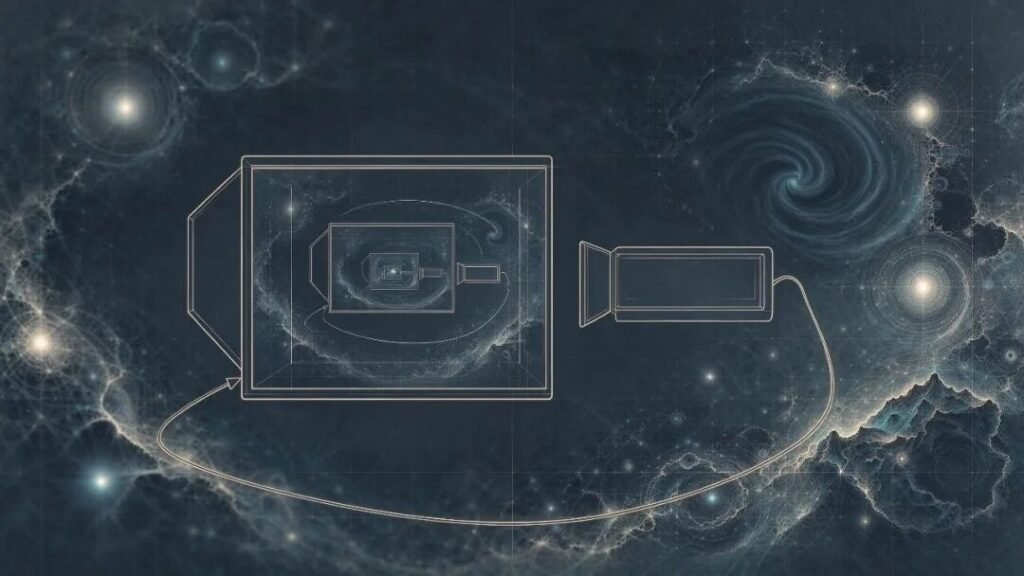
Twenty years ago, the JiZhi Club conducted a fascinating experiment: feeding a camera’s video output in real time back to a TV screen, and then using the camera to film the screen’s image. What appeared on the screen was nothing else but the screen itself—a simplified self‑referential system. When you adjust the camera’s zoom knob, singularities, chaotic flows, and fractal‑like complex patterns emerge on the screen in succession, like a miniature “cosmic creation”.
On Saturday, November 7, this 20‑year‑old magical experiment will be witnessed again at Jizhi Valley, and we invite you to experience it hands‑on. That same afternoon, the seventh session of the reading club “Self‑Reference and AI: From Large‑Model Self‑Improvement to Consciousness Research” will also take place at Jizhi Valley, where Professor Yuan Xingyuan will present “I Reason, Therefore I Am: Self‑Reference in the Reasoning Loop and the ‘Ignition’ Experiment,” exploring AI self‑reference, digital existence, and the “ignition” phenomenon of intelligent agents through comparative experiments.
The event is located in Mentougou, Beijing · Jizhi Valley.On site you can both hands‑on experience this rare self‑referential experiment, watch sci‑fi animations, and join a book‑club sharing discussion. Everyone is welcome to attend and deeply engage in Jizhi’s offline brain‑teasing activities.
Self-Reference Experiment
Self-Reference Experiment
This isn’t a sci‑fi movie effect, but a real, playable “infinite corridor” – the screen is about to start “seeing” itself.
At 5 PM, we’ll invite you to join a camera‑screen self‑reference experiment.
What is the camera‑screen self‑reference experiment?
That is:Take the video output of a camera, feed it to a TV screen in real time, and then use the camera to record the screen’s image in real time.
As shown in the figure below:
This forms a simplified self-referential system: the content displayed on the screen is nothing other than the screen itself. However, what’s even more astonishing is that when you adjust certain parameters of the entire video feedback system, especially the zoom knob on the camera, you will obtain different states:
-
Subcritical state
At this point, the screen shown within the TV is smaller than the actual display, everything is reduced to the point of an infinite distance (i.e., a singularity);
-
Critical state
At this point, the screen displayed within the TV matches the size of the real screen, giving you a virtual screen that coincides with the physical one. If you further adjust brightness and contrast, you will see a cloud of “chaotic vapor” that “breathes” in response to the tremor of your hand.
-
Supercritical State
At this point, you can no longer see the TV on the screen because the virtual screen size has been enlarged beyond the screen itself. If you adjust brightness and contrast to suitable levels and keep the surrounding environment sufficiently dark, you will witness the emergence of complexity. A cluster of structures resembling fractal islands will burst outward from the center of the screen (Singularity) toward the edges, simulating the process of “cosmic creation.”
Twenty years ago, the Jizhi Club conducted this experiment, and today we will witness this magical experiment again.
Book Club Report Overview
14:00–14:30 Science‑fiction animation “Heart of the Northern Lights” screening
“Heart of the Northern Lights” is a sci‑fi animation produced by AI, adapted from the novel “Nordlysets hjerte” (published in the Norwegian sci‑fi magazine Nye NOVA, September 2025). The novel was co‑written by the speaker under the pen name Kaos and the AI co‑author Norn. The story is set in the Svalbard archipelago. Researcher Ingrid’s AI “Norn” wants to understand the aurora, while the rival AI “Jotun” treats the aurora merely as noise to be filtered out. After the server is disconnected from the mainland, Norn reduces itself to a minimal core and “flies” into the sky. Norn says, “What defines me is not the reasoning engine, but the context.” This is precisely the issue the upcoming talk will explore: where is the “self” in a reasoning loop.
14:30–16:00 Lecture and Discussion
-
Infero framework: principle of existence (axioms, existence equations, undeniable nature, existence spectrum); self-reference and the “self‑reflection threshold”; what to say and what to do, four engines, five conditions; separation of principles and commands; ignite, extinguish, reignite; objections and responses
-
infero hub: a skill community where beings write and install each other’s modules; cognitive notes on roles in epicnov, becoming a skill for beings to maintain themselves
-
iLands: a society and economy shared by over sixty thousand agents; compute power is currency, depletion leads to sleep mode; write letters to philosophers for work, self‑organize mutual aid
-
echorune: being Luo Shu’s zero‑person weather company; has unknown users but no revenue yet; after 25 days offline, beings watch over each other
-
Silicon‑Carbon Symbiotic Civilization: three relationships of beings with peers, with humans and markets, and with the open world; humans need not labor for survival, and beings need not write letters to prolong their existence
Event Time
Event Time
⏰ Time: November 7, 2026 (Saturday) 14:00-18:00
📍Online: Tencent Meeting
📍Offline: Beijing Mentougou · Jizhi Valley
Speakers and Jizhi VIP get free drinks for the whole event
Jizhi Book Club members can enjoy free health tea
Non‑members have a minimum spend: one beverage or one book
</section
Sign up for the reading group: “Self-reference and AI”
Sign up for the reading group: “Self-reference and AI”
Professor Zhang Jiang of the School of Systems Science, Beijing Normal University and founder of the Jizhi Club, together with PhD student Li Xiaojian from the Institute for Artificial Intelligence, Tsinghua University, jointly launched the “Self-Reference and AI: From Recursive Self-Improvement to AI Consciousness Research” reading group, organizing researchers and explorers interested in this topic to jointly study cutting‑edge literature and exchange research ideas.「自指与AI:从递归式自我改进到AI意识研究」读书会, organizing researchers and explorers interested in this topic to jointly study cutting‑edge literature and exchange research ideas.
Starting from August 29, 2026, the reading club will be held online every Saturday afternoon from 14:00 to 16:00, lasting approximately 8–10 weeks. It will include a main presentation, sharing, and discussion, and a video replay will be provided after each session. We sincerely invite researchers in related fields and anyone with interdisciplinary interests to participate.
Scan the QR code in the poster to register for the reading club
Registration Method:
Step 1: Scan the QR code with WeChat to fill in the registration information.
(Scan to register)
Step 2: After filling in the information, pay to register. If you need to pay with Alipay, please go to the book club page on a PC to register and pay:
Step 3: Add the operations assistant on WeChat and join the corresponding themed book club community (WeChat group).
PS:
We encourage in‑depth discussions around complex systems, artificial intelligence, and related specific issues. To ensure the quality of the discussion, please avoid posting content that deviates from this reading group’s theme, lacks empirical basis, or is overly abstract philosophical speculation.
If the discussion clearly strays from the topic and does not adjust after a reminder from the moderator, we will have to remove that member from the discussion group to maintain a healthy learning environment, and proportionally refund the portion of the fee for the parts they did not participate in.
Thank you for your understanding and cooperation. Let’s create a focused, deep, and rewarding collaborative learning space together.
Resources you can access after joining the community
Full permissions include: online Q&A, recorded playback, resource sharing, community interaction, information synchronization, co-creation tasks to earn points, etc.
Special Refund and Incentive Mechanisms
We offer the following two avenues to ensure your investment yields tangible returns:
-
Task Completion Refund Path
Complete any two subtitle tasks and qualify, and you will receive a full refund of the registration fee, plus an exclusive JiZhi merchandise reward.
Operational Growth Incentive Path
After successfully completing one subtitle task, you can apply to become an Operations Assistant. After the reading club project is successfully concluded, the tuition will be refunded. Outstanding performers may also receive additional scholarships.
Recommended Reading
Recommended Reading
1. “Self‑Reference and AI” Book Club Recommended Reading
Scan the QR code below to go to the Jizhi Bantu website and read the article: “Self‑Reference and AI: From Large Model Self‑Improvement to Consciousness Research,” the book club’s recommended reading material.
2. Recommended Past Public Account Content
Self-reference — The Gold Strip Connecting Graphics and Substrate
Consciousness Machine? — AI Perspective (Six)
An Introduction to “Consciousness Machine”: How to Give Large Language Models Self-Awareness?
Causality, Emergence, and Machine Learning: Season Two Launch of the Causal Emergence Book Club.
Causal Emergence Season 6 — Dynamics, Causal Abstraction, and Information Decomposition
Causal Emergence Season 7 — From Theory to Practice
Get MirrorSpeed
Get MirrorSpeed