Fable and Astra Enter the Physical World, While Ant’s Lingbo Takes Root at the Fingertips
Fable and Astra Move into the Physical World, Ant Lingbo Chooses to Take Root from the Fingertips
内容摘要
Why does Lingbo insist on embodied nativeness? By Wang Yi. In the past two days, everyone has seen the news about Claude Fable 5.2, which demonstrated tasks such as unscrewing bottle caps, solving Rubik’s cubes, and drawing in real‑time, seamlessly, directly boosting the success rate of arm generalization.
Why does Lingbo insist on embodied originality?
At the same time, Ant Lingbo Technology released the open‑source tactile foundation model LingBot‑Touch, which unifies magnetic tactile, visual tactile, and piezoresistive sensor signals—three completely different types—into a single “tactileToken”, for use by various dexterous hands and motion models, enabling robots to “see clearly and think clearly” while further completing the tactile perception needed for fine manipulation.
Can general large models “dimensionality‑reduction strike” embodied intelligence?The relationship between these two technical routes is precisely the current focus of discussion in the embodied intelligence industry.From AntLingbo’s perspective, general large models and embodied foundation models have a synergistic relationship of 1+1>2: the former enhances understanding and reasoning about tasks and environments, the latter fills in physical perception and closed‑loop operation capabilities. Only by advancing together can they jointly accelerate the maturation of the embodied industry.
Ant Lingbo’s chief scientist Shen Yujun’s view on recent market fluctuations is rather sharp; he bluntly says:“A tool that works is not necessarily the most suitable tool.”He hopes this tool“is neither too big nor too small”: the key capabilities should have no shortcomings, and non‑essential capabilities should avoid waste. The “size” here does not refer to parameter scale but to capability configuration. For example, an embodied model should not aim to match the programming abilities of Fable, Astra, because full‑stack software engineering is not a strict requirement for robot tasks. Conversely, perception and understanding of physical modalities such as distance and tactile feedback are abilities that digital‑world models do not natively possess but are indispensable for robots to perform high‑precision, complex operations.
Implementing haptics is not a choice, it’s a must‑answer question
In the past three years, embodied intelligence has been racing ahead driven by visual and language modalities, producing a series of impressive demos, but once robots enter the real world, they often stumble at the fine‑manipulation stage.
Through extensive practical implementation, the industry has realized that visual and language modalities address the thinking “before contact”, while haptics addresses the state “after contact”.When the gap between embodied intelligence’s “knowledge” and “action” is so evident, haptics is no longer an optional question but a mandatory one.
Robotscan only prove whether they can hold an object steadily after their fingers actually touch it.
This brand‑new modality, haptics, is gradually stepping onto the industry stage, but it has also taken some detours over the past few years. For example, the prevailing belief once was: does adding haptics actually introduce noise into the model and degrade quality? Should the haptic modality wait until the sensor roadmap is fully defined?
In recent months, the consensus on haptic modalities has been rapidly reversing. However, even though the necessity of haptic modalities has become a consensus, it does not mean the industry has found a unified solution. Currently, haptic sensors still have three different branches—visual haptics, magnetic haptics, and piezoresistive haptics.——
Each of the three approaches has its pros and cons. Visual haptics obtains contact information by observing deformation of a flexible surface, capturing richer contact shapes, but inevitably suffers from frame‑rate limitations; magnetic haptics senses force via magnetic field changes, offering thinness and speed, yet is vulnerable to ferromagnetic interference; piezoresistive haptics measures pressure through resistance changes, which is cheap and easy to cover large areas, but has low resolution and tends to drift over time.
The lack of convergence in technical roadmaps also gives rise to many industry pain points. Because there is no tactile foundation that unifies modeling of three types of heterogeneous tactile signals, a universal representation cannot be generated, resulting in extremely low R&D efficiency in the industry.
For an intuitive example, a robot learned today“how to detect finger slip”, but if tomorrow it has to switch to another dexterous hand or tactile sensor, that experience becomes completely invalid. An engineer joked that each tactile sensor is like its own“dialect”, incomprehensible to the others.
Lingbo’s latest release of LingBot‑Touch is precisely an attempt to eliminate this pain point, and its biggest feature is: universality and compatibility.
Lingbo gave us an overview of the entire tactile model training process.
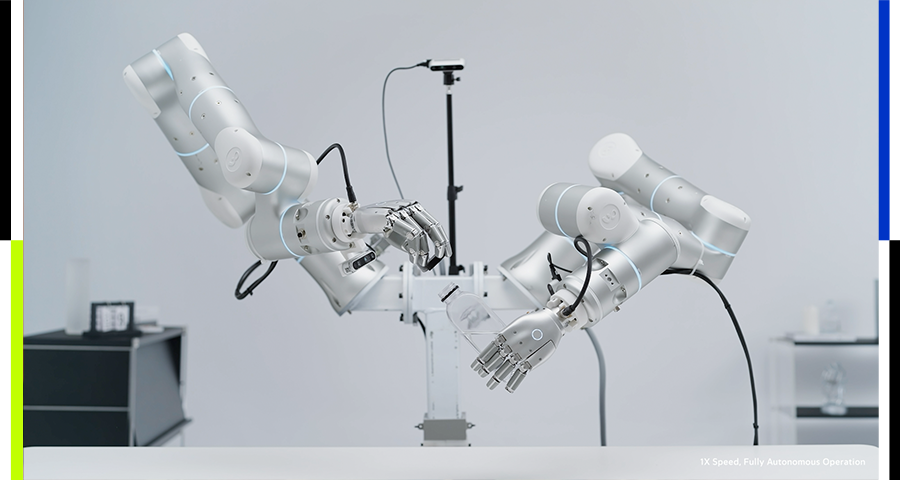
First, LingBot-Touch‘s data mainly comes from two types of real operations: one involves a person wearing a haptic glove, collecting 2197 hours of piezo‑resistive haptic data and 1136 hours of magnetic haptic data; the other involves teleoperating the Sharpa Wave dual‑arm robot, collecting 1650 hours of visual‑haptic data.
The following training process can be briefly summarized in three steps:
First, to enable the model to uniformly understand tactile signals generated by different sensors, the research team first maps all touch points to a unified standard fingertip coordinate system; second, for different sensing principles such as piezoresistive, magnetic, and visual tactile, dedicatedTokenizer (encoder) are designed; third, the raw signals are converted into Tokens that the model can process, and finally fed into the same Transformer for training.
The overall training approach is somewhat like giving the model a “fill-in-the-blank”—randomly masking a portion of fingertip tactile information, letting the model infer what happened in the masked region based on contact changes at other locations. However, it does not require the model to precisely reconstruct the raw sensor data, but rather to predict more meaningful features, such as what contact state and physical changes those values represent.
The final result is that LingBot-Touch directly bridges the multiple layers of obstacles that previously existed between sensors, dexterous hands, tasks, and motion models.
For example, when you replace a tactile sensor with a different one based on the same principle, the new model does not require retraining. Even if you need to swap the dexterous hand, and the new hand uses sensors that were not seen during the pre‑training phase, it can be integrated directly.
Additionally, if you change the hand task—whether flipping pages or unscrewing caps—you don’t need to retrain an entire tactile model; a small number of demonstrations are enough for the motion model to learn the new operation. Even when the underlying motion model needs to be replaced, the same set of tactile information can still be used.
Real‑world testing also confirms this.
Taking bottle‑cap twisting as an example, Sharpa Wave has a success rate of only 56.25%—after integrating LingBot-Touch, the robot can sense the cap about to slip, adjust the force in time, and the success rate rises to 90%.
In other words, while the industry is still debating how to implement haptics and whether it’s worth it, Lingbo has already turned it from a“sensor selection issue” into a“platform capability issue”. Once this move is made, the next question is no longer whether to adopt haptics, but whether the brain can keep up after haptics are integrated.
Schema Assault
Why does Lingbo still insist on embodied native?
After realizing the importance of haptics, some might think that directly embedding haptics onto the base model means the robot is ready for deployment and everything will be fine?
That’s completely wrong.
For example, there are some players who treat a general large model as a ready‑made brain, then add motion data and tactile information to quickly produce works. Their judgment is realistic; instead of spending a lot of money developing their own brain, they might as well “surrender”. However, some approaches are more subtle: they leverage the power of schemas for semantics, but do not blindly graft physical intelligence.
Unlike the above, Lingbo chose a longer, steeper, and more thorough path—insisting on building embodied native models—the tactile model mentioned earlier is actually just one sense in Lingbo’s brain model matrix.
In recent years, the LingBot familyLingBothas already established a far‑reaching embodied native framework, covering not only touch but also spatial perception, world prediction, instruction comprehension, and action generation.
In the view of Lingbo’s chief scientist Shen Yujun, there are at least three gaps between schemas and the real world.
First, the data gap. This is just like a person cannot become Federer by watching Federer play tennis tens of thousands of times. Internet data is abundant and cheap, but the real world has far more diverse data dimensions—how many newtons of force are used to grip the racket, how the wrist and fingertips adjust posture according to the ball’s trajectory. These data exist only in real contact and practice.
Secondly, the physical world does not pause.A close observation reveals that Fable 5.2 has strong reasoning and task decomposition in a simulated environment, but its actual execution speed is very slow. Previously, GPT-6 Astra’s original video also lasted as long as three hours. Real devices require millisecond‑level changes, while a cloud‑based large model takes minutes to think through a single action, which has long been a problem in tasks.
Third, directly feeding new haptic modalities into the base model in a simple and brute-force way does not necessarily1+1>2.An internal test example at Lingbo is the Sharpa Wave zipper case: without inputting haptic modality, the success rate is39%—if you crudely inject haptic information, the success rate drops directly to15%, and the haptic input instead becomes“dirty data” that interferes with the model.
Therefore, Lingbo’s anti-consensus proposes “embodied native” strategy: In the ideal robot, it is not “a smart foundational model equipped with tactile modalities and a robotic arm”, but should be driven all the way through—semantic intelligence rooted in the digital world, and physical intelligence also needs its own roots, mastering real‑world data, its own sensors, and its own pre‑training methods.
During the past few years of dormancy, Lingbo Brain 2.0 has built a complete native technology stack. It is called “native” because it does not simply transfer the language and visual capabilities of general-purpose large models to robots, but instead constructs an embodied native model system centered on perception, understanding, and action in the physical world.
According to Lingbo, the Lingbo Brain 2.0’s spatial perception layer is composed of LingBot-Vision and Depth 2.0, enabling the robot not only to recognize what objects are but also to determine their spatial boundaries, distances, and geometric relationships.
For example, when faced with transparent cups, reflective metal, or stacked clutter, the robot no longer merely guesses object outlines from a 2D image but truly understands the objects’ positions and shapes in three-dimensional space.
The dynamic interaction layer uses LingBot-Video and World 2.0, allowing the robot to further understand the dynamic changes in the physical world: not only knowing what is in front of it, but also predicting how its actions will alter the environment. For example, when pushing open a door, it must know where the door is, anticipate how the door will swing, the amount of resistance it will encounter, and whether it will rebound after release.
The tactile perception layer is provided by LingBot-Touch, supplementing information that vision cannot perceive, enabling the robot to judge contact position, force, and slip state. It is akin to equipping the brain with a subdermal nerve layer, allowing it to sense whether an object is slipping and whether the grasping force is appropriate.
Finally, the action execution layer consists of LingBot-VLA 2.0 and VA 2.0, converting the above perception and prediction capabilities into actual actions, allowing the robot to continuously infer, receive feedback, and adjust during execution, rather than, like traditional models, generating motion commands in a single pass based on the input.
It is worth noting that the relationship among the four hierarchical model matrices is not a simple “1+1+1+1=4”, but rather “greater than 4” after sharing physical representations. In other words, the haptic information extracted by Touch will feed back into VLA’s grasping decisions; the World model uses contact feedback to verify predictions; and VLA’s spatial priors will help Touch resolve discrepancies.
We might use“a robot lifting a bowl full of water” as an example to aid understanding—Depth tells it where the rim of the bowl is,Touch detects the fingertip starting to slip and the bowl tilting,World predicts that the grip will be released,the soup would spill,VLA instantly reallocates the force from“pinching”to“supporting the bottom”.
In fact, persisting with embodied native Lingbo is not “minority”; abroad, there are already a number of companies that don’t follow the paradigm and have abandoned the approach of “turning LLM into a robot.”
But Lingbo differs in that it not only does force control, nor does it only build world models; instead, it is more systematic, turning various modalities into “embodied native” nerves, weaving them into a physical brain that can be reused across hardware.
Building Roads and Bridges for the Embodied Intelligence Industry
Bringing the perspective back to the industry, LingBot-Touch is just an entry point. The four‑layer architecture of LingBot Brain 2.0—spatial perception, tactile perception, dynamic interaction, and dexterous manipulation—aims to solve a bigger problem: can robots have a universal intelligence foundation that doesn’t require retraining from scratch every time the hardware changes or a new scenario is entered?
If this can be accomplished, it will have at least three impacts on the entire industry.
First, it decouples robot hardware from intelligent algorithms.
In the past, after a robot company selected a particular dexterous hand, sensor, and body, it often had to retrain perception and motion models around that hardware. Switching to a different hardware set required many algorithms to be redone.
What Lingbo aims to do is to abstract perception capabilities such as vision, depth, and touch from specific hardware, creating modules that can be invoked independently. This way, hardware manufacturers can focus more on mechanical structures and motion control, while sensor manufacturers don’t have to build algorithm systems from scratch. Each vendor can excel at its own strengths, and collaborate through a unified intelligent platform.
Secondly, ensure that the data collected by robots can be continuously accumulated, rather than being tied to individual projects.
In the past, the industry was not lacking companies that collect data; the real problem was that the data often tied to specific hardware and specific tasks. When a project ended, switching to a different robot or a different target, the previous data might not be directly usable.
Lingbo’s approach is to use a unified representation to convert physical interaction data collected from different devices and modalities into reusable training material. This way, what a robot learns in one scenario has a chance to transfer to another device or another task. Data is no longer a one‑time consumable, and it can continuously accumulate as training and deployment progress.
Third, making the robot’s fine manipulation easier to move out of the lab.
Spatial perception lets the robot see its surroundings, tactile perception lets it sense contact and forces, dynamic interaction helps it understand changes in objects and the environment, and dexterous manipulation turns this information into actual actions. When these layers of capability work together, the robot can move beyond executing a preset motion to handling the various uncertainties of the real world.
For application developers, this means that in scenarios such as retail sorting, logistics handling, and industrial assembly, future deployments may no longer require engineers to repeatedly fine‑tune each task. Instead, they can deploy to new scenarios with minimal adaptation on top of a general model.
Putting these three aspects together, Lingbo aims to build not just a robot model but an intelligent infrastructure layer in the value chain: it integrates task and motion models upward, adapts to various robot bodies and sensors downward, and enables vision, touch, and force capabilities to work collaboratively.
Currently, Lingbo is also conducting real‑world scenario testing with ontology vendors such as Leju and Taihu, as well as scenario partners like Guoda Pharmacy and Longsheng. Whether this architecture can truly run end‑to‑end will ultimately depend on its ability to achieve stable migration across different hardware and tasks.
Shen Yujun used an interesting analogy: embodied intelligence can draw on the digital world’s “pre‑training—fine‑tuning” paradigm, but it cannot simply copy the development trajectory of large models.
For example, Tesla trains FSD, not by distilling driving ability from GPT. A car’s understanding of collisions, inertia, road conditions, and other vehicles’ behavior ultimately comes from the continuous accumulation of real driving data.
In the future, robots will be the same. A general large model can help them understand tasks, but to know “how to adjust the force when a pill is about to slip off the fingertip”, they still need training from the real physical world.
When robots move from display cases into factories and warehouses, the real differentiator may no longer be who can produce flashier Demo, but who can let intelligence continuously accumulate in the real world and transfer the learned capabilities to more hardware and scenarios.
This may also be the reason why Lingbo “embodied native” strategy is truly worth looking forward to — it not only makes robots smarter, but also attempts to build a set of infrastructure for the entire industry that can be continuously reused and evolved.
Get MirrorSpeed
Get MirrorSpeed