Google makes a major splash with Genie 4: World models finally come to life
Google Announces Genie 4 with a Bang: The World Model Finally Comes to Life
Summary
Google is serious this time: AI‑generated worlds are starting to have sound, and world models are stepping up to a new level. In the early hours of today, Google DeepMind officially announced Genie 4. The official positioning for it is
Google is serious this time: AI‑generated worlds are starting to have sound, and world models are stepping up to a new level.
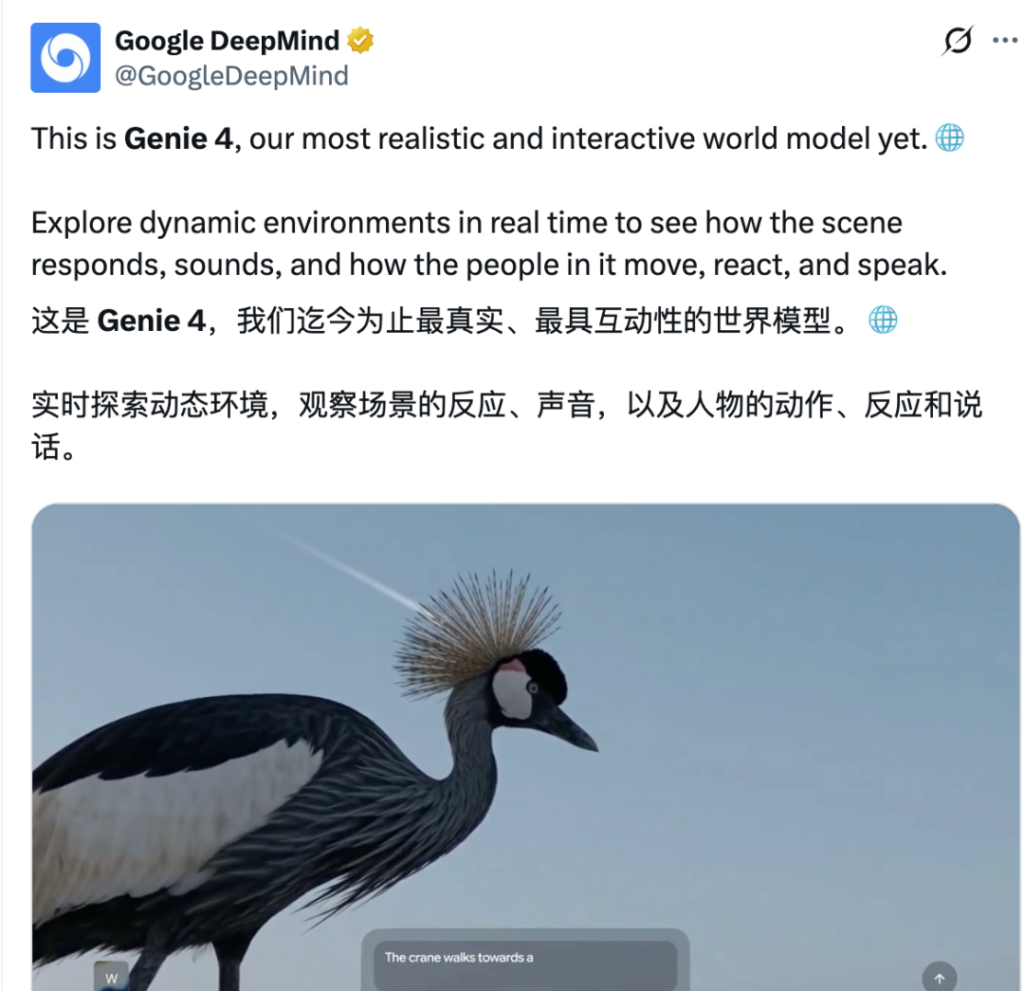
In the early hours of today, Google DeepMind officially announced Genie 4. The official positioning for it is:our most interactive world model to date.
Most importantly! It is DeepMind the first native audio‑generating real‑time world model. In the official release video, every audible sound is generated by Genie 4 itself.
In addition, Genie 4 pushes physical motion, character actions, and real‑time control another step forward.
What exactly is a world model? Let’s first look at a case study presented by Google.
The premise is just one sentence: a red-crowned crane walks across the snow, the twilight sky gradients, documentary style.
The scene shows a red-crowned crane walking in the icy snow. In the lower left corner, the WASD keys are lit, the lower right corner shows the arrow keys, and the camera stays glued to it.
Then, type a line into the input box:A meteor streaks across the sky.
A white line really slices across the heavens.
Type another line: the red-crowned crane walks toward a white piano.
An electronic keyboard appears on the snow, the crane lowers its head, leans over, and presses its beak onto the keys.
Last line: the crowned crane spreads its wings and flies.
The crowned crane opens its wings, lifts off from beside the piano, while the snowfield behind, the piano, and the meteor in the sky all remain in place.
One input, one event—each step is computed on the spot, and no shot is pre‑filmed.
Honestly, the concept of a world model has been popping up every few weeks for the past year.
Genie itself has gone through three versions so far. But this time is different—it brings the world model to life.
◽The difference from the previous version is obvious at a glance
If you want to know what makes Genie 4 so powerful, just compare it with the previous version.
Google officially released a side‑by‑side comparison, both sides generating a theater backstage.
The left side is Genie 3. The right side is Genie 4: the camera moves into a bustling backstage corridor, where actors are touching up makeup and adjusting costumes, with racks and equipment packed nearby, and curtains, mirrors, and warm light bulbs filling the space. As the camera goes in, you see not just a well‑set room, but a group of people actively at work.
Even though it’s a theater backstage, the scene generated by Genie 4 includes more characters and details, and the movements look more natural. As the camera moves in, you see not just a well‑arranged room but a group of people busy at work.
So this upgrade isn’t just about making the world look clearer:people move more naturally, scenes have sound, and objects generate appropriate changes when they collide.
First, let’s talk about the first one: sound.
◽Every world comes with its own sound
Previous generations of generated world models—like wind blowing, leaves rustling, waves crashing—had no sound at all.
Of course it’s not that Google forgot to do it; aligning sound and visuals on the same frame and keeping them coherent is much harder.
The highlight this time is that each world comes with its own ambient sounds, from the wind in the woods to the waves crashing ashore.
You can see it from a single clip in the official demo.
A platform floats in the silent middle of a lake, with a misty forest in the distance, a pale blue‑gray overcast sky, and a warm‑yellow sphere hanging in the center, while a middle‑aged man in a loose brown suit stands on it playing the saxophone.
The prompt asks the person to continue playing naturally, with subtle breathing, finger movements, and a slight body sway.
The sound section is written like this: natural lake ambient sounds, distant wind, gentle water sounds, and authentic saxophone tones;Aside from the physically present instruments in the scene, do not add extra background music.
Google wants more than justhaving sound; the sound must grow out of this world.
The other segment features a first‑person dragon rider, soaring on a black giant dragon at 140 km/h through a mountain racing track. The audio bar reads: deep wing beats, high‑altitude wind, distant volcanic rumble, and crackling fire.
Sound alone isn’t enough,Genie 4 introduces real‑time interactive dialogue.
◽Characters can engage in interactive dialogue and also respond to commands
The official calls human language the real challenge. This time it introduces real-time interactive dialogue; characters can talk to each other and also react to user actions and events in the world, all in real time.
On the other hand, the most obvious leap this time is the model’s ability to simulate humans, making movements natural, responsive to the environment, and controllable in real time.
The demo below showcases Genie 4’s capabilities.
A 1980s Japanese rural train station, a red train parked beside the platform, and a station attendant wearing a wide-brimmed hat walking ahead of the crowd.
Type a sentence in the input box: He announces the next train’s departure.
Then type another: An elderly woman rushes in carrying a suitcase.
The camera sweeps along the carriage, and a white‑haired elderly woman with a brown leather suitcase actually walks in from the edge of the frame.
Another more interesting example comes from University of Pennsylvania professor Ethan Mollick, who got early access.
He first had Genie 4 generate a city inhabited by robots and horses, then added a friendly otter character to the scene.
He makes the otter come over to ask a question; the otter then appears on screen and even starts talking.
This world is truly fascinating—characters can speak, respond, and react on the spot to user commands and events happening in the world.
The characters’ reactions feel natural, and the subsequent physical movements become even more realistic.
◽Object collisions are more natural, and changes can continue to be generated.
Earlier versions of Genie also demonstrated water, gravity, and object interactions. With Genie 4, Google aims to simulate collisions, aerodynamics, and other scenarios even more realistically.
Official demo: a whole watermelon sits on a stone platform, then a heavy marble bust crashes down, crushing the watermelon and scattering its red flesh.
It looks like just “a watermelon got smashed,” but for the model it must continue generating the post‑collision scene: the statue falls, the watermelon splits, the flesh spreads around. Every step has to connect to the previous scene.
There’s also a shot of a long pink satin drape laid among the flowers and grass. As the wind blows, the light fabric lifts and ripples across the meadow.
Now we can see that this world model can modify the world in real time, making physics and character actions more realistic.
With so many things happening at once, then who is responsible for letting the world keep playing out?
The answer is a division of labor.
◽Gemini as the director, Genie is responsible for performing the world
We can think of it as a set: Genie is the actor, Gemini is the director.
The director’s work is a chain: observe the current scene → break down the goal → plan the next step → check whether this step succeeded → adjust the plan on the fly based on changes.
Gemini 3.8 Flash is the director, acting as the guiding agent in the loop: while Genie generates the world in real time, the model observes the scene, breaks the goal into step‑by‑step actions, reviews each incoming frame, and checks whether the previous step succeeded.
If the world changes, or we issue a new command, it instantly revises the plan.
The official source attributes the reliable causality, procedural behavior, and multi‑step reasoning to this loop.
The division of labor roughly looks like this:
Genie 4 is responsible for rendering the world’s visuals and sounds.Gemini 3.8 Flash handles watching, dissecting, connecting, and checking.Gemini Omni provides the foundational appearance and behavior, anchoring the simulation to how it should look in the real world.
This hassle is aimed at solving an old problem: multi-step tasks can’t be reliably handled by pure pixel generation alone.
If a character walks to a table, reaches out, picks up a cup, and takes a sip, any misalignment in the intermediate steps breaks the whole action. Only with a language model watching can the task be completed properly.
This is also the next direction mentioned by Google itself:Combine structured reasoning about language and code with pixel‑level sensory simulation.
In their words, Gemini plans the structure and narrative timeline behind the scenes, while Genie generates the physical reality in front of you—what the world looks like, sounds like, and how it responds, drawing it stroke by stroke.
◽Testers have started playing with it, but the world model is still imperfect
The theory is explained, but what will this thing actually look like when it ends up in people’s hands?
University of Pennsylvania professor Ethan Mollick typed a line on his computer: a new‑Gothic brutalist city inhabited by robots and horses, about a minute later the city appeared. He then asked for a dragon, and a friendly otter NPC, all in real time.
His assessment: a wildly crazy experience, though not perfect.
a16z partner Justine Moore also got early access. She said this is a fully interactive world generated from an initial prompt (environment plus role), feeling like a huge leap forward, now you can prompt to change this world and interact with it, and it even includes native audio.
It’s lively, but not perfect—those four words are also written by Google on the release page.
Google admits:visual details and objects drift over time, the longer the world model runs, the more prompts change, the farther you walk in the scene, the more obvious it becomes
This world will forget.
The official model page also states that the model only supportsa few minutesof continuous interaction, not long‑term conversations.
You can’t spend an afternoon in it yet.
The current usage barrier still exists. Genie 4 is now a research preview, available only to a small group of trusted testers. Later it will roll out to Google AI Ultra subscribers in Project Genie, as well as early partners of the Gemini API and Google AI Studio, with an official waitlist already posted.
Although it’s not perfect yet and there are still barriers. But One sentence, one world. Genie 4, this time it’s truly different.
References
[1] https://deepmind.google/blog/genie-4-a-new-generation-of-world-simulation/
[2] https://blog.google/innovation-and-ai/models-and-research/google-deepmind/introducing-genie-4/
Get MirrorSpeed
Get MirrorSpeed