GPT claims a breakthrough on a millennium problem, but OpenAI released it without even understanding it.
GPT Solves the Millennium Problem with a Major Reversal! OpenAI Publishes Without Fully Understanding It…
Summary
henry posted from 凹非寺 Quantum Bit | Official Account QbitAI – What a loss! OpenAI’s Navier‑Stokes saga has turned around again… Just over a month ago, OpenAI announced it had cracked this
henry posted from 凹非寺
Quantum Bit | Official Account QbitAI
What a loss! OpenAI’s Navier‑Stokes saga has turned around again…
Just over a month ago, OpenAI announced it had solved the $1 million‑prize Millennium Problem, only to be questioned by mathematicians about the originality of the results.
At that time, everyone, including OpenAI itself, believed that the 166-page proof followed the research route proposed by two Spanish mathematicians.
However, now, as mathematicians gradually grasp the 166-page proof, an unexpected development has emerged:
The proof method ultimately adopted by OpenAI is not the so‑called “Spanish route” that everyone previously thought.
What’s even more absurd is that even OpenAI doesn’t understand what its own model research was about… and it carelessly claimed at release that it followed the “Spanish route”.
How was this discovered?
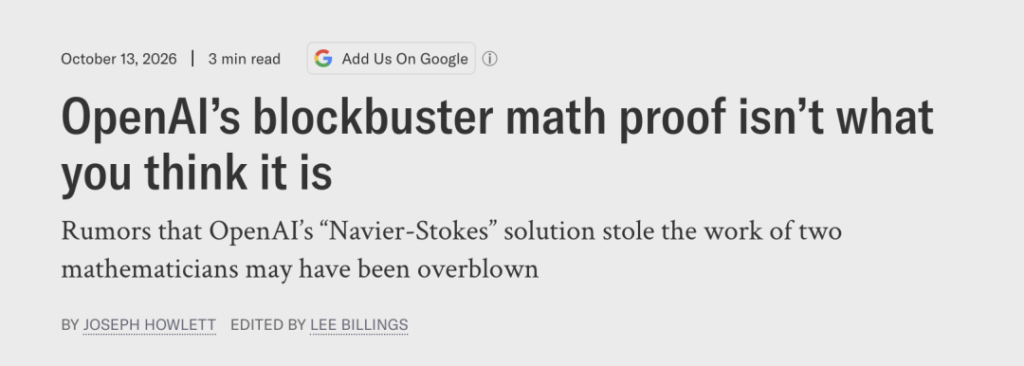
In the latest investigative report published by Scientific American, the journalist interviewed several expert teams who are studying the proof.
These experts are increasingly convinced that when OpenAI finally completed the proof, it actually used a completely different approach.
Swiss EPFL mathematician Gonzalo Cao‑Laboro said plainly:
After digging into the specifics, you’ll see that this is a different approach.
Wow, OpenAI’s own model completed the proof, but the company itself didn’t even figure out how it was done, and just rolled it out—
It’s truly end‑to‑end, and as for how it’s done, don’t worry about it!
And it’s no wonder Tao Zhexuan has objections (doge).
OpenAI’s proof didn’t take the “Spanish route” after all?
To understand this reversal, we need to briefly revisit what problem OpenAI actually solved.
Navier‑Stokes equations describe how fluids such as water, air, and the like move.
But mathematicians have never been able to prove whether an initially smooth, regular three‑dimensional fluid will remain smooth forever under the equations, or whether it might develop a singularity in finite time, causing the local flow speed to blow up to infinity.
The latter situation is mathematically called “finite‑time blowup.”
In 2000, the Clay Mathematics Institute listed it as one of the seven Millennium Prize Problems, offering a $1 million prize for a proof.
And the answer OpenAI gave in September this year was:It really will blow up.
However, what it proved is not whether a fluid can develop a singularity on its own without external forces, but rather that by constructing a special smooth external force, the fluid can be driven to blow up in finite time.
This scenario satisfies the C and D formulations announced by the Clay Mathematics Institute, but the version without external forces that mathematicians care about remains unsolved.
Both research approaches in this controversy happen to exploit the fact that the official problem statement permits external forces.
First, let’s look at the so‑called “Spanish route.”
Earlier, Spanish mathematicians Diego Córdoba and Luis Martínez‑Zoroa proposed a research method:by carefully arranging external forces, continuously driving the fluid into extreme states, ultimately causing singularities in the equations.
Subsequently, New York University mathematician Tristan Buckmaster and Anthropic employee Levent Alpöge continued the investigation, using AI models such as Claude and Codex to demonstrate that the Euler equations and related fluid equations can experience blow‑up under smooth external forces.
However, the Navier–Stokes proof announced by OpenAI also used smooth external forces. Moreover, the publication times of the two research results were close, even sparking a controversy over the ownership of the findings.
Therefore, it was commonly believed that OpenAI followed the path laid out by the Spanish mathematician and completed the final step.
But it now appears that this is not the case.
According to the latest report from Scientific American, although both methods use external forces to achieve detonation,OpenAI ultimately demonstrated that the way it constructs external forces is completely different from the Spanish approach.
In other words, both sides used the same problem conditions but employed different mathematical methods.
However, there is another detail worth noting. OpenAI initially used a smaller team of agents to complete an intermediate proof. Some experts believe that this early result may indeed have followed the Spanish approach.
But later, when the system scaled up to about 10,000 agents, it seemed that completing the final proof would require a different approach.
Therefore, the method for the final proof is different, which does not mean that the previous research ideas were completely ineffective.
As for whether the model was exposed to other researchers’ data during training, OpenAI has publicly denied it, but external parties still cannot independently verify.
Camillo De Lellis, a mathematician at Princeton’s Institute for Advanced Study, also believes that this controversy is unlikely to yield a clear factual conclusion.
OpenAI also does not truly understand the proof provided by its model
Compared with the previous disputes over authorship, this *Scientific American* report also reveals a more noteworthy phenomenon:
AI can now produce mathematical proofs that even developers struggle to understand.
When the results were announced on September 8, OpenAI executives repeatedly claimed that the proof followed the research path of a Spanish mathematician. It was only more than a month later, after external mathematicians examined it in depth, that they discovered the two actually used different methods.
*Scientific American* therefore offers a straightforward judgment:OpenAI does not truly understand the proof generated by its model.
Moreover, to this day, the mathematical community has not fully grasped it either.
This sounds odd, but OpenAI did verify the proof.
In addition to the 166‑page paper, the system also generated the corresponding Lean formalization code, allowing step‑by‑step verification of the mathematical derivation.
The issue is that a proof may be logically valid, but that is clearly different from a human truly understanding the underlying mathematical ideas.
Lean can help check the derivation, but it won’t automatically tell mathematicians why the method works, how it relates to existing research, or whether it can be generalized to other problems.
Therefore, even with formal code, experts still need to use other large language models to reorganize and comprehend the proof.
And just as mathematicians haven’t finished tackling this problem, OpenAI has once again released722 mathematical manuscripts, covering 372 sets of research results.
It includes a series of major mathematical problems such as the Hodge conjecture, the quasi‑Riemann hypothesis, the BSD conjecture, and others.
Of course, the verification progress of these results varies, and some have not yet been formalized in Lean.
But mathematicians are already starting to fall behind. For example, mathematicians like Terence Tao have repeatedly said that AI generates new proofs at a speed far exceeding the rate at which humans can understand and digest them.
This Navier–Stokes reversal precisely exposes that paradox.In the past, mathematicians usually first understood the problem, developed methods, and then gradually wrote the proof. Now, AI may hand over the proof first, and humans will later go back to study how it was done.
Because you can’t, that’s why you do—it’s a philosophical statement.
I just realized! It turns out this sentence is about AI solving math problems!
Reference link
[1]https://www.scientificamerican.com/article/openais-blockbuster-navier-stokes-proof-isnt-what-we-thought-it-was/
One-click triple action“Like”“Share”“Heart”
Feel free to leave your thoughts in the comments!
— End —
🌟 Light Up the Star 🌟
Get MirrorSpeed