Jensen Huang on Chinese AI Firms: The Scarcer the Compute, the More They Push Architecture to the Limit
Jensen Huang on Chinese AI Companies: The Scarcer the Compute, the More They Are Forced to Optimize Their Architecture to the Extreme
Summary
Editor | Dongmei “Hey, everyone quiet! TSMC’s Morris Chang is on the phone!” When this call came in, employees outside Jensen Huang’s office were playing the first‑generation PlayStation, with laughter and shouts blending together. And he had already been contacting TSMC
“Hey, everyone, quiet down! Zhang Zhongmou is on the phone!”
When the call came in, employees outside Jensen Huang’s office were playing the first‑generation PlayStation, a mix of laughter and shouts filling the air. He had been trying to reach TSMC for a long time: flipping through the yellow pages, looking up numbers, repeatedly dialing the U.S. office, leaving voicemails, yet never getting a callback. Finally, he wrote a long letter to Zhang Zhongmou.
One evening, a voice on the other end said, “This is Zhang Zhongmou from TSMC.”
Years later, Jensen still remembers the excitement: “Maybe we won’t have to go bankrupt.”
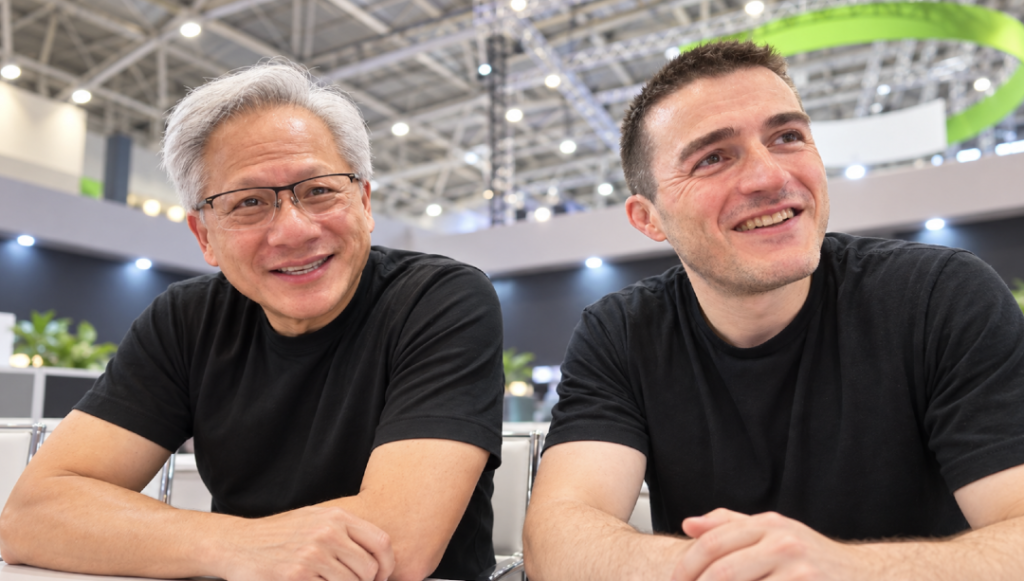
During this long walk‑talk‑eat conversation with Lex Fridman, Jensen Huang recalled how Nvidia first connected with TSMC and explained an intriguing choice: why he ultimately selected TSMC. One detail that moved him was that Jensen Zhang would plainly tell him, “We can’t do this.” In Huang’s view, those answers reflect a commitment to business boundaries, integrity, and long‑term relationships. Chip manufacturing is full of unknowns, and you can’t pre‑agree on every detail—“What you really choose isn’t what you buy, but who you build with.”
This collaborative mindset also informs his view of the current AI competition.
When discussing Chinese AI companies that Lex has visited, Huang believes the shortage of compute power is forcing them to design more efficient architectures. “They are under extremely, extremely tight constraints,” yet they continue to raise capital, push their businesses forward, and “desperately get things done.”
These serious topics are interwoven between visiting exhibitions, night markets, and breakfast. Facing the eyes of the whole world, he admits that he still gets nervous every time he speaks publicly; back at the night market, he recalls how his family couldn’t afford restaurant meals when he was a child, and an incident where he cut his face and his father carried him to the hospital.
From a phone call that could change an entrepreneurial fate to a breakfast he was reluctant to put down, this conversation showcases Jensen Huang’s concrete attitudes toward technology, relationships, and life. What he repeatedly emphasizes is: let others know you want them to succeed, and give partners the incentive to keep operating and growing.
Below is a curated selection of this dialogue, with some repetitive small talk and everyday conversation fragments removed.
Lex: Are you nervous before the keynote starts? The whole world is watching you.
Jensen Huang: I was extremely nervous at the time. But I always get nervous. Every time I speak publicly, regardless of the occasion, I get nervous.
Lex: Does this nervousness keep you sharp?
Jensen Huang: Yes. I don’t take any of this for granted. I want to do my best. And often everything only comes together at the last minute, leaving little time to rehearse, and we indeed didn’t rehearse. So I’m not exactly sure what I’ll say when the time comes. I don’t even have a teleprompter.
If in the coming years we are to build and sell computing devices worth tens of trillions of dollars, the entire Taiwan must be involved, and the whole ecosystem must participate.
Every company here will need to invest hundreds of billions of dollars over the next few years. So they first need to understand this, be inspired, be willing to join in, and also realize what they can gain from it.
Therefore, in the keynote, I try to explain these points as concisely as possible.
Lex: By the way, Jensen Huang is especially warm to me, so warm that I feel a bit undeserving. But he treats everyone like that, the same to each person.
You also didn’t forget to look after gamers, showcasing gaming laptops and games.
Jensen Huang: I love gamers. That’s where we started. Don’t forget your roots. No matter how high you go, never lift your feet off the ground.
Lex: Gamers are the most passionate group in the world. Some of the happiest moments in my life are playing video games with NVIDIA hardware. Look here, look here.
Jensen Huang: Look at these people.
Lex: It’s unbelievable. It’s the honor of my life. Thank you for giving me this experience. I’m honored to see an engineer welcomed like a rock star, truly inspiring. Engineers build this world, yet they often don’t receive the love and recognition they deserve.
You inspire tens of thousands, even millions of kids, making them think: “Okay, I want to become an engineer too.”
Jensen Huang: Exactly, that’s it.
Lex:How was your trip to mainland China this time?
Jensen Huang: Oh my god, it was total chaos. Did you see those scenes? I went to downtown Beijing, and the scene instantly boiled over, completely out of control.
Lex: You went to eat, right?
Jensen Huang: I ate everything at every restaurant. Then I became the “spokesperson” for each restaurant.
They moved so fast, maybe just half an hour, and I was already online, becoming the promotional banner for every restaurant. Tomorrow we’ll have an especially great lunch, it will definitely surprise you. Eating zongzi, wrapped in leaves. The zongzi at this place can be called a masterpiece.
Lex: Speaking of Computex, thanks for suggesting I come. I think I’ve never experienced a scene like this, with excellent engineers everywhere.
Jensen Huang: This is the place where computers for the whole world are made. And the people here are very humble.
Lex: This is also something I felt during my travels in mainland China. I interviewed many people in the AI field, and after coming to Taiwan, I felt the same: humility, always very humble. These young engineers are changing the world, yet show no arrogance at all.
Lex:Why do so many outstanding companies emerge across all layers of the technology ecosystem, especially in the hardware infrastructure sector? What’s your take on this?
Jensen Huang: It goes back to a man named Li Guoding. He helped drive local science‑technology and industrial policies, carrying a related mission. In the 1950s, he already had a vision: to bring science, technology, and tech manufacturing to Taiwan.
It was his vision that led Morris Chang to come to Taiwan.
Note: On January 28, 1910, Li Guoding was born into a well‑off family at Hanxi Gate in Nanjing. In 1926, he entered the Mathematics Department of Southeast University, soon transferring to the Physics Department. In September 1934, he was awarded a prestigious Sino‑British scholarship and went to study at the University of Cambridge in the United Kingdom, joining the Cavendish Laboratory under the world‑renowned physicist and Nobel laureate Professor Rutherford, where he conducted research on radioactive particle physics. He is also hailed as the “Father of Taiwan’s Information Industry.”
There were some events before this, but I’m not clear on the exact chronological order. The wafer fab that Philips spun off later became TSMC, and the semiconductor manufacturing equipment business it spun off later became ASML. It’s amazing to think that all of these are linked to Philips.
Philips is a consumer electronics company, which can be likened to Europe’s General Electric. You should recall that General Electric also did semiconductor manufacturing in its early years and was involved in various advanced manufacturing businesses. In short, Li Guoding managed to attract Philips to Taiwan, and that was the real starting point.
Lex: It was like planting a seed.
Jensen Huang: Right. Later, UMC and TSMC were both looking for chips suitable for manufacturing, and the PC revolution happened just at that time, the timing was perfect.
IBM made a visionary decision at the time by opening the specifications for what became known as IBM‑compatible chipset standards. Essentially, this covered the chips that make up the motherboard, including the cache controller, memory controller, interrupt controller, as well as the VGA controller and graphics controller. The relevant specifications were defined and made public.
Consequently, clever engineers designed chipsets based on those specifications and handed them over to TSMC and UMC for manufacturing. This marked the beginning of the PC industry’s rapid growth.
Initially, companies like Compaq and IBM were making PCs. Later, because Taiwan supplied PC chipsets, a wide variety of companies could enter the market, including a young man named Michael Dell.
He bought motherboards from Taiwan, assembled them into PCs, and obtained operating system licenses from Microsoft, thus becoming a PC manufacturer.
The entire industry cycle is built this way. Michael’s relationship with Taiwan can be traced back a long time ago.
Lex:This also has to do with culture. A very friendly lady told me she grew up in Taiwan. She said, “When I was still a little girl, before I could spell Gucci, I could already spell CoWoS.”
I think that sentence is clever and also shows the status of engineering technology in the local culture—what kinds of things are considered cool.
Jensen Huang:That’s right, CoWoS.
Lex:So, thanks for making engineering cool again, Jensen.
Jensen Huang:Yeah, we made technology cool again.
Lex:So does Nvidia now have many local teams in Taiwan?
Jensen Huang:The local team is about a thousand people. It includes supply chain, a large amount of systems engineering work, as well as operations engineering, and engineers in wafer manufacturing, packaging, and testing.
Lex:So, they’re all engineers doing hardcore hardware work, right?
Jensen Huang:Yes. We’re planning to build a building that looks a lot like the one you visited before, almost a replica. We need to finalize the site here and acquire a plot of land first. That building can accommodate four thousand people, so we’ll hire another three thousand. I really like this place, and I also love the night market here—it’s famous for a reason. My parents love the food here; we used to come to the night market all the time.
When we were kids, saying “going out to eat” meant coming to places like this, not going to a restaurant. Our family didn’t have much money, so we would wander the night market and sit at these tables to eat.
One time, I needed to use the restroom, so I walked away on my own. I approached a chef to ask if there was a bathroom nearby. He was wiping his knife, and my face happened to be right next to it. The knife slipped and cut a line across my face.
I was five then, or more precisely, almost five. My dad picked me up and ran to take me to the hospital.
Nevertheless, I have always loved night markets ever since, and I hold beautiful memories of this place. I love everything about it and the people here.
Everyone is working hard to make a living, and despite the exhausting work, they still want to share something with you. They don’t have much money. The profit from a single item may be just a tiny amount. They give all the profit to me simply to express goodwill.
This is the warmth of Taiwanese hospitality. Moreover, watching them create things and showcase their craftsmanship is a pleasure in itself.
Jensen Huang:Did you go to Shanghai?
Lex:Yes, I went and visited MiniMax and a few other AI companies.
Jensen Huang: Those companies are impressive.
Lex:Then I went to Hangzhou and visited Yushu. The people working on robots are also very humble. There are many robot companies there. Do you know what those AI companies keep saying? Everyone says: “We need more compute power.”
Jensen Huang: Right. But to some extent, precisely because of the lack of compute power, it forced them to come up with those outstanding, highly efficient architectures.
Lex: Right, exactly.
Jensen Huang: Constraints can be said to be the mother of invention. Scarcity of resources spurs innovation.
Lex: Right.
Jensen Huang:They are under extremely, extremely heavy constraints, yet they are still raising capital, still moving forward, right? They are just scrambling to get things done.
Lex:You’re basically like the Beatles of the 1960s. And after going through all this, you remain humble. Jensen, your life is truly incredible. When millions look up to you and you bear such responsibility, do you sometimes feel a lot of pressure?
Jensen Huang:No, because I don’t see it that way. People have always been good to me.
Lex:Even when you had nothing.
Jensen Huang: Right. I’ve always treated others well, been polite, and have always hoped they could succeed and be happy.
When I was in school, I always hoped other kids would do well too. I was also happy to share my assignments with everyone.
I enjoy seeing others succeed, including peers working at other companies.
Lex:The way this world works is fascinating. When you sincerely cheer for others and wish them success, somehow you end up becoming more successful yourself.
黄仁勋:For example, all 43,000 NVIDIA employees hope for my success. That’s really the case, do you get what I mean?
Lex:And you also wish each of them success. This creates a ripple effect that keeps spreading outward.
黄仁勋:Yes, exactly. Kindness is not a zero‑sum game; it isn’t bound by physical laws.
Lex:Just off‑topic, Jensen, I heard your fried rice is especially good.
黄仁勋:Yes. I watch AI videos, and also fried‑rice videos. I also watch some videos of dogs, pandas, or otters to relax.
Lex:Can you elaborate on your views about export controls? You have consistently argued that export controls are not a winning strategy for the United States. Could you explain the most persuasive arguments from both the supporting and opposing perspectives?
Jensen Huang:Let me start with one side’s reasoning; it’s actually quite simple.
If something is valuable and useful, and can multiply capability—such as rare earths, computer technology—broadly speaking, any technology can amplify capability, and you could also say knowledge and intellectual property have the same effect—then, when we possess these resources and deny others access, we can enhance our own position while weakening theirs.
Lex: In other words, by holding a certain resource in our own hands, we gain a competitive advantage.
Jensen Huang: Right, don’t let it fall into others’ hands. For physical resources, this logic isn’t without merit. Think of refined rare earths, or bullets, bombs. As long as the other party or participants can’t produce these things themselves, this line of reasoning usually holds some weight.
But the counterargument is: if our goal is long‑term national security and sustained domestic peace and harmony, then prosperity is the best way to achieve those goals.
The safest country in the world is the wealthiest. The United States has such a powerful military because we possess enormous wealth. This wealth is born together with outstanding technology, and technology and wealth form a mutually reinforcing flywheel. Ultimately, what you should strive to strengthen is this flywheel.
So the question is: are you pursuing preventing others from acquiring this technology, or making this flywheel spin better?
My view is that a more comprehensive long‑term strategy is to keep this flywheel running continuously. To achieve that, you must simultaneously have technological leadership and wealth.
This flywheel is extremely important. Its development logic is no different from that of many computing and platform technologies. In these fields, the foundation of wealth is the business you do with customers and the user base that has already deployed and uses your technology.
A solid user base and customer usage generate more technical demands, which in turn create more wealth, allowing you to scale technology investment and size faster than others.
Technological leadership brings economic leadership, and economic leadership supports technological leadership, further driving economic superiority. This cycle enables enterprises and nations to maintain a lasting advantage. Therefore, instead of focusing only on limited, tangible things that cannot generate positive feedback on their own, I advocate extreme caution and selectivity when imposing restrictions on acquiring certain technologies.
In addition, we must maintain a healthy cycle between technology and the economy. A balance between the two is required, and I believe we should do everything possible to avoid conflict.
We should compete; competition is indispensable. But we should also do everything possible to avoid conflict. So the question becomes: when both sides have a competitive relationship, some strategies lead that relationship toward conflict, while other strategies can help prevent conflict.
Lex: We previously talked about interdependence. For example, in the AI tech stack, everyone uses the same hardware, the same software, studies at each other’s universities, builds friendships, and conducts research collaborations. Different companies engage in friendly competition, but fundamentally, this is still a form of cooperation. The more such connections exist, the harder it is to separate the peoples of two nations, and thus the less likely a global conflict will arise.
Jensen Huang: The harder it is to decouple, the harder it is for conflict to occur. I agree with that. Your description just now is spot on, and there’s one more point that helps understand this issue: In fact, AI is not just a model, but an entire tech stack, with each layer supporting AI. Without energy, AI cannot exist.
Jensen Huang: We know that some countries and regions have a strong advantage and capability in energy, while others do not. So, looking at the entire tech stack, you’ll find that the leaders differ at each layer.
Lex:I personally think that the United States has the most innovative people, capable of proposing the craziest, boldest, most imaginative, and ambitious ideas. In this regard, I believe the US is at the top of the world.
Jensen Huang: You’re right. Various factors have long interacted and accumulated, forming this powerful innovative capability. One huge advantage we have is that our flywheel is also the strongest. One reason is that English can reach the vast majority of places in the world.
If you are a US company, based on the US tech stack and using US standards to develop products, then your product is relatively easy to deploy globally.
China does not have the same conditions. Therefore, we have a global flywheel advantage. Technology without customers is useless.
Lex: Yes, you must leverage this advantage, not take it for granted. English as a language has global influence. The United States can build an ecosystem that people around the world use, which is a tangible advantage. So, if you isolate yourself from the rest of the world for some benefits that isolationism might bring, you will also pay a real price.
黄仁勋: Exactly.
Lex: You will lose this advantage.
Jensen Huang: Exactly. That’s also why I think: on one hand, we want to keep advanced technology in our own hands; on the other hand, we need that flywheel. Every word you just said hit the key point. We want the platform to cover as broad a market as possible, because that drives the flywheel, creates wealth, and that wealth gives us the R&D capability needed for continuous innovation.
But this flywheel is also very fragile.
You can see that once the flywheel gets going, growth takes on some exponential characteristics. A platform may have been built for ten, twenty years—in our case, thirty years—and then suddenly cross a tipping point, as if it becomes ubiquitous overnight.
But on the other hand, this flywheel can also stop and may slow down quickly. So the issue with export controls lies in how to achieve this balance. Every country has the right to decide how to use the technologies, capabilities, assets, and resources it creates that constitute its national advantage. It is a right owned by the state.
At the same time, we must ensure that the United States’ valuable national assets—its technology sector being one of them—can maintain the largest possible flywheel and the broadest platform coverage, thereby sustaining a virtuous cycle of economic leadership and technological leadership.
This is the balance that needs to be struck.
Jensen Huang: In 1996, the PC revolution was just taking off. The PC chipset industry also emerged during that period, and the term “chipset industry” began to appear, giving rise to the fabless semiconductor sector.
At that time, Cirrus Logic was a giant, along with S3 and the smaller Weitek. Western Digital had also previously made graphics chips.
I have competed with all kinds of companies. At that time, the wafer foundries were all very strong, and Japanese firms were entering the wafer foundry business one after another. U.S. foundries were few, because Intel mainly focused on manufacturing its own products, AMD was also making its own products, and TI, Texas Instruments, was the same.
So chip companies from other countries entered the foundry business, hoping to serve this emerging chipset industry. SGS‑Thomson was also doing wafer foundry at the time. We approached them first, but they were unwilling to take our business.
Back then, foundry capacity was extremely limited. If you wanted to use a company’s foundry capacity, you had to license your technology to them. That was one of the conditions.
This reminds me of early agreements signed by some AI companies: if you want compute power, you have to hand over something to license.
In our era, we had to license our intellectual property to contract manufacturers. Later, I heard about Taiwan’s TSMC, and at that time also UMC. They didn’t have such additional conditions.
Of course, they didn’t have much money themselves either and were struggling to operate. I remember TSMC was roughly a $300 million company back then. Three hundred million dollars—at that time it sounded to me almost like three hundred billion dollars.
In fact, it was still a very small company.
I heard about TSMC and also about Morris Chang, so I tried to call their U.S. office. Back then I found phone numbers through the Yellow Pages. I found a number for TSMC, called it, and got an answering machine.
You think, you call a company, and the person who answers the phone is actually a recording. I left my name and phone number, and gave a brief introduction about Nvidia: we are a newly founded startup developing computer graphics chips…
I was hoping someone would call me back. I called several times, but no one returned the call, not even once.
Finally, I wrote a letter to Zhang Zhongmou, a very long letter, and sent it to him. Then, for a long period, there was no news.
Until one day, around six or six-thirty in the evening, someone called and said, “I am Zhang Zhongmou from TSMC.”
At that time, everyone outside my office was playing video games. They were laughing and shouting outside. I remember we were all playing the first-generation PlayStation. I shouted, “Hey, everyone be quiet! Zhang Zhongmou is on the phone!”
He actually called me back. I was thrilled that the founder of a company personally returned the call, because it meant we might not have to go bankrupt.
We chatted for a while, and he invited me to Taiwan, China. So I returned to my hometown for the first time.
Lex: That was the first time you went back after being away for many years?
Jensen Huang:Yes, it’s my first return in thirty years.
Lex:That was the beginning of everything. Not just your partnership, but a starting point for the entire industry’s development.
Jensen Huang: TSMC and its main competitor UMC are literally just a street apart. It’s actually a road within the park, basically the distance between this building and the other one. I went to UMC first, then to TSMC, in that order. Both companies were very friendly, and I’m glad they were willing to talk with us.
Jensen Huang: People often ask me why we ultimately chose TSMC instead of UMC?
Actually, I like both companies equally; they are both excellent. But TSMC has one thing that especially impressed me: when I make many requests, Morris Chang would say, “We can’t do that.”
I asked again, “What about that matter?” He would still say, “We can’t do that either.” There are many things they simply can’t do.
He has a set of management philosophies for his company, as well as core values he holds in high regard. He constantly talks about corporate governance, integrity, partnerships, and long‑term thinking. Those are the only topics he discusses, never anything else.
He once said, “Jensen, if we cooperate, I assure you we will do everything we can and overcome any obstacles for you.”
For the past thirty years, they have been living up to that promise.
Lex: He kept his promise.
Jensen Huang: The core values of this company are incredibly strong, and they’ve been there from the very beginning. You have to go through both good times and bad together, and the future will bring many unpredictable events. That’s because you are jointly creating a chip. Wafer foundry isn’t about buying a ready-made product off the shelf; you have to build the chip together, and building a chip is a very difficult task.
Therefore, you can’t possibly know every detail in advance, nor can you make all decisions beforehand. What you truly choose is not what to buy, but who to do it with.
I made a wise choice on this matter at the time. The focus isn’t on what to buy, but on selecting who to partner with. To this day, I still uphold this attitude and philosophy of choosing partners.
Lex: One remarkable thing about the tech industry is that you not only have to choose who to work with, but also commit to working with them for decades. It’s a loyalty to the relationship.
Jensen Huang: Right. We’ve been working with TSMC for thirty years. Often, once we understand each other, we just say, “Okay, let’s start.” That’s how it is—thirty years.
Why is this considered wisdom? Because how can you possibly spell out every unknown scenario in a partnership in advance? It’s like trying to draft a watertight prenuptial agreement. The problem is, the more you try to specify everything, the more fragile the relationship may become.
So, I choose to keep some flexibility and explore forward together. We’ll use a term called “rough justice,” which means roughly fair in the long run. Sometimes they get a bit more, sometimes I get a bit more.
Sometimes the outcome satisfies me more; other times, it satisfies them more. But over time, it balances out. Now, can you understand why TSMC has become such a legendary company?
Lex: Completely understand.
Jensen Huang: I don’t know if everyone works with them this way. If many people do, I’m not surprised. But I prefer to collaborate in this manner. Look at our employees; I haven’t tied them here with airtight contracts. We chose each other and chose to work together.
It’s impossible for every instance to be perfectly fair; sometimes it leans slightly toward one side. But in the long run, this overall fairness can be achieved.
Lex: This also makes both parties more willing to take responsibility and do a good job, because you both voluntarily chose to cooperate.
Jensen Huang: They need to know that you want them to succeed. All of my employees know that I want them to succeed. TSMC knows it too. Every day, TSMC knows that I want them to succeed.
This is reflected in our partnerships, in our business interactions, and in my ongoing effort to help them become a better company. And they have been doing the same for me. You’re not just buying something; you’re deciding to create something together.
Our company is built on TSMC’s platform, and also on Taiwan’s industrial ecosystem. So these relationships are crucial. If you make a decision out of a momentary displeasure, or always try to force everyone to bid for your orders, or only let yourself profit while others earn nothing—people here will remember that, and everyone will know about it.
So, always leave some benefit for your partners. Always consider whether others can sustain their business and achieve success. Last year, the stock price of my entire supply chain rose 300%, while our own stock price barely moved. Seeing our supply‑chain partners achieve such results is the most satisfying thing for me.
Of course, I’m not saying I’m happy that our own stock didn’t rise. I’m pleased that our platform is now large enough to let all partners grow together and keep pace with its development. That’s a good thing.
Original video link:
https://www.youtube.com/watch?app=desktop&v=FGCP2F_7rQk
Disclaimer: This article is compiled by AI Frontline, does not represent the platform’s views, nor constitute investment advice, and may not be reproduced without permission.
Conference Recommendations
The QCon Global Software Development Conference·2026 (Shanghai edition) will be held on October 22–24. This year’s conference focuses on engineering practices in the Harness AI era, from “building AI” to “harnessing AI”, covering hot technology directions such as AI Native architecture, Agent Runtime, AI Infra, Agent security and observability, Loop Engineering, embodied intelligence and world models. We invite the global tech community and frontline industry practitioners to share the most valuable engineering experiences of the AI Native era. For more details, scan the QR code or contact ticket manager 18514549229 for inquiries.
Are you also “watching” this? 👇
Get MirrorSpeed