Scientists Turn Control into “Mechanical Intelligence,” Enabling Robots to Use Two Air Tubes for Three Swimming Modes
Scientists Convert Control to “Mechanical Intelligence”, Enabling Robots to Use Two Air Tubes to Achieve Three Swimming Modes
Content Summary
In a laboratory at North Carolina State University (NCSU), a palm‑sized soft robot weighing less than 15 g is floating in water. It carries no micro‑computer or sensors, and no real‑time control algorithm is introduced, only
In a laboratory at North Carolina State University (NCSU), a palm‑sized soft robot weighing less than 15 g is floating in water. It carries no micro‑computer or sensors, and no real‑time control algorithm is employed; driven only by two air tubes, it can flexibly switch among jellyfish, fish, and rotor modes, performing ascent, hovering, turning, and other motions.
This robotic system comes from Professor Jie Yin’s team in the Department of Mechanical and Aerospace Engineering at NCSU.Inspired by the feather star, they created a bistable, dual‑actuated robot capable of three‑dimensional motion.The related research was published on October 7 local time in Science Advances.
The team calls the design philosophy behind the system “mechanical intelligence”: shifting control tasks that would normally be handled by algorithms to the coupling of materials, geometry, and structure.
(Source: Science Advances)
The ingenious “four‑ounce lever” mechanical design
Over the past decade or so, soft underwater robots have evolved into a variety of shapes, but most of them can only achieve a single mode of motion, with their range of movement confined to a two‑dimensional plane: they can move forward and backward, ascend and descend, but cannot turn.
To achieve three‑dimensional maneuvering underwater, independent propulsion systems must be equipped for each of the three axes. In 2018, the MIT Computer Science and Artificial Intelligence Laboratory (MIT CSAIL) introduced a soft underwater robot fish named SoFi, which uses six independent drive inputs to control tail fin oscillation, buoyancy adjustment, and pitch‑wing control. Combined with a hydraulic pump, onboard lithium battery, and acoustic remote‑control module, it can achieve three‑dimensional autonomous swimming at depths of up to 18 meters in Fiji’s coral reef waters.
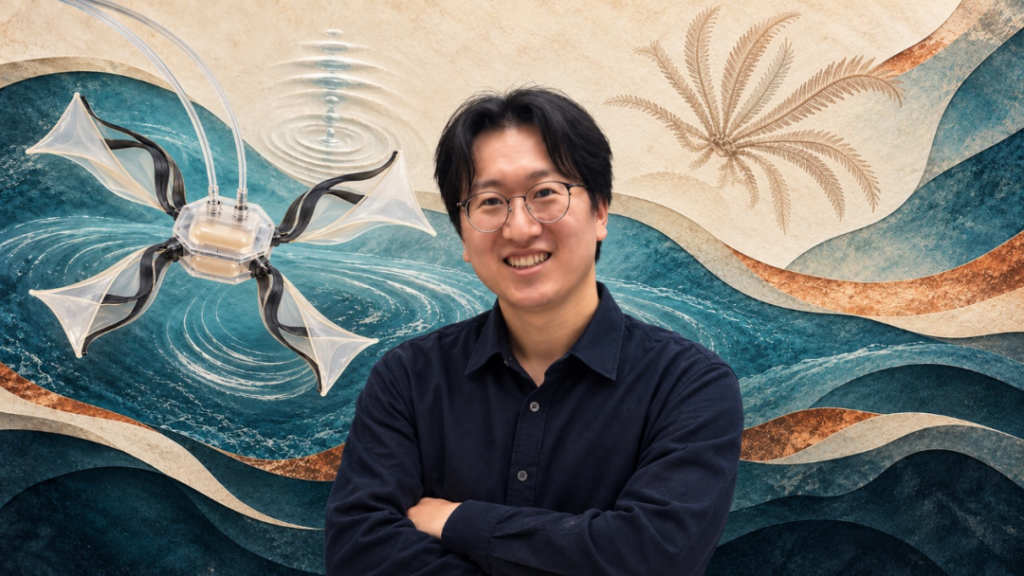
In this latest work, Yin Jie’s team took a different approach, dramatically simplifying the architecture of soft robots. Inspired by the morphology of the sea feather star, they designed a central octagonal frame with four flexible triangular arms attached.Inside the frame, the team used ultra‑soft silicone to create flat pneumatic bladders that serve as dual‑channel pneumatic actuators. The entire robot is 55 mm long and weighs only 14.5 g.
On the frame, the researchers deployed two clever mechanical structures. The first is a “monostable” design for the flexible arms. In everyday life, the most common monostable component is a spring door: you must apply force to open it, but it snaps back automatically when released. The team released stored energy by locally cutting a pre‑bent strip structure and then used heat treatment to relieve residual stress. With a single inflation actuation, each arm can complete a full “down‑stroke‑rebound” cycle. The flip occurs in about 26 ms, with the elastic energy instantly converted to kinetic energy, producing thrust far greater than that from slow bending.
Another design feature is the central frame of the bistable structure. It serves as the mechanical coupling hub for the four arms. Two pneumatic channels are symmetrically placed on either side of the frame, and when they inflate and deflate with different timing, the motion trajectories of the four arms change accordingly.
When both channels inflate and deflate simultaneously, the frame bends symmetrically, the four arms strike down together and then rebound in sync, generating a vertical pulsating motion—this is the “Jelly mode,” used for ascent, descent, and hovering. Inflating only one channel causes the arms on that side to make large strokes while the opposite side remains still; the two side arms produce auxiliary swings, and the robot turns and swims in one direction like a fish—this is the “Fish mode.” With the two channels inflating alternately at a 180° phase difference, the robot switches to “Rotor mode”: adjacent arms on opposite sides strike in turn, causing the robot to spiral upward in place. The rotation direction (clockwise or counter‑clockwise) can also be adjusted by the chirality of the bonded strip structure.
The superior performance validates the advanced nature of this design: In jellyfish mode, the robot achieves a maximum ascent speed of 1.64 body lengths per second and a minimum cost of transport (CoT) of 17.6, both outperforming comparable jellyfish‑inspired soft robots; in rotor mode, the maximum rotation speed is about 90 degrees per second.
The three modes can switch continuously and smoothly; the robot can follow a П‑shaped trajectory to perform a combined ascent‑hover‑turn‑descent maneuver, and after a rotor‑mode spin‑reorientation it can seamlessly transition to straight swimming in fish mode, achieving true three‑dimensional maneuverability.
The team also demonstrated several application scenarios: a soft magnet mounted on the robot’s underside can collect rusted screws from the seabed, and with a small hook it can retrieve plastic waste individually or cooperatively; equipped with a 3.5 mm diameter micro‑camera, it can crawl into transparent pipes to capture underwater footage.
(Source: Science Advances)
Where do biomimetic targets come from?
As the biomimetic target of this study, the sea feather star is an echinoderm with feather‑like flexible arms that can achieve jellyfish‑like vertical pulsed ascent, stationary hovering, horizontal propulsion, and three‑dimensional directional adjustment through coordinated multi‑arm movements without changing its body shape.
These features are the main reasons the team selected it as a prototype, but the first author of this research, Dr. Qing Haitao, told DeepTech that their approach was not to first spot an interesting‑looking organism and then try to copy it; “Instead, we start from the engineering problem: What capability is currently most lacking in soft underwater robots? Which organisms in nature have already solved this problem with relatively simple body structures? Finally, we extract the mechanical mechanisms that can truly be translated into engineering design.”
Working backwards from this, the biggest shortcoming of soft underwater robots so far has been multimodal and three‑dimensional motion, and the mechanical principles behind the sea feather star happen to provide a structure that can be replicated.
(Source: Science Advances)
Real sea feather stars have more than ten arms, complex feather‑like branches, and fine neuromuscular control. Replicating each of these on a robot would require more actuators, tubing, and control channels, which would defeat the original intent.
Therefore, the team abandoned details that only increase replication fidelity without enhancing engineering capability. They retained four radial flexible appendages to form the minimal viable engineering unit; the four arms are arranged along two orthogonal directions, allowing coordinated flapping; and they use two pneumatic channels to achieve multimodal propulsion.
Qing Haitao added, “The central octagonal frame is not solely to resemble the Haiyu star in appearance; it is the result of a co‑design of structure and actuation: it distributes the deformation induced by pneumatics across the four arms, while elastic coupling and pre‑stored energy coordinate the arms’ sudden movements and rebounds. It is both the robot’s body and a mechanical ‘coordinator.’”
Mechanical Intelligence: Letting the Body Share Control
When discussing the design philosophy behind the Haiyu Star robot, Qing Haitao said that “mechanical intelligence” is the team’s consistent concept, which means embedding part of the work that would normally require sensing, computing, and control directly into the robot’s structure, achieving the most functions with the fewest actuators.
This idea dates back to 2022. At that time, Yin Jie’s team reported a novel butterfly‑stroke robot that used the flipping characteristic of a bistable structure to solve the problems of slow response, limited stroke amplitude, and insufficient thrust of soft actuators, converting slow pneumatic input into rapid, large‑amplitude wing flaps, achieving a swimming speed of 3.74 body lengths per second. However, each wing required two independent actuations to complete a full stroke, and the motion trajectory was confined to a two‑dimensional plane.
(Source: Science Advances)
In December 2024, Qing Haitao, as first author, Manta‑ray‑inspired robot was published in Science Advances. This time, the team upgraded the bistable mechanism to a monostable one: inflating drives the wing to flip downward, and the structure automatically snaps back when deflated. A complete flapping cycle requires only a single actuation input.
At the same time, the elastic recoil of the monostable design enables the robot to swim on the surface and also maneuver underwater. This robot broke the speed record for soft swimming robots, reaching 6.8 body lengths per second, but it remains confined to a two‑dimensional plane.
The Haiyu Star robot represents the team’s third evolution on the “mechanical intelligence” track, using geometric asymmetry, elastic coupling, and drive-phase modulation to organize two pneumatic inputs into three swimming modes, enabling movement in three‑dimensional space.
However, where are the boundaries of mechanical intelligence? This was also feedback the paper received during peer review.
Qing Haitao explained that this key question prompted them to clarify that mechanical intelligence is not about stacking more coupled components. Achieving multimodal swimming capability with fewer inputs is the result of a series of precise designs. The structure’s response to inputs requires no complex computation, no software commands, and exhibits no noticeable control latency.
Regarding the limitations of mechanical intelligence, Qing Haitao admits that once a structure is fabricated, its behavior is often confined to specific tasks, and its reprogramming and cross‑scenario adaptability are not as good as electronic control systems; material performance degradation, manufacturing errors, load variations, and other factors can cause the preset mechanical response to deviate.
In addition, the current robot still operates under open‑loop control: the operator manually sets the inflation/deflation frequency and phase of the pneumatic channels, lacking sensors and real‑time decision algorithms, which limits its adaptability in complex environments.
A concrete manifestation is that when switching from rotor mode to fish mode, the residual angular momentum generated in the previous rotation stage affects directional swimming, making precise direction control difficult.
Building on this, adding a large number of sensors and controllers can indeed enhance a robot’s ability to perceive depth, posture, flow speed, and obstacles, and use closed‑loop control to correct motion in real time. However, it also brings greater weight, higher power consumption, more complex packaging, and additional potential failure points.
Therefore, regarding the future development of the field, Qing Haitao is more optimistic about the integration of the two: “Mechanical intelligence handles high‑speed, repetitive, low‑level body coordination and passive stability, such as allowing the structure to naturally perform flapping, rebounding, and partial disturbance rejection; sensors and controllers handle high‑level task planning, environmental recognition, and error correction. This way, limited computational resources are used where real decision‑making is needed.”
How far are we from entering the real ocean?
Including the Haiyu Star robot, almost all high‑performance validation work for soft underwater robots has been carried out in a laboratory static‑water environment. The team also believes that this field has not yet addressed a series of more realistic issues such as deep‑sea hydrostatic pressure, ocean current disturbances, bio‑fouling, and long‑term cyclic stability.
In deep‑water environments, static pressure compresses the pneumatic cavity and reduces gas‑driven efficiency. The team proposes exploring pressure‑balancing designs and alternative solutions such as magnetic drive, electro‑hydraulic drive, and phase‑change drive. To cope with currents and turbulent disturbances, sensor integration is needed for closed‑loop control, with structural flexibility and bistable self‑recovery providing a first layer of passive disturbance resistance, and the control system offering a second layer of active correction.
Targeting real‑world scenarios, Qing Haitao proposed a hierarchical deployment concept: an autonomous underwater vehicle (AUV) or a remotely operated vehicle (ROV) handles long‑range navigation, power supply, communication, and global positioning. After reaching the target area, it releases multiple small soft swimming robots, which use their compliance and three‑dimensional maneuverability to enter narrow, fragile, or structurally complex zones for local exploration and manipulation.
When discussing the technical issues they most want to solve in the next phase, Qing Haitao said, they aim to evolve the current multimodal motion into truly autonomous behavior, allowing the robot to decide when to use each mode and to switch modes stably and accurately amid disturbances.
Source: Science Advances
In the long term, Qing Haitao hopes to push mechanical intelligence toward “embodied perception and decision‑making,” allowing structures to automatically alter their stability, stiffness, and propulsion modes under different flow fields or contact conditions, and, combined with minimal sensing and computation, achieve true embodied adaptation.
He believes that the ultimate goal of soft robot research is not to achieve more motion or swim faster, but to continuously optimize the system so that the mechanical body takes on more sensing, coordination, and control functions. The final aim is to establish a scalable design methodology that supports cable‑free, multi‑robot, long‑duration, and recyclable reliable ocean environmental monitoring and exploration.
In an era of ever‑more powerful algorithms, the success of the Haiyu Star bionic system offers a meaningful insight: the robot’s shell may also be an underestimated carrier of intelligence.
This paper received high praise from the Science Advances editors and reviewers, who wrote accompanying commentary articles that were published concurrently. The article’s authors include Dr. Qing Haitao, Prof. Zhu Yuanhang, Dr. Guo Jiacheng, Ph.D. student Zhou Caizhi, Ph.D. student Sun Haoze, Prof. Dong Haibo, Prof. Daniel Quinn, and Prof. Yin Jie. Dr. Qing Haitao is the first author, and Prof. Yin Jie is the corresponding author.
Reference material:
https://www.science.org/doi/10.1126/sciadv.aeg9211
https://www.science.org/doi/10.1126/sciadv.aem0495
Operations/Typesetting: He Chenlong
Note: Cover/featured image generated with AI assistance
Get MirrorSpeed