The Other Side of AI Boom: Behind $777 Billion Capital Expenditure, Who Is Realizing Revenue and Who Is Still …
Publication time: Oct 20, 2026 6:02 AM
Source column: MirrorSpeed CN
Source site: WeChat Official Account – Jingwei Venture Capital
Summary
Over the past decade or so, the tech companies people love tend to share one common trait: lightness. Software written once can be sold many times, and adding a user to a platform doesn’t double the cost. The capital market also favors this kind of business, requiring relatively low investment while allowing scale to keep growing.
Over the past decade or so, the tech companies people love tend to share one common trait: lightness. Software written once can be sold many times, and adding a user to a platform doesn’t double the cost. The capital market also favors this kind of business, requiring relatively low investment while allowing scale to keep growing.
But AI has overturned this logic. According to a16z’s cited forecast, the combined capital expenditures of Alphabet, Amazon, Meta, Microsoft, and Oracle this year have already surged to $777 billion. Money earned from advertising, e‑commerce, software, and cloud services is flowing into chips, memory, data centers, power equipment, cooling systems, and construction. It still looks like the tech industry, but the work is becoming more like heavy industry.
Interestingly, each layer that this money passes through has a different way of making profit. A chip company that receives an order may realize revenue immediately; cloud providers still need to figure out how to lease the machines; software firms must prove that after integrating AI, customers are actually willing to pay more; and the end‑user enterprises have to calculate exactly how many people this solution saves and how much money it generates.
The AI industry today is already being built at a breakneck pace, but it’s still unclear who will ultimately capture the profits. This 90‑page a16z report is basically doing the math. Below, enjoy:
Source | Z Potentials
The money a tech company earns is increasingly turning into equipment orders for another company. According to the forecast cited in a16z’s September 2026 market report, the combined capital expenditures of Alphabet, Amazon, Meta, Microsoft, and Oracle that year will approach $777 billion. Funds are flowing out of advertising, e‑commerce, software, and cloud services into chips, memory, data centers, power equipment, and cooling systems. These world’s most profitable enterprises are shouldering an unprecedented construction cost for the next phase of growth.
Over the past decade or so, capital markets have favored tech companies that can serve more customers with relatively little investment. Software can be sold repeatedly, platforms can handle more transactions, and scaling up often comes with improved profit margins. AI still has this expansion potential, but before it generates sufficient revenue, companies must first purchase equipment, build data centers, secure power, and wait for customers to incorporate the new capabilities into their daily operations. The gap between profit, investment, and return is stretched, and opportunities along the supply chain increase as a result.
a16z recently released a new 90‑page report “STATE OF MARKETS,” trying to place these changes within a single explanatory framework: technology is driving broader economic activity, AI is forming a new generation of computing platforms, capital expenditures are beginning to translate into orders and revenue, the value of software and hardware needs to be reassessed, and a portion of the most important corporate and operational data remains outside public markets. Below are the report’s eight core insights:
-
Investments in tech companies are becoming a macroeconomic issue
-
Platform-level changes are first manifested as a continuously growing purchase order
-
Capital expenditures are being realized, but the returns come at different times
<li
The cheaper the model, the larger the usage may be
-
From software to physical assets, technology re-encounters industrial constraints
<li
Software enters the “prove itself” stage
-
The most valuable companies entered the public market later
-
Private company data is beginning to become an early signal of economic changes
As an institution deeply involved in tech investing, a16z clearly wants to demonstrate that this wave of building has sufficient demand support. But even setting aside the report’s optimistic stance for now, we can still see a question worth serious discussion: when the cash flow of tech giants begins to affect factories, power grids, employment, and the bond market, the success or failure of AI has already entangled many businesses beyond the tech sector.
01
Investments in tech companies are becoming a macroeconomic issue
a16z opens by defining the current stage as the “Tech Is the Everything Cycle,” meaning a cycle where technology is ubiquitous. The report argues that technology has shifted from a relatively isolated “cottage industry” into the main driver of the global economy; today, technology—especially AI—is simultaneously affecting investment, R&D, revenue growth, profit margins, infrastructure, and the labor market.This may sound exaggerated, but it reflects a clear shift: the scale, profitability, and investment spending of tech companies have grown large enough to influence the operations of other industries.
In its report focusing on the U.S. market, technology companies have accounted for a large share of value creation and profit growth over at least the past decade, with profit margin expansion also standing out. The report states that, within its defined scope of technology firms, the sector rose more than 20% this year, yet its valuation multiples are about 20% lower than the five‑year average. It emphasizes that earnings growth is a key driver of stock price appreciation. The way technology companies are classified can affect these results, but the data at least reminds us that when discussing market enthusiasm, we cannot overlook the actual money companies are earning.
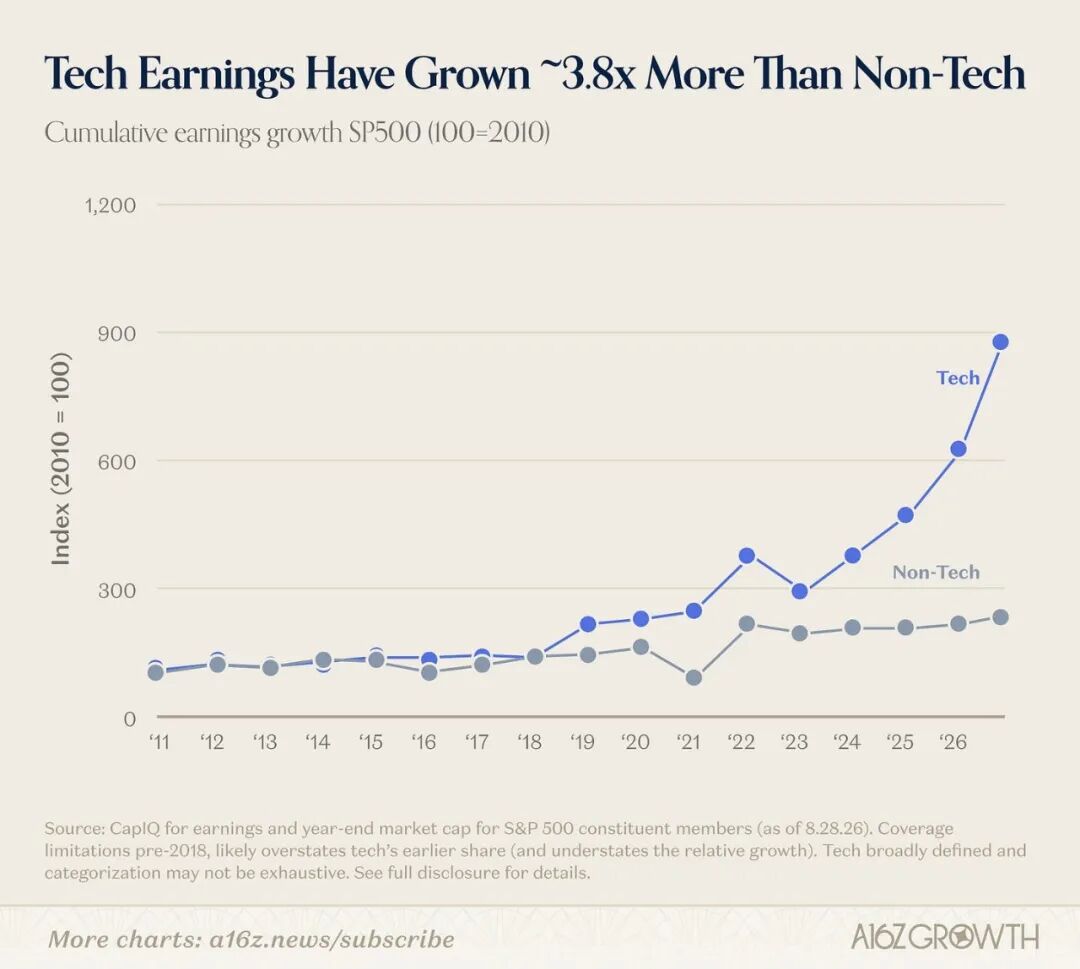
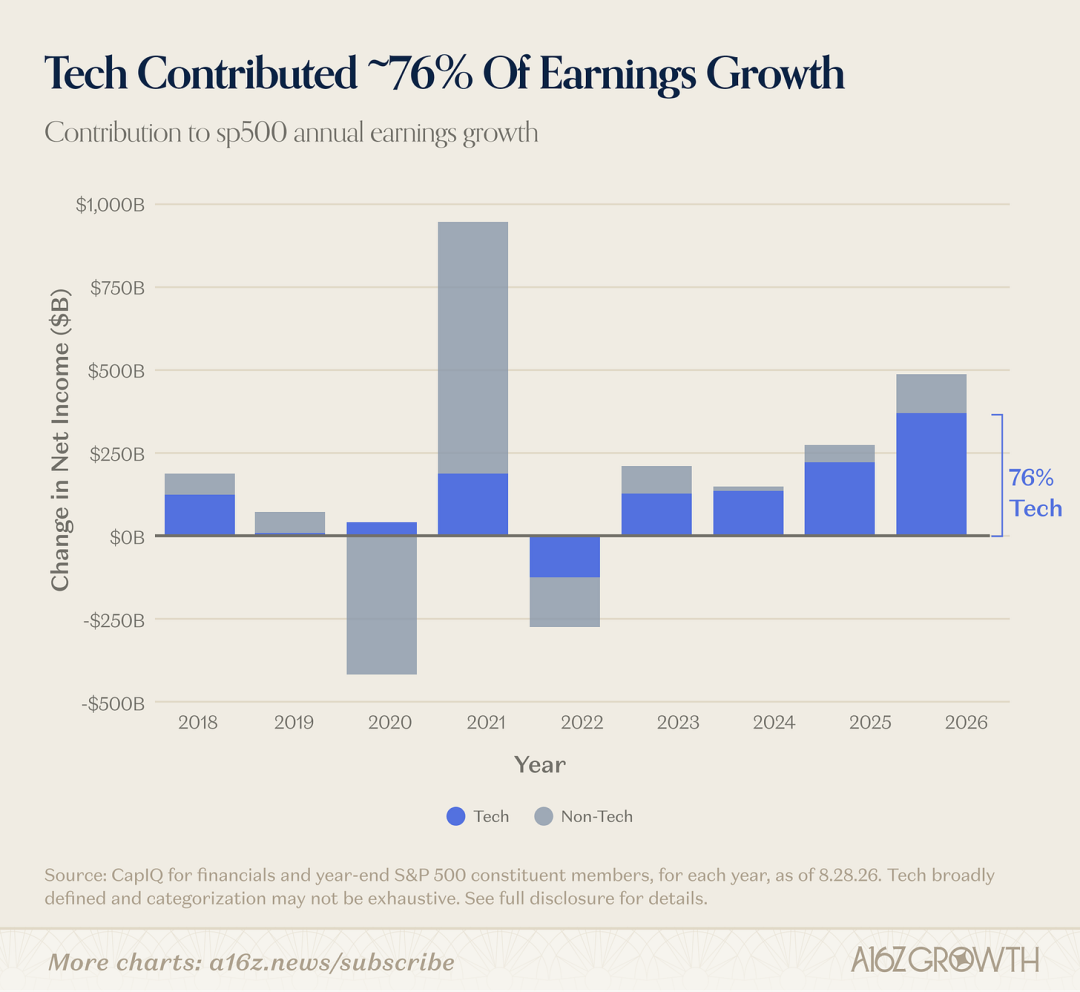 Now the destination of these profits is beginning to change. The giants are increasing investment, engineering contractors are winning projects, equipment manufacturers are expanding capacity, power companies are scheduling construction, financing institutions are providing funds. The orders that suppliers face do not depend on how many users a chat app has added today, but on whether large customers continue to purchase and whether projects can progress on schedule. Technological demand, through capital expenditures, has become revenue that other industries can recognize.
The report even regards AI infrastructure construction as an especially important expansion force in the current economy, linking it to new construction spending, skilled labor demand, and debt financing. This judgment cannot be directly generalized to all countries and industries, but it offers a way to observe the macroeconomy: the investment plans of a few large firms are becoming the basis for many companies to schedule production and hiring.
When investment is concentrated on a few buyers, risk also travels along the same chain. If a giant raises its budget, the supply chain may benefit collectively; if it delays construction, the impact spreads to equipment, engineering, and financing. This gives AI an increasingly macro‑variable character. The changes it brings have already gone beyond product competition, and the magnitude of total investment, how funds are allocated, and which regions truly benefit still require detailed analysis.
02
Platform-level changes first manifest as a continuously growing purchase order
The report’s cited data shows that the combined capital expenditures of five major tech companies rose from $241 billion in 2024 to $416 billion in 2025, with a forecast of nearly $777 billion for 2026, and an expectation of over $1 trillion per year starting in 2027. Different charts use slightly different forecasts, but the trend is the same: the market keeps scaling up construction, and estimates made a few years ago for this round of investment were clearly too low.
a16z believes this reflects a platform-level shift. The compute capacity that enterprises procure must support workloads that are expanding from search, storage, and traditional cloud services to code generation, content creation, analytics, and automated task execution. Users are buying software capabilities, which may generate ongoing compute consumption behind the scenes. As models are integrated into more and more processes, production capacity needs to be prepared in advance, and infrastructure development may therefore span many years.
This is an investment with competitive pressure. Large customers demand more compute power, cloud providers worry that insufficient supply will push customers to competitors; model companies want to improve capability and scale of use, and also need more stable resources. Waiting can reduce the probability of a wrong investment, but may cause loss of market position, so companies act before demand is fully clear.
The cost has already shown up in cash flow. The report forecasts that the squeeze on the giant’s free cash flow from capital expenditures will continue until around 2028, and cites market predictions that cash flow will recover thereafter. This is a judgment about the future. The company can maintain high profits while leaving less cash due to construction spending; whether new projects will ultimately generate sufficient returns depends on utilization, customer payments, and equipment renewal costs.
Beyond internal cash, debt financing is also increasing. The giants have mature businesses and strong credit, giving them better conditions than most startups to support long‑term projects, but the high returns of existing businesses do not automatically translate into returns for new AI projects. Multi‑year build cycles mean opportunities can persist, but also that misjudgments can be costly to adjust. The scale of platform‑level changes is already evident, and platform‑level profits are still taking shape.
02
Capital expenditures are being realized, but the realization of returns varies
Whether capital expenditure is effective depends on which end of the industry chain you look from. For equipment suppliers, orders from giants and completed deliveries can generate revenue; for cloud service providers, they also need to turn these devices into services that customers are willing to purchase; for end customers, they need to demonstrate that the business benefits after procurement can cover the costs.
a16z uses cloud orders, model revenue, and enterprise use cases to show that this round of construction already has demand support. The report says that the backlog of revenue orders for major cloud providers has doubled year over year, and new compute providers are also growing rapidly. These signals indicate that customers are willing to commit to purchases, but the backlog still needs to be delivered, and revenue growth must be viewed together with costs. Securing orders upstream does not mean the entire industry chain has achieved the same quality of profit.
Closer to the final operating results is the corporate disclosure included in the report. Meta reported conversion gains from AI advertising tools; ServiceNow said AI products’ annual contract value in Q2 2026 exceeded $1 billion. AI has entered specific metrics such as ad performance, contract value, and service costs, and these metrics will directly affect companies’ budget planning for the next year.
Similar signals appear in the retail sector. The report cites disclosures from Amazon and Walmart showing that customers who use their shopping assistants spend about 40% more per order on average. However, high‑spending users may be more inclined to adopt new tools, so this difference cannot be entirely attributed to AI. The value of the application needs to be validated through comparable experiments, sustained usage, and repeat purchases, and corporate disclosures provide a starting point for further observation.
The tangible impacts of construction are more direct. Data centers require construction and maintenance, power infrastructure needs to be installed, vendors need to schedule production, and the demand and wages for skilled technicians are therefore affected. AI may reduce the labor needed for certain tasks, but it may also create more engineering, operations, and new business positions; the specific changes depend on how companies use the technology and cannot be inferred solely from model capabilities to predict overall employment outcomes.
“Capital expenditures are being realized,” which contains two layers of meaning: procurement has already turned into revenue and labor demand for some companies, while whether the entire round of investment is worthwhile still awaits more customer returns. The first layer has already occurred, the second is still being validated. Separating the two helps understand why the supply chain can be thriving while the market still debates investment returns.
04
The cheaper the model, the larger the usage may be
AI price reductions lead to an easily misjudged outcome. The cost per call drops, which intuitively seems to mean the industry’s overall spending decreases; however, lower prices also bring more tasks into the usage scope, and calls that were occasional can become continuously running processes, so total demand may actually increase.
The report explains this shift using the Jevons effect. Data, customer service requests, or internal searches that companies previously deemed not worth modeling have become economically viable as costs drop; companies already using AI can also have their systems perform more checks and experiments. Unit costs and usage scale change together, and the final expenditure depends on the combined effect of both.
This is especially true for agents. Completing a task often requires planning, retrieval, tool invocation, checking, and retrying, and multiple model calls are needed to deliver a single result. Reducing call costs makes such workflows more acceptable to enterprises. However, consuming more tokens may also stem from inefficient retries; the commercial value still depends on task completion rate, delivery quality, and manual review costs.
Another explanation offered by the report is that AI adoption is broad in scope but still limited in depth. A small number of high‑intensity users integrate models into complex workflows, with needs far greater than those of occasional users who just use the tool to write emails. Therefore, the number of users cannot fully reflect market size; whether companies incorporate AI into ongoing operations may be more meaningful than registrations and trials.
Pricing tiers also leave room for different models. Simple tasks use low‑cost models, complex tasks use more powerful models, and routing and caching help enterprises control costs. Open‑weight models and closed‑source models can perform different tasks within the same business, and model selection is determined jointly by capability, price, and deployment requirements.
This can explain why price reductions and the growth in compute demand occur simultaneously, but it does not guarantee that all vendors’ revenues will increase. The relationship between token usage, underlying compute consumption, GPU rental prices, and total customer spending is not a fixed proportion. How much new demand is unlocked by efficiency gains and how quickly supply expands will together determine the size and profitability of the compute market.
05
From software to physical assets, technology once again encounters industrial constraints
Demand growth must be grounded in physical infrastructure. Models can be distributed quickly over the network, but chip manufacturing, data‑center construction, and power‑grid integration each have their own cycles. AI expands the demand for compute power and also increases the demand for resources that are hard to replicate quickly.
a16z calls this shift from “Bits” to “Atoms”. Beyond GPUs, high‑bandwidth memory, optical interconnects, cooling systems, power equipment, and even copper and skilled labor have entered the list of items needed for expansion. Some traditional cyclical industries are seeing strong orders and profit growth, and investments by tech companies are thus becoming an important source of demand for industrial firms.
The report notes that about three years after construction begins, the supply chain still has long delivery cycles, and receiving chips does not mean they can be powered on immediately. Data center space, networking, cooling, and power are all essential; a delay in any one link can affect the utilization of the entire equipment set. Computing power is the output of an entire system, and the number of chips can only explain part of it.
This round of physical investment also includes electrification, manufacturing rebuilding, robotics, aerospace and defense. They are driven respectively by the energy transition, demographic shifts, policy and security needs, while AI offers new possibilities in automation and product capabilities. The report cites an estimate of about $90 trillion in global infrastructure investment demand by 2040, a scope far larger than AI, reflecting broader construction needs.
The capital markets need to reassess these companies, but they should not simply rewrite the industrial cycle as perpetual growth. When supply is tight, revenue, prices and profits may all rise; after capacity expansion is completed, competition and utilization rates will again affect earnings. The report suggests that some semiconductor companies may still be cheap, while acknowledging that their demand is heavily dependent on the capex of industry giants, and the low valuations may reflect concerns about a cyclical downturn.
A company’s long‑term value still depends on its processes, certifications, customer relationships, difficulty of substitution, and cost control. AI creates new sources of demand, but industrial issues such as construction time, depreciation, capacity utilization, and cash recovery remain. Consequently, technology investment now includes a type of business that requires patience: after receiving an order, the product must be manufactured on schedule, and profit must be retained after the expansion phase ends.
06
Software enters the “prove itself” stage
The other side of strong hardware performance is pressure on software valuations. AI makes programming easier, and the market is beginning to question whether companies still need to purchase so much off‑the‑shelf software. A feature that previously required a team to develop can now be completed more quickly, which indeed affects customers’ choices and increases the competition vendors face.
However, when enterprises purchase software, it also includes permissions, security, maintenance, compliance, and system integration. A demo program and a production system that runs long‑term carry different responsibilities. After development costs drop, some generic features become harder to charge for; software that is deeply embedded in core processes may be able to increase its value with AI.
a16z summarizes industry changes as entering the “Prove-It Era”. The report finds that software stock adjustments are uneven, with cybersecurity and observability standing out, vertical software experiencing less valuation compression than horizontal software, and industry revenue growth and operating leverage not universally deteriorating. Whether customers still rely on the product and whether AI can enhance its position are more explanatory than the software label itself.
Valuation changes are also related to industry maturity. The report notes that the share of high‑growth, low‑profit companies is decreasing, while slower growth and higher profitability are becoming the norm. Companies can operate more steadily, but the growth premium granted by the market may decline. Attributing all adjustments to AI would overlook the original relationship between valuation and growth rate.
The pricing model also faces scrutiny. Seat‑based pricing is built on the link between the number of employees and the scale of usage; intelligent agents may enable fewer people to accomplish more work, or may allow software to take on tasks that were previously delivered manually. How much customers are willing to pay increasingly depends on what the product delivers, not merely on how many people can log in.
At the same time, AI features increase inference and service costs. Greater usage does not necessarily mean higher gross profit, and charging based on outcomes also requires addressing performance measurement and responsibility attribution. Software companies must simultaneously demonstrate customer benefit and their own profitability: customers continue to pay, and vendors can still retain profit after delivery. Growth, profitability, and sustainable competitive advantage are now being examined together.
07
Most valuable companies, entered the public market later
Tech companies can raise increasing amounts of capital before going public, with a portion of their value growth remaining in the private stage. The five large unlisted tech firms selected in the report have a combined disclosed valuation of about $2.2 trillion, exceeding the cumulative valuation of tech companies that went public from 2015 to 2025, which the report tallies at roughly $1.73 trillion. Although the two valuation bases are not identical, this nevertheless illustrates the scale of large private enterprises.
In the past, public market investors had more opportunities to participate in a company’s growth at an earlier stage; after a company delays its listing, the public market may only engage with it when it is already large. Listing has become part of capital structure adjustment and liquidity arrangements, and whether a company can obtain development funding increasingly depends less solely on the IPO window.
Opportunities for value growth are also not evenly distributed. The report highlights that fewer funds are investing larger amounts in fewer companies, widening the return gap among fund managers. AI has lowered the barrier to product development, and companies that can acquire customers, achieve scale, and maintain an advantage remain scarce, causing capital to concentrate on a small number of standout firms.
The boundary between primary and secondary markets is shifting, but the issues of exit and return are even more important. As book valuations grow, they need to be realized through equity sales, dividends, or IPOs. The longer a company stays in the private market, the more investors need to understand their capital horizon and exit conditions. How much value the industry creates versus how much cash investors ultimately retrieve remains a different accounting.
08
Private company data is beginning to become an early signal of economic changes
Enterprises staying in the private market for the long term have also changed how the outside world observes the economy. Many new businesses have not yet been fully captured by traditional statistics, yet they have already left traces in model calls, payment flows, and infrastructure transactions. The report treats companies such as OpenRouter, Stripe, Kalshi, and Databricks as important windows for observing these changes.
OpenRouter connects different models, and its data can reflect the scale of calls and model choices on the platform. The report shows that in September 2026 its weekly token processing volume was about 27 times that of a year earlier. This figure does not represent the entire AI market, but during a phase of rapidly changing demand, call records provide a signal closer to usage intensity than mere user counts.
Stripe looks at software companies from the payment side. The report cites its sample, noting that the revenue growth rate of some SaaS companies rebounded in 2026, which is inconsistent with the narrative of a broad software market downturn. Payment data allows researchers to see operational changes earlier, but the conclusions are still affected by the composition of platform customers, company age, and statistical methods, and cannot be directly equated with the performance of the entire industry.
Databricks provides another type of evidence. The report presents its model routing research, showing how enterprises balance performance and cost for specific tasks. This kind of data helps understand which applications are approaching an economically feasible threshold. Kalshi’s prediction market on GPU compute pricing reflects participants’ expectations for future costs; it reflects expectations, while actual supply and demand still need to be validated by transactions and usage.
Each of these sources can only see a portion of the market. Growth in platform share will affect call volume, changes in customer composition will affect payment growth, and the judgments of market participants may also deviate from actual outcomes. The report itself acknowledges that private companies, while providing signals, often also tell their own business stories. The more timely the data, the more it needs to be checked for scope and representativeness.
Traditional statistics offer coverage and comparability, while platform data provides speed of updates and business detail. Cross‑validating these with listed company financial reports, capital expenditures, and equipment deliveries makes it easier to pinpoint where changes are occurring. AI is reshaping economic activity and forces observers to adjust their tools: by the time all changes appear in quarterly or annual statistics, companies may have already made their next round of investment decisions.
These eight viewpoints ultimately converge on a single question: How is AI turning technical capabilities into economic activities, and who bears the costs in the process.
Tech giants use profits from existing businesses to build new production capacity, suppliers get orders, cloud service providers await delivery, software companies adjust products and pricing, and startups vie for customers and financing. Market enthusiasm can appear across many layers, but revenue at each level requires continuous payment from the layer below. Ultimately, whether end customers derive enough benefit from AI will determine if these financial flows can be sustained over the long term.
a16z believes the market is still in its early stage, and demand has ample room for expansion. The orders, call volumes, and use cases presented in the report provide a basis for this judgment; the cited forecasts of future cash‑flow recovery and investment scale, however, need more operational results to back them up. The gap between construction already generating revenue and employment, and the entire round of investment achieving sufficient returns, is still bridged by equipment utilization, service costs, and customer renewals.
In the coming years, the most substantial changes may show up in less conspicuous records: a project connecting to the grid on schedule, a batch of devices maintaining high utilization, an agent reducing manual verification, and a software company preserving its gross margin after adding AI features. They aren’t as easy to spread as model launch events, but they demonstrate whether the money enterprises invest has become a sustainable business.
In the past, the most prized capability in the tech industry was generating more revenue with less capital. Today, it is trying to use massive investments to tap larger demand. This shift will give some companies new opportunities, while also exposing the costs and misjudgments of certain projects. Only after equipment is built, contracts are delivered, and customers renew will the new profit distribution become clearer.
AI has already begun rewriting the entire economy’s ledger, and what comes next is to see how these accounts are settled one by one.