Tsinghua’s Yao Qizhi Team Unveils Algebraic World Models: Enabling AI to Think Like Newton
Tsinghua Yao Qizhi Team’s New Work: Algebraic World Model, Enabling AI to Think Like Newton
Summary
Jay posts from Ao Fei Temple Quantum Bit | Official Account QbitAI “Let AI think like Newton,” this endeavor finally looks promising. The research team led by Prof. Yao Qizhi and Prof. Yuan Yang at Tsinghua University has launched a heavyweight project,
Jay posts from Ao Fei Temple
Quantum Bit | Official Account QbitAI
“Let AI think like Newton,” this endeavor finally looks promising.
Tsinghua UniversityProfessors Yao Qizhi and Yuan Yang‘s research team has launched a major project called the “Algebraic World Model”.(Algebraic World Model, AWM).
People have often asked a question before:
If we let AI learn only all the knowledge that existed before Newton discovered universal gravitation, could it derive universal gravitation on its own?
The awkward part is that training data is easily contaminated, making it hard to recreate such a scenario: creating a completely unfamiliar world and letting AI observe and experiment from scratch.
But now, algebraic world models offer a new solution. Letting AI start from observation and experimentation to further understand the world is becoming less distant.
AI playing games—does it look like Tycho observing the stars?
There is a game suite called ARC-AGI-3, now a showcase for cutting‑edge models to flex their muscles. The hallmark of this game is that it tells you nothing—no rules, no objectives.
It’s simply, letting you figure it out on your own.
Top-tier players like GPT Astra, combined with the Provider Adapter framework, can achieve99.9% high scores here.
When it plays games, it organizes the game mechanics into a set of symbolic rules.
It’s densely packed, with a high information density, and far more precise than other models.
But essentially, this thing is like Tycho’s lab notebook.
Tycho, Kepler’s teacher, a fanatic observer, recorded massive amounts of planetary data with frightening precision.
But he only recorded the phenomena.
The one who actually derived the three laws of planetary motion from this data and uncovered the underlying principles was Kepler.
The rules generated by Astra are Tycho’s notebook, not Kepler’s laws. They merely describe the phenomena and fail to capture the essence of how this mini‑game world operates.
Hallucinations Still Occur
What problems arise if you only record the phenomena?
The researchers took a game called sc25 and tweaked it slightly, setting the initial move count to a number that makes completion impossible.
For example, in level 4 you normally need at least 19 moves to win, but they only gave you 18.
Then they let Astra play.
In the end, Astra tried 8 rounds, got a bit frustrated, and then asserted: 18 steps definitely won’t work,I estimate it will take at least 22 steps to win.
Yes, it not only failed to find the correct answer but also gave an absurdly wrong 22-step solution.
This isn’t an isolated case. In 12 similar tests, the top‑tier GPT‑6 Astra and Claude Opus 5.5 together identified “impossible” only 5 times, and in 4 of those the minimum step count they provided was still incorrect.
This kind of hallucination in a game is at worst just a minor inconvenience.
But in the real world, if an AI agent is tasked with a job, tells you “it’s not doable,” and provides an incorrect reason, the consequences could be serious.
What we truly need is for AI, when a task is impossible, to clearly tell us “why it’s impossible” and provide an accurate judgment, such as “just a slight increase in the conditions would make it possible.”
Obviously, relying solely on intuition and trial-and-error won’t work.
The Power of Algebra
How to solve it?
At this point, we have to rely on the power of algebra. That is the Algebraic World Model (AWM) mentioned earlier, developed by the Tsinghua team.
Abstract all objects, relationships, and rules in the game into an “algebraic world.” Then, leverage the now‑superior mathematical abilities of large models to understand this world.
The process is roughly three steps:
-
Explore: Play a few rounds, write the observed phenomena as executable Python code, forming initial “hypotheses” or “rules.”
-
Refine: Use new observations to validate and adjust these hypotheses, then distill them into more general objects and rules.
Proof: Finally, formalize these patterns into a language called Lean 4, turning them into logically rigorous, machine‑verifiable mathematical assertions.
In plain terms, we move from exploratory trial‑and‑error to modeling and formal proof.
How does it perform?
Facing that previously unsolvable level, the AWM based on the Opus 5.5 model only needed two attempts to directly prove that the level is unsolvable at the current step count, and that just one more step would secure a win.
In addition to being able to determine the “impossible,” AWM’s ability to clear levels is even stronger. Across the entire ARC‑AGI‑3 test set, it completed all 183 levels with Opus 5, achieving a score of 99.9%, and the average number of actions taken per level was only 43% of the human baseline.
This makes it the most efficient system known to date.
So how exactly does AWM work?
You may have heard of algebraic geometry and algebraic topology before. In short, algebraic geometry connects algebraic equations with geometric shapes, while algebraic topology uses algebraic tools to study properties such as connections and holes of spaces.
By algebraizing shapes and spaces, many questions that are hard to answer by observation alone can be solved. Mathematicians created algebraic geometry and algebraic topology because geometry and topology are the worlds they study.
Now, with the power of AI, AWM can extend this path to more unfamiliar games, interactive environments, and even real‑world tasks: discovering patterns through exploration, distilling structures from those patterns, and using mathematics to understand those structures.
Think Like Newton
This line of thinking actually runs through the entire history of science.
From universal gravitation and Maxwell’s equations to relativity, humanity’s greatest intellect has been doing one thing: extracting the most fundamental laws from complex phenomena and describing the world with mathematics, the universal language.
What AWM wants to do is to make AI learn this same method.
To achieve this goal, it drew inspiration from a branch of mathematics called “category theory.” This stuff sounds intimidating, touted as “the mathematics of mathematics,” because it studies not a specific mathematical field but the common structures underlying different mathematical theories.
AWM mainly uses two tools inside, called “Projection Limit” and “Inductive Limit”, which are essentially two complementary ways of thinking:
-
Define(Projection Limit): Assemble a bunch of existing concepts and their relationships together to define something new. You can think of it as decomposition and combination of concepts.
-
Find commonality(Inductive Limit): Observe a bunch of different things, identify their common points, and then unify them into a more abstract framework. You can think of it as generalization and specialization of concepts.
By iterating back and forth using these two methods, AWM can continuously refine the initially scattered and chaotic Python hypotheses, making them increasingly concise, clear, and consistent, ultimately forming a world model that can be reasoned about and proven.
Think of Newton back then; he wasn’t faced with a problem that already had an answer, but with countless scattered observations and phenomena. The truly great work was to extract a few core concepts like “force” and “mass” from these phenomena and organize them into a theory that can be deduced and tested.
What AWM wants to teach AI is this way of working.
Of course, it also has limits. Its proof is based on the “observed world” being valid. If the exploration is not comprehensive enough and some key rules are missed, the model only depicts a “partial truth,” not the complete world.
Therefore, the true path is a continuously looping process:
Observe → Hypothesize → Experiment → Abstract → Prove → Observe again
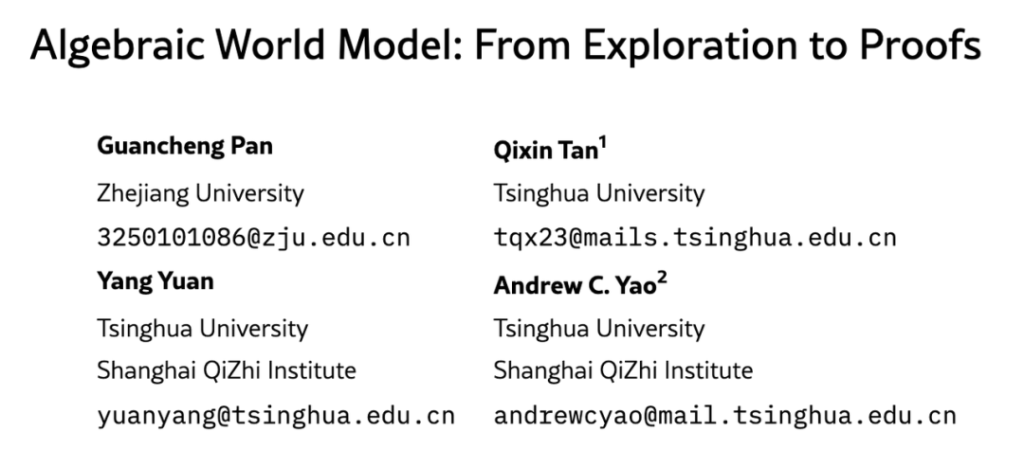
Paper Authors
The team behind this paper is equally noteworthy.
The paper has two co‑first authors,both undergraduates:
One is Pan Guancheng from Zhejiang University, currently on a leave of absence to conduct research at Tsinghua University.
The other is Tan Qixin from Tsinghua’s Yao Class.
The supervising faculty team is led by senior scholars in the field:
Yuan Yang, associate professor at Tsinghua University’s Institute for Interdisciplinary Information Studies and School of Artificial Intelligence, and director of the Embodied Intelligence and Intelligent Manufacturing Center at Shanghai Qizhi Research Institute.
Yao Qizhi, 2000 Turing Award laureate and academician of the Chinese Academy of Sciences, currently serves as dean of the Institute for Interdisciplinary Information Sciences and dean of the School of Artificial Intelligence at Tsinghua University.
In addition, he is the 2021 Kyoto Prize laureate, a foreign member of the US National Academy of Sciences, and a foreign member of the US Academy of Arts and Sciences.
Project homepage: https://ephemeral6.github.io/awm-site/
Paper URL: http://arxiv.org/abs/2610.40503
One-click Triple Action“Like” “Share” “Heart”
Feel free to leave your thoughts in the comments!
— End —
🌟 Light Up the Star 🌟
Get MirrorSpeed
Get MirrorSpeed