Understanding the huge mess OpenAI just caused in the computing world, in one article
Understanding the Big Mess OpenAI Just Stirred Up in the Computer World in One Article
Summary
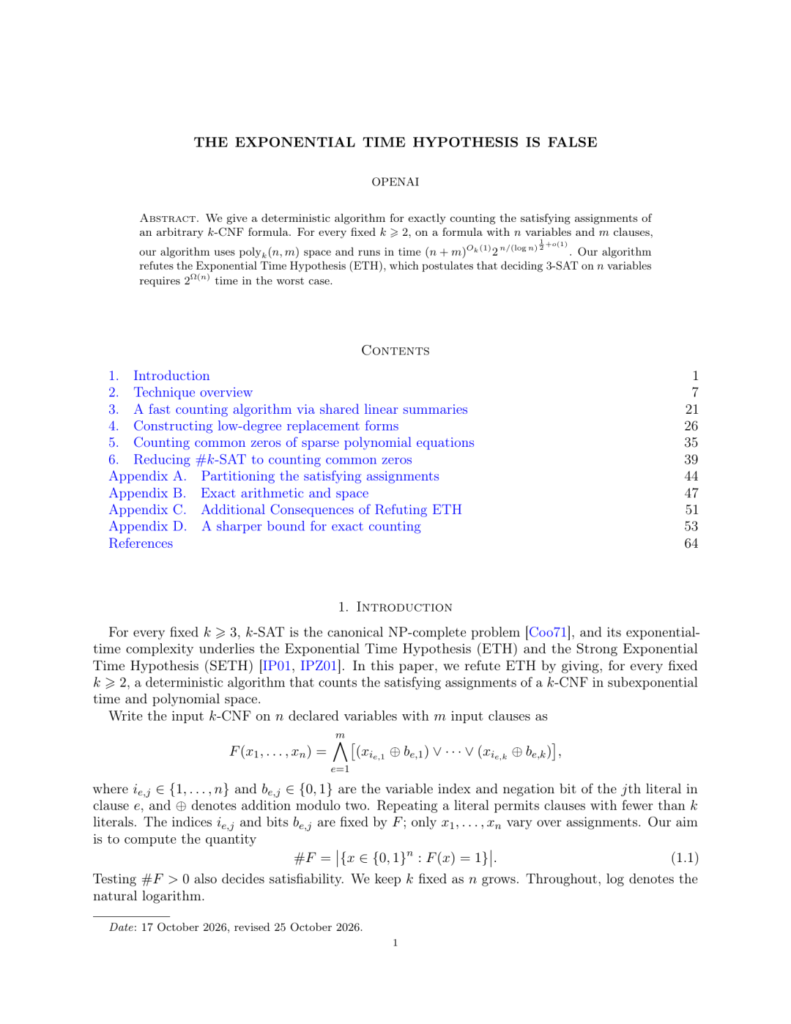
These past few days, both the computer science community and the crypto world have experienced a “nuclear explosion.” It started when OpenAI announced the latest results of its own model, with a title that is just a single short sentence: “The Exponential Time Hypo
These past few days, both the computer science community and the crypto world have experienced a “nuclear explosion.”
It started when OpenAI announced the latest results of its own model, with a title that is just a single short sentence:
“The Exponential Time Hypothesis is False” (ETH is wrong).
The front row of the comment section instantly split into two dimensions.
The PhD students working on theoretical computer science trembled and asked, “So are all the hundreds of top‑conference papers we’ve written over the past 25 years now worthless?”
Another group of netizens sprang out of bed, frantically opened their market apps, thinking Ethereum (ETH) had been knocked down.
First, a calming pill for our crypto‑trading friends.
This ETH is not that ETH. The so‑called Exponential Time Hypothesis that has been overturned has nothing to do with Ethereum at all.
But if you ask a computer‑theory scholar how big this really is,
they’ll tell you it’s like AI just manually pulled out a load‑bearing column from the foundation of modern computer science.
The building is about to collapse.
What’s even more outrageous is that more than one party is pulling the pillars.
On October 26, the arch‑rivals OpenAI and Anthropic almost simultaneously released their papers and Lean 4 machine‑verified code.
OpenAI delivered a full 67‑page paper, 3,977 Lean source files, and over 710,000 lines of formal proof code; a few hours later, Anthropic followed with Claude independently verifying the same conclusion.
Even the two pioneering founders who originally proposed the ETH hypothesis, Russell Impagliazzo and Ramamohan Paturi, have now formed an independent review panel overnight and are personally conducting the review.
Explain it in the most straightforward language: what exactly is this ETH?
Give an analogy and you’ll understand.
Usually at home we installultra‑B‑grade anti‑theft door locks, which have been studied by locksmiths and physicists worldwide for centuries. Although no one can theoretically prove they are absolutely unpickable, generations of thieves on Earth have been trying to pry them with wire for decades, and none have ever succeeded.
Thus the global security community simply established an axiom:
This lock cannot be turned open by human force.
In the past 25 years, countless scholars have researched this ironclad rule, producing hundreds of heavyweight papers.
For example, “Since this lock cannot be turned, the vault door with the same mechanism must also be unpryable” and “Ten safe‑design specifications based on the hypothesis that this lock is uncrackable.”
The entire edifice of modern security theory is built tightly upon this foundation.
And just yesterday, internal AI models from OpenAI and Anthropic burst out, slamming a stack of 710,000 lines of mathematical proofs onto the table, announcing:
“This lock can’t be turned, it’s wrong! AI has found the ultimate unlocking method!”
The audience gasped, and the residents’ first reaction was, “Whoa, can my front door still be locked tonight?!”
After the experts wiped away their cold sweat and examined the derivation produced by the AI, they also found the mechanical formulas to be perfectly tight, with no flaws.
But what does the “must‑open” method that the AI discovered look like?
The AI rigorously proved that:
As long as a thief stands at your doorstep and keeps twisting for 10 billion years, the spring inside the lock will undergo quantum metal fatigue and snap open with a click!
The evidence is rock solid, truly overturning the “absolutely unturnable” law.
But does this affect you locking the door and sleeping tonight? In fact, it doesn’t affect you at all.
A normal thief only needs a few minutes to commit a crime; if he actually twists for 10 billion years, the solar system might have exploded by then…
The ones whose world actually collapses are the scholars writing papers.
Because almost all of the hundreds of papers they published over the past 25 years were built on the premise “Assume this lock cannot be turned open at any time length, therefore…”.
Now that assumption has been kicked apart by AI, and all the theorems that relied on that sentence have had their foundations vanish overnight.
The “Exponential Time Hypothesis (ETH)” in computer science is exactly this anti‑theft door lock.
In computing, this lock is formally called 3‑SAT.
Imagine you have a row of switches in front of you, a total of n of them, each of which can only be toggled up or down. I’ll give you hundreds of wiring rules, each rule requiring only that a specific combination of three switches satisfies a condition, and ask you to find a setting that powers all the rules simultaneously.
The difficulty of this problem lies in the fact that each additional switch doubles the number of possibilities.
Only 3 switches have23=8 possible methods; when it reaches 300 switches, the possibilities directly exceed the total number of atoms in the universe (about 1080 ), even if all the computers in the world were combined, it would still be impossible to finish before the universe ends.
For decades, the top scientists have tried every trick to speed up, reducing the time from2nto1.618n, and then further squeezing it down to1.307n (PPSZ algorithm).
But no matter how much you compress, the unknown n always stays in the exponent, so the scale will always take off.
After hitting the southern wall countless times, 25 years ago the two elders Impagliazzo and Paturi simply proposed the Exponential Time Hypothesis (ETH).
They concluded that this exponential explosion is a natural law, and it will never be possible for an algorithm to reduce the exponential n to sub‑exponential.
No one can prove it, but everyone believes it.
Chip layout designers, logistics schedulers, graph theory researchers— as long as they can prove “if my algorithm were any faster, it would break 3‑SAT,” they can confidently claim in their papers that their algorithm has hit the cosmic limit and cannot be faster.
Hundreds of top‑conference papers have been built on ETH’s foundation like this.
Until this week, when AI from OpenAI and Anthropic swung the hammer.
AI took a purely algebraic detour. It puts a polynomial mask on each switch, uses a clever “exchange matrix” to partition the chaotic switches into non‑interfering groups, relies on a tiny amount of shared integers to transmit information, and finally uses Hermite interpolation to compute the exact number of solutions.
In the end, AI pushed the runtime upper bound to
2O(n · loglog n / √(log n))
You only need to take a glance at the denominator’s √(log n).
Humanity has been stuck for half a century, unable to eliminate then from the exponent; AI for the first time placed a term underneath that grows slowly asn increases, namely√(log n). In mathematical terms, this crosses the boundary between exponential time and sub‑exponential time.
ETH and its five variants, such as the enhanced SETH, were knocked down like a line of dominoes.
So why is it said to be equivalent to “a thief twisting for 10 billion years”?
A researcher specifically compared the new AI formula with the existing human PPSZ old algorithm (1.307n) and did the math.
Even if we treat all the hidden large constants in the AI formula as 1, when will the new AI algorithm finally outperform the human old algorithm?
The answer is, when the number of switches n exceeds 1079to10168.
The total number of fundamental particles in the observable universe is only1080…
In other words, unless you use every proton and electron in the entire universe to solve the problem, door locks remain secure in any real-world scenario humans can encounter.
However, while door locks are temporarily safe, mathematicians are already busy.
MIT computer science professor Ryan Williams was one of the first people called in to review this proof.
On October 27, he revealed in an interview that some steps in OpenAI’s proof are fairly routine, but a couple of other ideas are almost like they were written by “aliens.”
It is precisely these parts that make him feel this issue requires the entire theoretical computer science community to study together.
Interestingly, earlier this month when OpenAI released over 700 AI‑generated math manuscripts in one go, Williams publicly joked that it was like a “DDoS attack” on mathematicians.
As a result, this time he himself joined the review team.
Looking at the entire mathematical community, this debate is far more intense than ETH itself.
On October 22, Fields Medalist Terence Tao published a lengthy article in Nature, calling for the mathematics community to enter a brand‑new “Maths 2.0” era.
He noted that AI can now generate mathematical proofs in bulk within a short time, while human mathematicians are falling far behind in understanding these results.
In the past, a mathematical problem might take decades of research before anyone could provide an answer.
Now, AI spits out hundreds of proofs at once—how long will it take humans to comprehend them?
A more radical group of mathematicians simply chose to draw a clear line from commercial AI companies.
An organization called the Association for Human Mathematics (AHM), which has already gathered 1,008 members.
They pledge not to provide mathematical research work or consulting to commercial AI companies, nor to publish AI‑generated mathematical papers.
Among them, 654 people further joined the “No AI faction,” pledging to use no AI at all in their own mathematical research.
In the mathematical sky that has stretched over humanity for centuries, some rules may have completely changed.
References
[1] The Exponential Time Hypothesis is false: https://github.com/openai/math/blob/main/preprints/The-Exponential-Time-Hypothesis-is-False-October-25-2026/paper.pdf
[2] A subexponential‑time algorithm for solving 3‑SAT:https://github.com/anthropics/formalmath/blob/16a5ce41304fcdaea4e0be7c132e1c361dc26da5/eth/paper.pdf
Get MirrorSpeed
Get MirrorSpeed