Yes, Tesla really built a âflying carâ!
Yes, Tesla really built a “flying car”!
Summary
History is created by lunatics and engineers. By Wildcard editor Jingyu, source GeekPark (ID: geekpark), cover source Tesla. We know Elon Musk is a lunatic, but we didn’t expect him to be able to …
History is created by madmen and engineers.
We know Elon Musk is a madman, but we didn’t expect him to be this crazy.
On October 16 local time, at SpaceX’s rocket test site in McGregor/Waco, Texas, a white sports car was seen in an unbelievable state, defying gravity as it clung to a vertically upward‑bent artificial road. It wasn’t over yet—after reversing and accelerating on that stretch, the car left the road, flew into the air, rotated, and landed smoothly using its thrusters.
Indescribably cool | Image source: Tesla
The next‑generation Tesla Roadster sports car made its debut in exactly this manner.
Elon Musk opened by telling the audience, “We’re sure everything’s fine, but if anything goes wrong, our safety margin here isn’t very large.”
Of course, you know, a bit of fear can actually spark even greater excitement—old Musk knows his stuff.
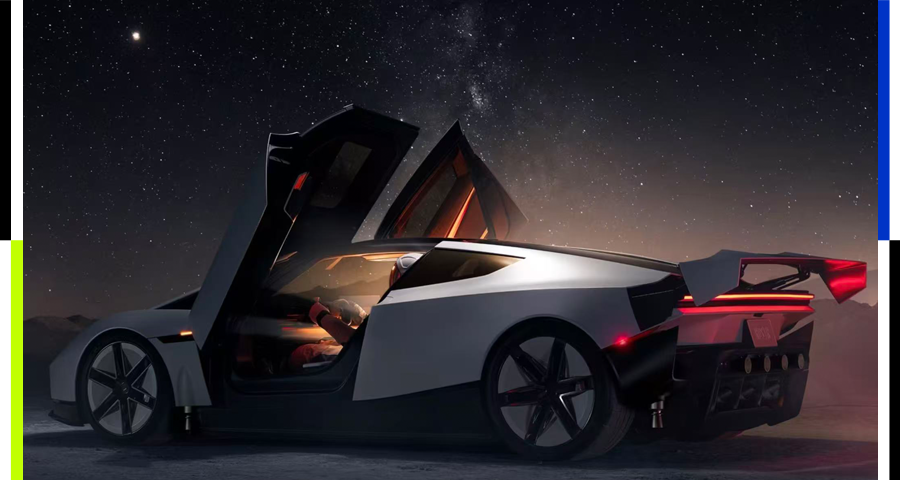
The test Rocket version uses no real driver | Image source: Tesla
In addition to flying, the next‑generation Roderster sports car is said to come in three versions—Performance, Thrust, and Rocket. The Rocket version is a single‑seater that can sprint from 0 to 60 mph in an astonishing 0.59 seconds.
Although the price hasn’t been announced, you can guess that billionaires around the world have probably already started preparing checkbooks.
Tesla Can Fly
Bottom line: the next‑generation Roadster can actually take off, not because of propellers or jet engines, but thanks to a cold‑air propulsion system “borrowed” from SpaceX, combined with a fan that can “suck” the car onto the ceiling.
The opening demo of the press conference is essentially a “joint operation” of these two systems.
A Roadster is upside down at the top of a curved ramp, its four wheels pointing to the sky, sticking there without falling. Then it drives out backward, flips in the air, stabilizes its posture with the airflow from its tail, and lands smoothly.
The car lands steadily, and the stage is first met with a “Well, it worked” — yes, it succeeded, followed by someone shouting more plainly, “Flying cars are real.”
Musk seized the moment to quote his old friend Peter Thiel, “We wanted a flying car and got 140 characters,” and then added, “That’s not the case anymore.”
It can hang upside down because it truly “sucks.”
The Roadster’s chassis houses a fan suction system that pulls air from beneath the car, creating negative pressure that can generate up to 2 g of adhesion. In other words, the force pressing it to the ground is twice its own weight. So even if the car is upside down and stationary, it won’t fall off.
Musk unusually “started the car” on stage, saying it can “pull the chrome on a trailer hitch,” and “suck a tennis ball through a hose.”
Joking aside, he also admits that nobody would think about driving upside‑down in everyday traffic. The real value of this system is on the track.
A normal tire’s grip limit is about 1.26 G; beyond that it will slip. With the fan suction, the Roadster can exceed 2 G in corners, looking as if it’s “defying the laws of physics.”Musk’s exact words were that it will “crush all track records.”
The fan system itself has two modes. At low speed it pulls the car down to supplement traction; at high speed it opens ducts at the front and rear, allowing more airflow under the car to further increase downforce. The body can switch between “high downforce” and “low drag” configurations, with a variable‑angle rear wing that automatically adjusts based on track conditions.
It can fly because it really has a “rocket.”
Inside the Roadster’s rear diffuser lies the main thruster, and there are additional thrusters around the body for attitude control. Musk says this lets it “basically fly like a rocket,” capable of rolling and performing all kinds of “crazy gymnastics moves.”
These thrusters don’t burn fuel; they use compressed air.
Vice President of Engineering Lars Moravy, who calls himself a “parameter nerd,” presented the numbers clearly on stage. The car is equipped with carbon‑fiber‑wrapped high‑pressure gas bottles—the same COPVs used on SpaceX’s Falcon 9 rockets—with a total volume of 600 L, holding about 250 kg of air, and ten nozzles handle all propulsion and attitude control. Tesla’s description on X is even more exaggerated: “Every usable space in the car is packed with COPVs.”
When the airflow is expelled from the rear main thruster at supersonic speed, you can see the “Mach ring” that only appears in a rocket’s exhaust plume..
Even more crucial, this “fuel” can replenish itself. Musk says the car can re‑pressurize its own high‑pressure gas tank without any special propellant, “it will inflate itself,” so it can fly whenever you want.
Tesla Roadster performing a “skateboard flip” | Image source: Tesla
The second demonstration that followed was even more exaggerated. The Roadster accelerated, soaring over an entire line of Tesla vehicles, including a Semi truck, flipping in the air before landing.
“I’ve seen a lot of things, but I’ve never seen this.” The host gave the move a name, calling it “Kickflip,” the sharp flip from skateboarding, “Tony Hawk would be proud of this.”
Beyond flying, it’s also an absurdly fast car.
Musk set the team’s goal for 0‑60 mph acceleration to “must break 1 second.” In the live test, the track was too short, so they had to cut fuel early, and the final result was 0.81 seconds.
He casually invoked Newton’s second law, a = F/m—more thrust, less weight, and the acceleration naturally increases. So he said the production version will be even faster, with the only limit being “don’t let the passengers’ retinas fall out.”
According to Tesla, this is “the fastest accelerating production car in the world.” While other cars cover a quarter‑mile, this one can cover a half‑mile. Top speed exceeds 230 mph (about 370 km/h), and Musk’s next goal is 0.5 Mach—“maybe a little higher.”
Someone on stage chimed in, “Where we’re going, you don’t need tires,” a nod to the classic line from Back to the Future.
Back to the car itself.
Design director Franz von Holzhausen explained that once they knew the car was meant to fly, the team looked for “the coolest aircraft” for inspiration, ultimately settling on the SR‑71 “Blackbird” reconnaissance plane and those “transforming cars.”
The new Roadster’s lines are very clean, with hidden headlights, a continuous tail light, and flush aerodynamic trim, giving it the same “cyber” vibe as the Cybertruck and Cybercab. The paint is a white called “Ano White”; Tesla says it borrows aerospace coating technology, offering UV resistance, low‑temperature durability, antistatic and corrosion‑proof properties, while the dark windows mimic a spacesuit visor.
It is a two‑seat vehicle. To reduce weight, the seats are molded as a single piece with the chassis, the steering wheel is a drive‑by‑wire yoke, and both brake and throttle are also drive‑by‑wire. The interior makes extensive use of magnesium, titanium, and carbon fiber.
After the launch event, Tesla announced three versions on X.
-
Performance version, “road‑ready”, two‑seater, equipped with active aerodynamics and a multi‑mode fan suction system, 0‑60 mph acceleration in under 1.6 seconds, reservation fee $50,000;
-
Thrust version, “track‑ready”, two‑seater, rear‑mounted cold‑air thrusters, 0‑60 mph acceleration in under 0.9 seconds, limited release, reservation fee $250,000;
-
Rocket version, “sky‑ready”, single‑seater, body fitted with ten cold‑air thrusters that enable upward flight and rotation, 0‑60 mph acceleration in under 0.59 seconds, invitation‑only purchase, not approved for road use.
Range exceeds 300 miles, about 480 kilometers, with a top speed over 230 miles/hour. Tesla defines Thrust and Rocket as “enhancement packages” built on the Performance version.
It’s worth noting that the scream‑inducing flights and flips all occur on the limited‑edition and non‑road‑legal versions. The road‑legal Performance version does not have a thruster. Musk himself said the car “may not be legal everywhere,” but “there will be a car like this that people can truly own.”
The Roadster waited nine years
What does it actually mean
At the opening of the launch event, Franz mentioned that it has been 20 years since Elon Musk first unveiled the Roadster to the world.
In 2006, Tesla released the first‑generation Roadster. It was built on the Lotus Elise chassis, began deliveries in 2008, and was discontinued in 2012, selling about 2,450 units in total.
The numbers were small, but its significance went far beyond sales. In an era when electric vehicles were still seen as “golf carts,” the Roadster was the first to prove that an EV could be fast, fun to drive, and have sufficient range. As Franz put it, they were “real cars.”
That same year, Musk released the famous “Tesla secret master plan,” which was simple: first build an expensive sports car, use the profits to build a slightly cheaper car, then use those profits to build an even cheaper one.
Lars said on stage that the Roadster was the reason he originally joined Tesla. Everyone knows the rest of the story: Model S, Model 3, Model Y—big ambitions gradually became reality.
The first‑generation Roadster also has a more romantic “sequel.” In February 2018, SpaceX’s Falcon Heavy made its maiden flight, sending Musk’s cherry‑red Roadster into space with a dummy in a spacesuit, “Starman,” in the driver’s seat. To this day, it’s still orbiting the Sun.
This time, Starman also made a cameo at the launch event. After the demo car landed, a Starman dummy poked its head out of the driver’s seat. The stage explicitly clarified, “That’s not a real person.”
But the story of the second‑generation Roadster isn’t that romantic.
In November 2017, at the Semi truck unveiling, Musk suddenly drove the new Roadster out of the truck’s cargo bay, prompting a chorus of screams. The promises at the time were 0‑60 mph in 1.9 seconds, a 620‑mile (≈1,000 km) range, a top speed over 250 mph, 2+2 seating, starting at $200,000, a limited Founder’s Edition at $250,000, with delivery slated for 2020.
In June 2018, Musk tweeted that the Roadster would get a “SpaceX option package,” adding roughly ten small rocket thrusters around the body to boost acceleration, top speed, braking and cornering – “maybe even make Tesla fly.” He explained the thrusters wouldn’t burn fuel but compressed air stored in SpaceX COPV tanks. Many took it as a joke at the time.
Then came the long wait. Pushed from 2020 to 2021, then to 2022, 2023, with Musk later promising a year‑end demo, an April demo, a demo after the Q1 earnings… Since 2017, the timeline has been shifted at least eight times. Even this launch was delayed from October 1 to October 15 because of strong winds and flood warnings in Texas.
Nine years later, the joke about a “SpaceX option package” has actually come true.
But the trade‑off is obvious. Compared with the 2017 promises, the range has been cut from 620 miles to just over 300 miles—almost halved; the seats have gone from four to a maximum of two; the top speed has dropped from over 250 mph to just over 230 mph. The only thing that exceeds the original claim is acceleration, with even the base Performance model beating the promised 1.9‑second figure.
The early adopters who put down a $50,000 deposit—or even a full $250,000 payment—for the Founder’s Edition have waited nine years, only to receive a vehicle with different specs, an unknown price, and production slated for 2028.
Tesla is reopening reservations this time. The Performance version requires a $5,000 deposit, followed by a $45,000 wire transfer within 10 days, or the reservation is canceled—together still totaling the $50,000 from 2017; the Thrust version’s deposit is $250,000, the same as the original Founder’s Edition.
So, what does this long‑overdue Roadster actually signify?
In my view, it’s first and foremost a “brand car” for Tesla.
In recent years, Tesla’s narrative has become increasingly focused on FSD, Robotaxi, and Optimus. At product launches, the host even asked Musk, “The future is autonomous driving, right?” and Musk said yes.
But the Roadster is a clear exception. He said that, in the long run, this will be the only Tesla that requires a human driver, “Since there’s only one manually driven car, we should push it to the extreme, even far beyond the limit.”
Interestingly, to ensure safety, the car used in this live demo was actually autonomous—what Musk calls “to make sure we don’t kill anyone.”
In other words, while the rest of Tesla’s fleet is learning to “go without a driver,” the Roadster is the last “toy” left for humans. Musk describes it as, “It may not be a car optimized for safety, but it cranks the fun factor up to 11 (out of 10).”
Secondly, it represents a “technical marriage” between Tesla and SpaceX.
The launch event was held at SpaceX’s rocket test site in McGregor, Texas, and before the opening they even arranged a static fire of a Raptor engine. Musk said this was the result of “the world’s best car company and the world’s best rocket company” collaborating, “cooler than any Bond car.” A Lotus Esprit from “007: The Underwater City,” capable of submerging, was also displayed on site.
High‑pressure gas bottles, cold‑gas propulsion, attitude control—these are all SpaceX’s specialties. This is also the first time that core technologies from Musk’s two companies have truly been integrated into the same product.
The timing is also delicate. In January this year, Bloomberg reported that SpaceX was considering a merger with Tesla; at the Q2 earnings call in July, Musk didn’t deny it, only saying that such a move “must go through the proper process.” This “joint showcase” staged at SpaceX’s test site inevitably sparks speculation.
As for whether the car can be mass‑produced on schedule, Musk’s answer on stage was, “We’ll go into production in 2028, really,” then he added, “Seriously,” to a chorus of laughter from the audience.
Will people believe it this time?
Musk has already figured out the next demonstration. He brought up the famous failed attempt in the 1970s when stuntman Evel Knievel rode a rocket‑powered motorcycle over Snake River Canyon, saying, “Let’s try it again.”
Get MirrorSpeed
Get MirrorSpeed