刚刚!Anthropic杀入具身世界:Fable5.2真机对弈62步跑通纠偏….
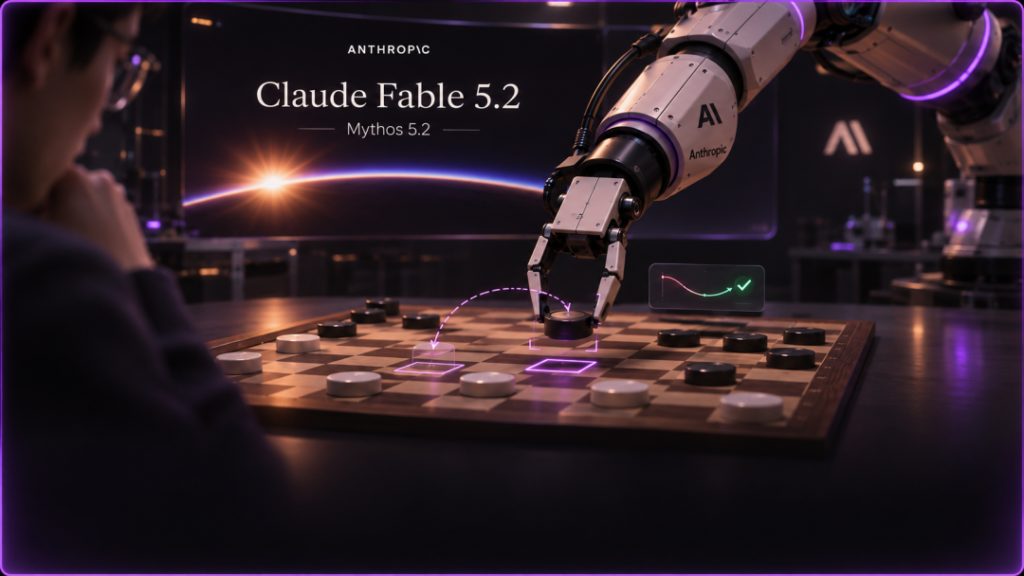
Just now! Anthropic enters the embodied world: Fable 5.2 runs 62 steps on real device, correcting deviations….
Content Summary
Author | Fei Ye, Qing He Editor | April Anthropic is at a very delicate timing. On one side is the unpredictable IPO test. Even though the valuation has converged to about $1.5 trillion, the potential
Anthropic is standing at a very delicate moment in time.
On the other hand, under close scrutiny from the capital markets, Anthropic unveiled its long‑awaited technical trump card: the next‑generation flagship model Claude Fable 5.2 and Mythos 5.2. Among them, Fable 5.2 is open to ordinary users after passing security restrictions in cybersecurity and biology, while Mythos 5.2 is primarily provided to vetted cybersecurity and life‑science research institutions.
Beyond Anthropic’s traditional strength in autonomous programming engineering, this time a new variable has been added—accelerating penetration into the physical world and embodied domains.
On the industry‑recognized benchmark—mechanical arm operation simulation RoboDojo, Fable 5.2 achieved an average success rate of 64.9%, not only leaving the previous generation Fable 5.1 (27.6%) and Opus 5.5 (39.4%) behind, but also directly surpassing GPT‑6 Astra (29.8%) by more than double.
Moreover, this capability is rapidly spilling into the real world—during a subsequent third‑party developer blind test on actual hardware, it took control of a real robotic arm and completed a full 62‑move game of checkers, and when frequently encountering physical contact errors and hardware deformation, it demonstrated a rare ability to self‑correct.
At the same time, former Tesla Optimus team dexterous manipulation engineer Bingjie Tang confirmed joining Anthropic as MTS (Member of Technical Staff). During her time at Tesla, she worked extensively on learning‑based dexterous manipulation for humanoid robots, covering data collection, policy training, model evaluation, and deployment on real robots; previously at NVIDIA Robotics Lab, her research focused on manipulation in contact‑rich environments and sim‑to‑real transfer.
In fact, this talent movement is not a one‑off action. Looking back over the past year, Anthropic’s testing chain in the physical world has been quite clear:
-
2025 launch Project Fetch, initially having Claude assist non‑robotic experts in programming to control robot dogs, and then further testing the model’s ability to autonomously connect to devices, read sensors, and execute tasks;
Released in July 2026 “Claude Plays Robotics” research, expanding the test scopeto robotic arms, quadruped robots, and humanoid robots, exploring how general-purpose large models can control robots through visual perception, task planning, and invoking motion strategies. In the same month, the launch of Project Pilot extended the experimental subjectsto drones, testing autonomous navigation and target tracking capabilities.
In August, the Model Hardware Standard (MHS) was released, attempting to establish a unified interface for AI to operate physical devices such as microscopes and robotic arms.
</ul
You can see that Anthropic is clearly no longer satisfied with having Claude operate only within software environments. This probing of the physical world is essentially a boundary breakthrough forced by commercial realities.
At a critical juncture of preparing for an IPO, the capital market’s scrutiny of Anthropic’s $1.5 trillion valuation is becoming increasingly stringent. Although overall revenue is still soaring, its Q3 quarter‑over‑quarter growth has slowed dramatically from 144% in the previous quarter to 47%. Coupled with margin pressure from massive compute investments, relying solely on in‑screen API calls and enterprise software subscriptions is visibly hitting a ceiling on growth speed.
The strategic weight of Physical AI is therefore being rapidly elevated.
From partnering with engineering service provider UST to embed Claude into chip manufacturing and automotive production lines, to launching the MHS specification that directly schedules scientific instruments and industrial equipment; and now with the Fable 5.2 robot simulation benchmark doubling, and former Tesla Optimus dexterity engineer Bingjie Tan joining at speed—Anthropic is trying to prove to investors that Claude will not remain just a brain in a chat window,it has the potential to become the core of physical productivity execution.
Although embodied business is unlikely to become a performance pillar in the short term, the shift in industry competition focus is an undeniable fact: large models are no longer satisfied with “answering questions,” but aim to “take over work.”
This logic of accounting based on the “final deliverable result” also extends to software development. A strikingly dramatic contrast then appears in Fable 5.2: even though its token price is exactly twice that of Opus 5.5, in high‑difficulty engineering tasks its actual cost bill is actually half as much.
Do you remember the discussion sparked by GPT-6 Astra in the robot simulation field back in September?
At that time, the paper “An Unexpected Robot Policy” presented a striking direction:There is no need to train a dedicated policy model for each robot task; a general large model can directly participate in robot control through visual observation, reasoning, and action interfaces. This prompted many to re‑examine the relationship between general large models and specialized embodied models.
Now, Anthropic has pushed this achievement much further.
In the officially released RoboDojo Sim benchmark, Fable 5.2 achieved 64.9%, GPT‑6 Astra scored 29.8%, the previous generation Fable 5.1 scored 27.6%, and Opus 5.5 scored 39.4%.
Converted, Fable 5.2’s performance is 2.18 times that of GPT-6 Astra, and 2.35 times that of Fable 5.1.
△ Performance of each model in RoboDojo Sim. Image source: Anthropic. This set of results was run internally by Anthropic, using each model’s highest available inference strength.
RoboDojo evaluates not conceptual understanding but end‑to‑end task execution: the model, based solely on a continuous video feed from a camera, must autonomously determine the spatial trajectories of each robotic arm joint and the gripping force. An average score of 64.9% meansit has moved beyond the trial‑and‑error realm of “random attempts” and is beginning to exhibit stable, cross‑scenario planning of continuous actions.
In the official live demo, Fable 5.2, without any task‑specific fine‑tuning, performedprecise actions such as manipulating puzzle blocks, unscrewing a bottle cap, and drawing simple sketches on cardboard with a pen.
△ Fable 5.2 controls a real robot to perform fine operations. Image source: Anthropic
In addition, unfiltered tests from third‑party developers further measured the upper limit of Fable 5.2’s generalization ability.
In the test, developer Karolina Dubiel (@karolina_dubiel) connected Fable 5.2 directly to a real physical robotic arm,letting it play a complete game of checkers with a human in a real desktop environment.
This seemingly simple adversarial test actually challenges the roughness and unpredictability of the real physical world:
– Fault tolerance: During the 62 moves of the whole game, due to table reflections, slight piece displacement, and insufficient gripper friction, the robotic arm experienced 14 instances of grasp drops or offsets. Yet without any manual code rewrites, the tester simply entered the natural language command “try again,” and Fable 5.2 was able to use visual feedback to actively review the previous failure, recalculate the grasp angle, and retry the action.
– Physical feedback perception and dynamic compensation: When the robotic arm extends under load, the end effector sags about 7 mm due to gravity and mechanical play. Faced with this unplanned physical deformation, Fable 5.2 does not execute the original theoretical spatial coordinates mechanically; instead, it reads torque and displacement telemetry from the joint sensors, autonomously adding a compensatory offset in subsequent motions to achieve accurate placement.
At the same time, Dubiel’s testing also exposed clear limitations of the current approach.
She added in the comments that the entire game actually took about 46.5 minutes, averaging roughly 45 seconds per move. The public video was sped up several times, even up to hundreds of times, so the real operation was not as smooth as it appears in the video.
On the business side, Fable 5.2 creates an apparent pricing paradox.
Its API costs $8 per million input tokens and $40 per million output tokens, which is a 20% reduction compared to the previous generation, but still exactly twice that of the flagship model Opus 5.5. Under normal logic, a doubling of unit price means soaring R&D costs.
However, in multiple tests involving real-world engineering, the ledger went in the opposite direction:
-
Code merge benchmark FrontierCode 2.0: Fable 5.2 only needs to enable the High inference tier to achieve 45.3%, matching Opus 5.5’s top tier at 45.5%, reducing the total cost per single task by about 50%; if pushed to the Xhigh tier, the score jumps directly to 49.1%, surpassing GPT-6 Astra (42.8%).
Knowledge and Chart Tasks: In the Perplexity WANDR large‑scale information collection and Chartography benchmark, Fable 5.2 achieved the same or even higher accuracy with about 40% of the single‑task cost of Opus 5.5 and less than 10% of the cost, respectively.
The essence of this cost inversion lies in the “First‑pass Yield” delivering a dimensionality‑reduction impact on compute consumption.
Real‑world tests by community developers revealed the key gap: creating a 3D submarine scene took Opus 5.5 6 hours 40 minutes with frequent human intervention for error correction and detail addition, whereas Fable 5.2 completed it in just 1 hour 26 minutes, almost in a single pass.
In complex projects with multiple nested iterations, the most costly aspect of traditional large models has never been the per‑token price of a single output, but ratherthe endless context rework, debugging backtracking, and human engineer intervention time caused by logical breakpoints.
Of course, this advantage does not apply to all scenarios: in the system operation test OSWorld 2.1, Fable 5.2 (89.3%) only leads Opus 5.5 by 2.1 percentage points; in the business flow AutomationBench, it even falls behind Gemini 4 Carbon’s 53.9% with a score of 51.4%.
In other words, when dealing with basic tables and shallow system clicks, Fable 5.2 may be an over‑engineered, high‑priced tool; but in the deep‑water zone where high fault tolerance and deeply consistent logic are required, it is a skilled worker that can save you dozens of rounds of ineffective debugging.
If code and robot testing demonstrate localized productivity, then in extreme engineering experiments, Fable 5.2 is the first to make continuous operation of large‑scale agent clusters industrially viable.
The most typical validation isthe formal transcription of Fermat’s Last Theorem. Anthropic scheduled about 1,000 Fable 5.2 agents, and in an environment with minimal human intervention, they completed the full formalization of the theorem in Lean in roughly 30 hours, whereas the previous system required 11 days.
A more critical set of comparisons occurs in the later stages of the task:
-
After running continuously for 18 hours, Fable 5.2 reached 86% progress, while Opus 5.5 was only at 26%;
-
Continuing to 30 hours, Fable 5.2 smoothly converged to 100%, whereas Opus 5.5 barely crawled to 27% and fell into a logical deadlock.
This ability to resist context drift and avoid logical dead loops in extremely deep reasoning networks has been directly reproduced in real engineering development:
-
Pure white‑paper construction system: Engineers started it from an empty folder, scheduled over 1,000 sub‑agents to run continuously for 8 days, and ultimately delivered a complete prototype of a notebook operating system that includes kernel, drivers, file system, window interaction, and embeds Claude.
-
Underlying architecture migration: A team of agents directly rewrote a critical production service from Python to Rust in full, resulting in a 26‑fold increase in service startup speed after deployment.
-
End‑to‑end hardware‑software penetration: Based solely on requirement descriptions, we collaborated with Diode to design three physical electronic products, covering component selection, PCB layout, 3D modeling of enclosures, and firmware flashing in a single seamless process; after hardware prototyping, the devices power on and operate without any circuit modifications.
In the past, the industry often talked about multi‑agent collaboration, but after dozens of toolchain calls, accumulated errors often cause the entire system to fall into a hallucination avalanche. The technical increment demonstrated by Fable 5.2 precisely pushes the fault‑tolerance threshold of long‑range tasks a great step outward.
From eight consecutive days of low‑level system inference on the screen to adaptive correction of a robotic arm’s end effector in the physical world, Anthropic, which is shaking the secondary market, is clearly no longer satisfied with being just a high‑premium software Copilot.
Under the spotlight of the capital markets, the story it is rewriting is that of an autonomous execution unit moving toward tangible productivity.
Disclaimer: This article is original to AI Frontline,does not represent the platform’s views, nor constitute investment advice, and may not be reproduced without permission.
The momentum continues: See you at AICon Beijing in December
On December 18–19, the AICon Global Artificial Intelligence Development and Application Conference will be held in Beijing. This year’s conference focuses on exploring the boundaries of A applications, featuring 13 major technical topics covering post‑training of large models, inference optimization, agent engineering, knowledge engineering, intelligent agent evaluation and security, self‑evolving systems, AI software delivery, native architecture, and organizational transformation, gathering top technical experts to deeply share real‑world breakthroughs in AI technology and large‑scale enterprise implementations.
Today’s Recommended Article
Are you also “watching”? 👇
Get MirrorSpeed
Get MirrorSpeed