报名开启Ⅰ启元实验室AI算法大赛,两大赛道聚焦开放世界目标感知!
Registration Open: I. Qiyuan Lab AI Algorithm Competition, Two Tracks Focus on Open-World Object Perception!
Content Summary
Each track awards 1 first prize, 2 second prizes, and 3 third prizes, with certificates of honor and “DJI series” physical prizes. With the rapid development of visual large models and multimodal technology, an old problem is becoming a new bottleneck: reliance
Each track awards 1 first prize, 2 second prizes, 3 third prizes, presents a certificate of honor, and provides physical prizes from the “DJI series”.
With the rapid development of large visual models and multimodal technology, an old problem is becoming a new bottleneck: traditional perception models trained on fixed categories are increasingly unable to meet the demands of object recognition in open environments. Categories absent from the training set, subtle fine‑grained differences that are hard to describe, objects under occlusion or low illumination, models that fail when the scene changes—
How can we accurately discover and locate new objects unseen during training based on natural language prompts or a few visual examples?
To address this, Qiyuan Laboratory launches the “Qizhi Cup” AI Algorithm Competition.
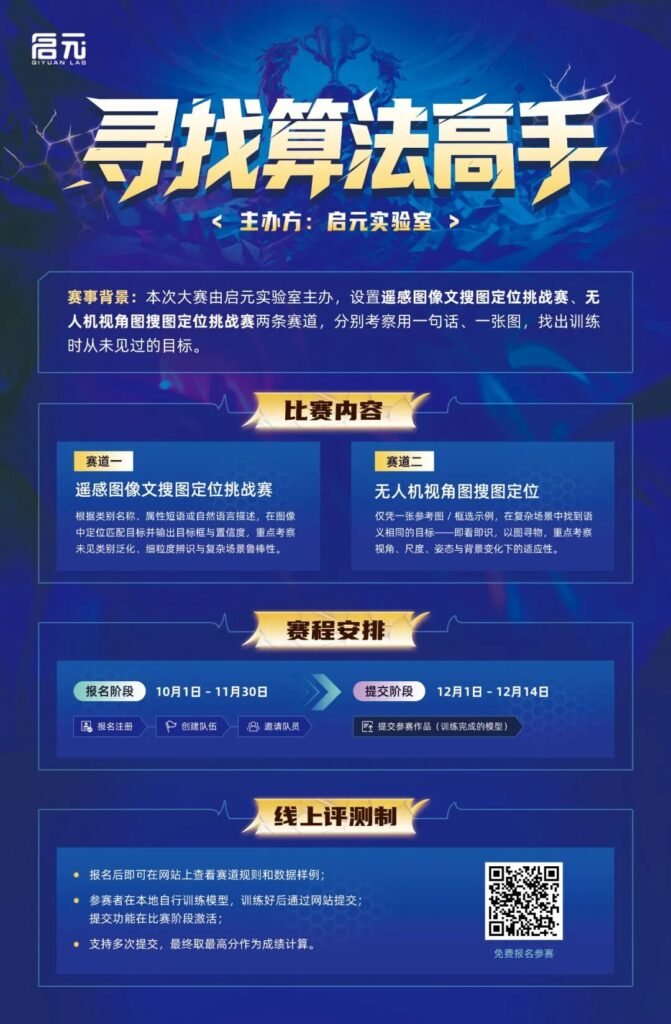
This competition features two tracks: 【Remote Sensing Image Text Search and Localization】 and 【Drone Perspective Image Search and Localization】, focusing on the capability directions of “language‑driven open‑target perception” and “instant recognition, image‑based object retrieval.” It aims to advance perception models from “fixed‑category recognition” toward open‑world understanding.
-
Track 1:Text-to-Image Retrieval · Remote Sensing Image Text-to-Image Retrieval Challenge
One sentence, find the target.
Participating teams must design and optimize open perception algorithms to recognize and locate targets that match the textual prompt—based on category names, attribute phrases, or natural language descriptions—in test images, outputting the corresponding bounding boxes and confidence scores.
The competition uses unified metrics, and conducts a comprehensive evaluation across six dimensions: basic perception, unseen‑class generalization, fine‑grained discrimination, prompt variation adaptation, robustness in complex environments, and cross‑domain scenario generalization. The focus is on two aspects: first, the algorithm’s ability to understand diverse linguistic expressions; second, its stability and adaptability under occlusion, low illumination, blur, and scene‑change conditions.
Example challenge: given a textual prompt for a campus patrol scene—“a white aircraft on the ground”—the participating model must understand the target category, color, and spatial relationship, locate all matching objects in the image, output the corresponding bounding boxes and confidence scores, and exclude distracting objects that do not meet the criteria. Cars on the ground or a dark aircraft in the distance should not appear in the results.
-
Track 2:Image‑to‑Image Search from Drone Perspective – Challenge
See it, recognize it, find items with images.
In real-world applications, many targets are hard to fully define with fixed category names—they can be described but not precisely; they can be exemplified but not exhaustively. The most natural approach then is: show the model an image.
This track requires participating teams to design and optimize visual‑prompt‑driven open‑world perception algorithms that, based on a target reference image, a cropped image, or a boxed example, identify and locate targets with the same semantics in test images. The challenge uses the same evaluation metrics as the text‑prompt track, focusing on the algorithm’s ability to adapt to different viewpoints, scales, poses, and background changes, as well as its stability under low‑quality prompts and complex environments.
Example: given a reference image of a “white airplane on the ground,” the model must find all semantically identical objects in a complex campus scene—no matter the angle, scale, or background—while excluding visually similar distractors.
The entire competition this year is held online, with participants training models locally and submitting their competition models through the competition website. The system will run evaluations and update scores.
-
Registration period (October 1 – November 30)
-
Scoring Rules:
-
Eligibility
Since the competition launched, community activity has continuously risen. A large number of high‑quality discussions have emerged around competition rules, evaluation standards, data usage, and submission processes. The organizers have assigned multiple technical and operations staff to respond online, ensuring participants can efficiently advance their modeling and submission work.
In this high‑level algorithm competition, participants will gain not only technical breakthroughs, but also professional guidance and review feedback from industry‑leading experts. During the event, industry experts will provide Q&A support and on‑site commentary on key aspects such as algorithm design and model optimization, offering contestants valuable growth opportunities.
At the same time, the competition is also an important window for showcasing technical achievements and enhancing team influence. Leveraging the “Qizhi Cup” to connect research, universities, and industry resources, outstanding projects are expected to move from the lab to real-world applications, and technical strength will be seen and recognized by more industry organizations.
This year’s competition is a public‑welfare event with no cash prizes. Each track awards one first prize, two second prizes, and three third prizes, along with an honor certificate and physical awards:
[First Prize] DJI Osmo Pocket 4P Vlog Set;
[Second Prize] DJI Osmo Pocket 3 Gimbal Camera;
[Third Prize] DJI Osmo Mobile 7P smartphone gimbal.
Outstanding participants will also receive a green recruitment channel from Qiyuan Lab (final results are subject to job requirements, personal preference matching, and employer assessment conclusions).
Turn technical achievements directly into career competitiveness.
The competition website provides registration, data usage, review and evaluation and other participation guarantees. Participants must register through the competition website: http://121.196.102.212/portal.
Get MirrorSpeed
Get MirrorSpeed