Cells constantly consume ATP, so many reactions can become trapped in states that would be impossible at equilibrium. If the driving force supplied by the fuel is fixed, how far can the steady state of a chemical reaction network deviate from equilibrium? A recent study published in Physical Review X answered this question without needing any rate constants: knowing only the network topology, the standard free energies of the species, and the driving force, one can delineate all possible steady‑state concentrations, i.e., the “thermodynamic space” of the network. Using this framework, the authors calculated the thermodynamic limits on processes such as chiral selection and molecular self‑assembly, and even identified missing steps in a network. This article is an interpretation of the work by the paper’s first author, Liang Shiling.
Keywords: nonequilibrium thermodynamics, chemical reaction networks, hypergraphs, symmetry breaking, self‑assembly
Paper title: Thermodynamic Space of Chemical Reaction Networks
Paper link: https://doi.org/10.1103/g875-ldn5
Journal: Physical Review X
Publication date: October 26, 2026
</h3
Starting from equilibrium
If you seal a pot of molecules, it will eventually reach chemical equilibrium: the concentration of each molecule is uniquely determined by free energy and conserved quantities, independent of reaction rates. In living systems, however, chemical reactions continuously consume energy. Cells constantly use fuels like ATP and expel waste, so the reaction network operates in a far‑from‑equilibrium steady state, allowing the normally scarce high‑energy structures at equilibrium to accumulate in large amounts, and enabling an imbalance between left‑handed and right‑handed molecules of equal energy.
How much deviation can energy consumption produce? Non‑equilibrium steady states usually depend on all kinetic details, and most rate constants in real networks are unknown. The research team addressed a simplified version of this question in their 2024 PRL paper[2] (see the Jizhi Club article “PRL Express: Thermodynamic Limits of Symmetry Breaking in Living Systems”, then referred to as the “non‑equilibrium phase space”), but it only applied to linear and catalytic networks where each reaction converts one molecule into another. Real chemical reactions often involve multiple molecules, such as two monomers forming a dimer, turning the network into a “hypergraph,” where the original method no longer works. The new work[1] tackles this general case.
The starting point of the study is the minimal reaction cycles in the network, namely elementary flux modes. Traversing a cycle once returns the internal molecular counts to their original state; the net effect is merely converting fuel into waste, and the released free energy constitutes the “budget” of that cycle. The research team demonstrated that, as long as the network can reach a steady state, the driving force of any reaction will not exceed the largest budget among the cycles that contain it (scaled by the number of times the reaction appears in the cycle).
Concentrations are subject to the same constraints. The conversion between a set of molecules often follows multiple pathways, each consuming varying amounts of fuel; each pathway corresponds to an effective equilibrium constant. Regardless of the chosen rate constants, the steady‑state concentration combinations are bounded between the minimum and maximum effective equilibrium constants. These inequalities together define the thermodynamic space (Figure 1). At equilibrium the upper and lower bounds coincide, collapsing the space to a point; the stronger the driving force, the wider the space. When a particular pathway becomes fast enough to dominate the entire network, the system will lie on the boundary determined by that pathway, so this inequality also indicates which pathway must be accelerated to push a given concentration to its limit.
If there is no direct reaction between two groups of molecules, the research team introduces an ultra‑slow “probe reaction” into the network. It carries virtually no flux, does not alter the steady state, yet can read the chemical potential difference at its ends, much like a voltmeter with infinite internal resistance. In this way, as long as a conversion does not violate conservation laws, upper and lower bounds can be written for the corresponding concentrations.
Figure 1. Schematic of thermodynamic space. (a) An external chemical reservoir supplies fuel and removes waste; molecules in the network are transformed and assembled via multiple pathways; the red and blue lines represent the pathways with the largest and smallest free‑energy changes, respectively. (b) All steady‑state concentrations lie between the boundaries defined by these two pathways (green region), and the width of the region is proportional to the non‑equilibrium driving force.
Chirality and Self-Assembly
Chirality is the most intuitive example. A pair of mirror‑image molecules have the same energy and each occupies half at equilibrium. The research team analyzed the classic Frank model[3]: the two chiral molecules R and S are generated autocatalytically from an achiral precursor, and then combine into dimers that consume each other. The conclusion is |ln(r/s)| ≤ Δμ/RT, where Δμ is the free energy released when two precursors become one dimer, meaning that the degree of chiral deviation is capped by the driving force (Figure 2). Roughly estimating with this model, at room temperature, to have one chiral molecule reach 99%, the driving force must be at least about 11 kJ/mol; each additional “9” in the proportion requires roughly another 5.7 kJ/mol; achieving 100% homochirality would require an infinite driving force.
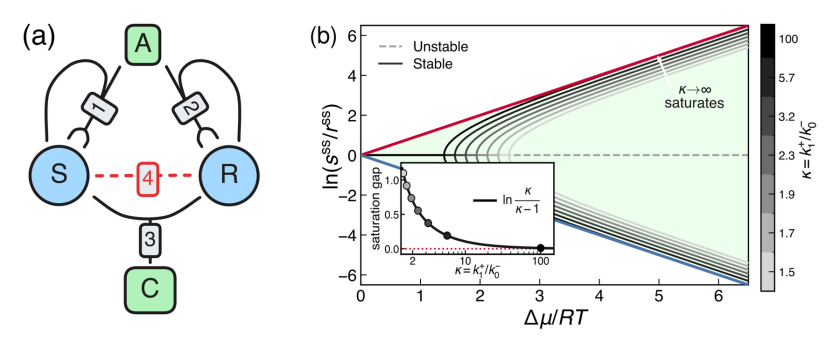 Figure 2. Thermodynamic upper limit of chiral symmetry breaking. (a) Frank model, concentrations of A and C are fixed externally, the red dashed line compares the probe reactions of S and R. (b) When the driving force exceeds the critical value, the racemic state (gray dashed line) splits into two chiral solutions, all solutions lie between ±Δμ/RT (red and blue lines); the faster the dimerization (larger κ), the closer to the upper limit.
In a fuel‑driven self‑assembly model, the thermodynamic spaces of monomers, dimers, and trimers intersect the plane of “conservation of total monomer units,” yielding all possible steady states (Figure 3); random simulations with a large number of rate constants never produce a steady state that exceeds the bounds. In this model, the abundance of dimers and trimers relative to monomers can be up to exp(Δμ/RT) times higher than at equilibrium. The same approach also provides the thermodynamic limits for chemical bistability (the Schlögl model) and the contrast of reaction‑diffusion patterns.
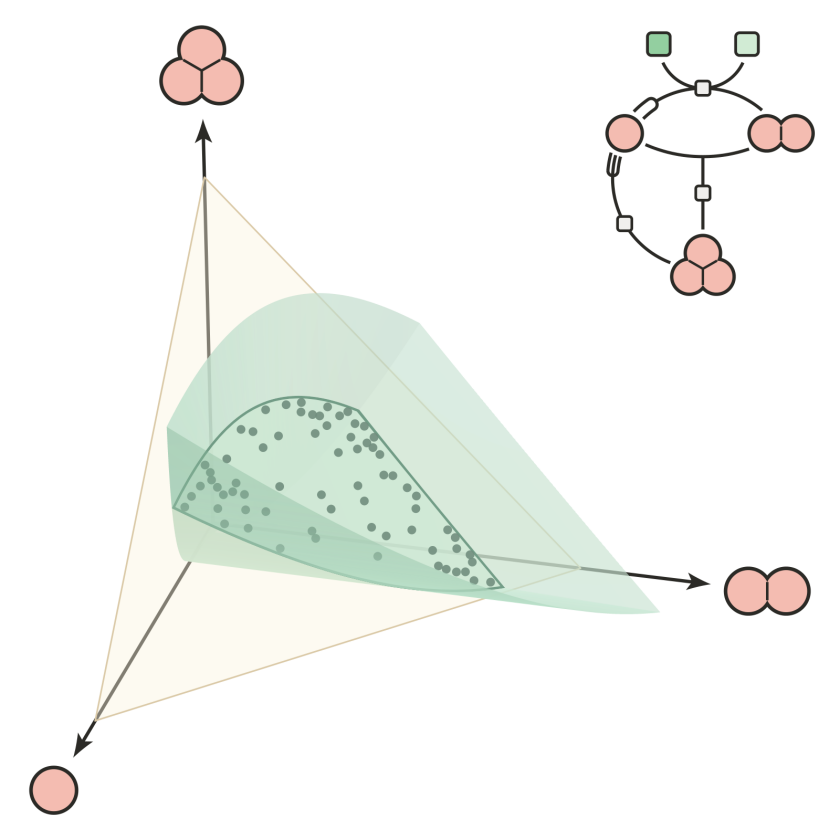 Figure 3. Thermodynamic space of self-assembly. The three axes represent the concentrations of monomers, dimers, and trimers; the beige plane indicates conservation of the total number of monomer units, and its intersection with the green thermodynamic space yields all possible steady states, with dots representing steady states under random rate constants. The upper right corner shows the reaction network.
Conversely, validate the model
Regardless of what value the rate constant takes, the steady state cannot escape the thermodynamic space, so once the measured concentration goes out of bounds, the problem lies in the model itself. One example is dimer assembly (Figure 4): if the network includes a step “two activated monomers directly bind,” the fuel‑driven activation reaction can be used twice in one cycle, and the amplification upper limit of the dimer is exp(2Δμ/RT); without this step, the limit is only exp(Δμ/RT). Once the measured amplification factor exceeds the latter, the network lacking this step can be excluded without fitting any rate constants. This reuse of the drive is unique to hypergraphs and does not occur in linear networks.
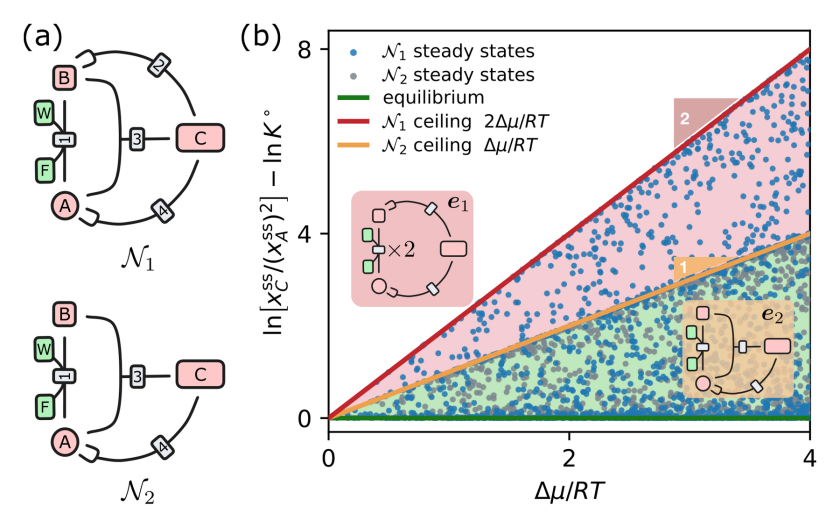 Figure 4. Testing network structure using thermodynamic space. (a) Candidate network N1 contains all four reactions, N2 lacks reaction 2 (2B⇌C). (b) Upper limit of dimer amplification: N2 is the orange line with slope 1, N1 is the red line with slope 2. The dots represent steady states under random rate constants; measurements falling within the red region can rule out N2.
This work also leaves many follow‑up tasks. The most immediate is oscillation: sustained oscillators such as circadian clocks never settle into a steady state, and whether the thermodynamic space can be extended to limit cycles remains an open question. Another direction is metabolic networks. Previously, people often treated “which concentrations are achievable” as a constraint‑optimization problem over a large number of rate constants; the thermodynamic space directly provides the exact feasible region and identifies which pathway determines the limit of a given product. The challenge is how to efficiently find these pathways in large networks. When designing artificial chemical systems, one can also use it for a quick estimate: with a certain fuel, what is the furthest step an assembly or replication system can reach? As for the origin of homochirality, it provides a necessary condition: to achieve a given proportion of a particular chiral molecule, the driving force must be at least how large.
All images in the article are taken from paper [1] and used under a CC BY 4.0 license; some images have been cropped and renumbered, and the caption of Figure 1 has been translated into Chinese.
References
[1] S. Liang, P. De Los Rios, D. M. Busiello. Thermodynamic Space of Chemical Reaction Networks. Phys. Rev. X 16, 041026 (2026).
[2] S. Liang, P. De Los Rios, D. M. Busiello. Thermodynamic Bounds on Symmetry Breaking in Linear and Catalytic Biochemical Systems. Phys. Rev. Lett. 132, 228402 (2024).
[3] F. C. Frank. On spontaneous asymmetric synthesis. Biochim. Biophys. Acta 11, 459 (1953).
[4] P. Goloubinoff, A. S. Sassi, B. Fauvet, A. Barducci, P. De Los Rios. Chaperones convert the energy from ATP into the nonequilibrium stabilization of native proteins. Nat. Chem. Biol. 14, 388 (2018).
[5] C. Berton, D. M. Busiello, S. Zamuner, et al. Thermodynamics and kinetics of protonated merocyanine photoacids in water. Chem. Sci. 11, 8457 (2020).
Shiling Liang, postdoctoral researcher (ELBE) at the Dresden Center for Systems Biology (CSBD), earned a Ph.D. in Physics from EPFL in Lausanne, Switzerland, in 2024, and will join the Department of Physics at Fudan University as an assistant professor in early 2027. Research focuses on nonequilibrium thermodynamics and living systems, investigating the universal constraints on systems far from equilibrium and how these constraints influence biological processes.
The group will recruit Ph.D. students and postdoctoral researchers in the Department of Physics at Fudan University, and undergraduates are also welcome to join research projects. The work centers on nonequilibrium statistical physics, stochastic thermodynamics, and chemical reaction networks. Students with backgrounds in physics, chemistry, biology, mathematics, or computer science are encouraged to contact us, specifying their background and research interests. Interested candidates should email sl-liang@outlook.com; more information is available on the personal homepage:
Non-equilibrium Statistical Physics Reading Club
The 2024 Nobel Prize in Physics was awarded to artificial neural networks, marking a machine‑learning revolution sparked by statistical physics. Statistical physics not only explains thermal phenomena but also helps us understand how different scales—from microscopic particles to the macroscopic universe—are connected and how complex phenomena emerge. By studying the collective behavior of large numbers of particles, it successfully links the randomness of the microscopic world with the determinism of the macroscopic world, providing a powerful tool for understanding nature and offering a significant driving force for the development of machine learning and artificial intelligence.
To deeply explore the frontier advances in statistical physics, the Jizhi Club, together with the School of Science and the Center for Interdisciplinary Science at Westlake University, chaired by Professor Tang Lei‑han, Professor Wang Jin from the Department of Chemistry and Physics at SUNY Stony Brook, postdoctoral researcher Liang Shiling from the Dresden Center for Systems Biology, Assistant Professor Tang Qian‑yuan from the Department of Physics at Hong Kong Baptist University, and many other renowned scholars at home and abroad, jointly launched the “Nonequilibrium Statistical Physics” reading group. The reading group aims to discuss the latest theoretical breakthroughs in statistical physics, its applications in complex systems and life sciences, and interdisciplinary research with cutting‑edge fields such as machine learning. The reading group has concluded; you can now sign up to join the community and unlock access to the replay videos.

For details, see: From Thermodynamics and Life to Artificial Intelligence: The Journey of Statistical Physics – Non-equilibrium Statistical Physics Reading Group Launch!
6. The college entrance exam score is just a ticket, your research adventure sets sail here!
7. Join the JiZhi Subtitle Group: Become a “networker” in the complex science knowledge community
Click “Read Original”, sign up for the book club