What Is a Complex System? Why the Economy Is a Complex System | “Understanding Chaos” Book Club Episode 1
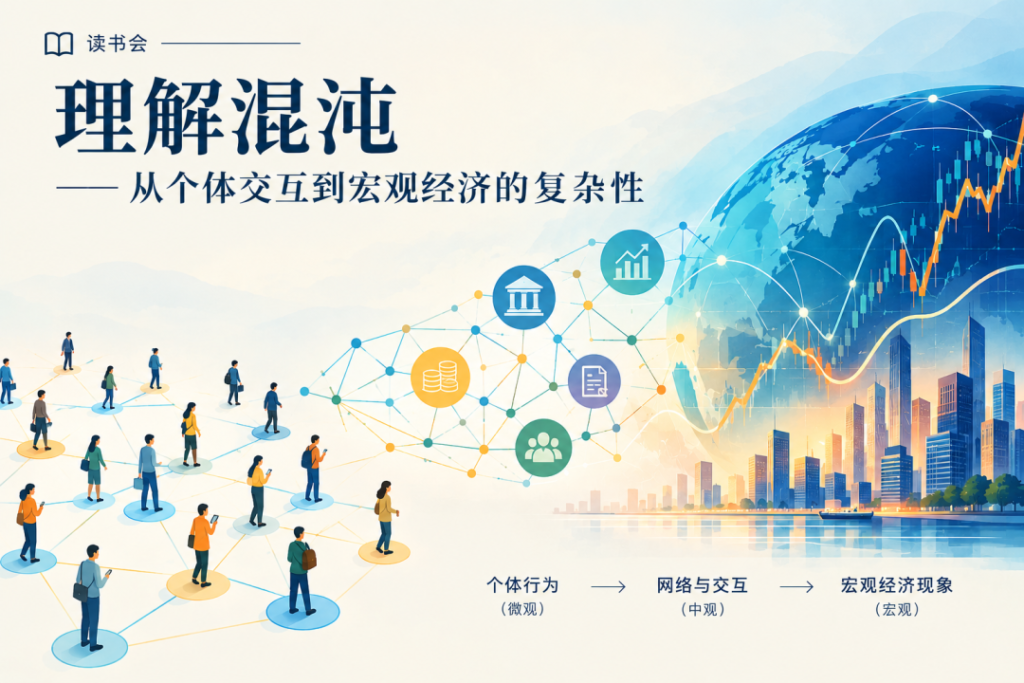
What Is a Complex System? Why Is the Economy a Complex System | “Understanding Chaos” Book Club Session 1
Summary
Intro: Is the economy a machine that can be precisely described by mathematics, or a constantly evolving complex system? Join us as we follow the newly published complex economics book Understanding Chaos, start from individual interactions, and explore the complexity behind macroeconomic phenomena.
Introduction
Is the economy a machine that can be precisely described by mathematics, or a constantly evolving complex system? Let’s follow the newly published complex economics book Understanding Chaos, start from individual interactions, and explore the complexity behind macroeconomic phenomena. This issue is the first session of the Understanding Chaos reading club, where master’s student Fang Yiwen from Beijing Normal University will share the book’s introduction, Chapter 1, and Chapter 2.
“Understanding Chaos” is translated by the JiZhi Club. This new‑book reading session is jointly initiated by three translators: Tao Ruyi, a PhD student at Beijing Normal University; Sun Lu, a PhD student at the University of Macau; and Fang Yiwen, a master’s student at Beijing Normal University. The reading club will run online every Saturday from 19:30 to 21:30 starting October 31, 2026, for about ten weeks, featuring a main presentation, discussion, and a post‑session video replay. Participants who wish to engage more deeply are welcome to apply to be a session speaker.
Report Overview
Why, even with increasingly abundant data and sophisticated economic models, do we still struggle to accurately predict economic crises? Must economic fluctuations always stem from external shocks? How do simple micro‑level behaviors give rise to complex macro‑economic phenomena?
In this reading group we will jointly read the preface, introduction, and first two chapters of J. Duoyin Famer’s Understanding Chaos: Better Economic Theory, Better Understanding of the World. Starting from the case of economic forecasts during the COVID‑19 pandemic, we will introduce the different research approaches of complex economics versus standard economics, explore core concepts such as emergence, adaptation, and chaos, and further use economic networks, balance‑sheet relationships, and agent‑based modeling to understand how economic systems continuously evolve through individual interactions.
Let’s re-examine economic operations from the perspective of complex systems, considering how economic theory influences our understanding of the world, forecasts of the future, and decision-making.
Sharing Outline
-
[Preface] A Successful Economic Forecast:Supply and demand shocks under the COVID-19 pandemic, industrial network transmission, dynamic models, and forecasting performance
-
[Introduction] Why do we need complex economics?:Limitations of traditional economic models, comparison of research paradigms, agent-based models, realism principle
-
[Chapter 1]What is a complex system?:Emergence and adaptation, scientific prediction, roulette, chaos theory and economic cycles
-
[Chapter 2] The economy is a complex system:Economic ecosystem, economic networks, balance sheet networks, accounting + behavioral science
</h3
Core Concepts
-
Complex systems and emergence: Complex systems consist of interacting components, and the whole can exhibit properties that individual parts do not possess. Macro‑economic phenomena may also emerge from the interactions of many micro‑economic agents.
-
Chaos: Deterministic nonlinear systems can also produce irregular motions that are difficult to predict in the long term.
-
Agent‑based modeling: By defining economic agents with bounded rationality and heterogeneity and their behavioral rules, we simulate transactions and feedback among agents, studying the formation and evolution of macro‑economic phenomena from the bottom up.
-
Economic networks: Economic agents form interdependent networks through production, trade, and financial contracts.
Speaker Introduction
Speaker Introduction
Speaker: Fang Yiwen, master’s student at the School of Systems Science, Beijing Normal University, translator of “Understanding Chaos”. Research focus: macroeconomic reconstruction.
References
References
[1] MISHKIN F S. Housing and the monetary transmission mechanism[R]. Washington, DC: Board of Governors of the Federal Reserve System, 2007. (Finance and Economics Discussion Series, No. 2007-40).
[2] DEL RIO-CHANONA R M, MEALY P, PICHLER A, et al. Supply and demand shocks in the COVID-19 pandemic: an industry and occupation perspective[J]. Oxford Review of Economic Policy, 2020, 36(S1): S94-S137.
[3] PICHLER A, PANGALLO M, DEL RIO-CHANONA R M, et al. Production networks and epidemic spreading: how to restart the UK economy?[R]. Oxford: Institute for New Economic Thinking, University of Oxford, 2020. (INET Oxford Working Paper, No. 2020-12).
[4] PICHLER A, PANGALLO M, DEL RIO-CHANONA R M, et al. Forecasting the propagation of pandemic shocks with a dynamic input-output model[J]. Journal of Economic Dynamics and Control, 2022, 144: 104527.
</h3
Time Information
⏰ Time: October 31, 2026 (Saturday) 19:30-21:30
📍Online: Tencent Meeting
📍Live: Jizhi Club WeChat Video Channel and Bilibili account streaming simultaneously
Friends interested can scan the QR code to sign up for the reading club, then join the student group for communication.
Live Information
</h3
Sign up for the reading group: “Understanding Chaos”
“Understanding Chaos” is translated by the Jizhi Club. This new‑book reading session is jointly organized by Jizhi Club together with three translators: doctoral student Tao Ruyi from Beijing Normal University, doctoral student Sun Lu from the University of Macau, and master’s student Fang Yiwen from Beijing Normal University.
The reading club will run online every Saturday from 19:30 to 21:30 starting October 31, 2026, for about ten weeks. Each session includes a main presentation, discussion, and a video replay will be provided afterward. Participants who wish to engage more deeply are welcome to apply to be a guest speaker for a session.
Scan the QR code in the poster to sign up for the reading club
Registration Method
Step 1: Scan the QR code with WeChat to fill in the registration information.
Scan to Register
Step 2: After filling in the information, pay to register. If you need to pay with Alipay, please go to the reading group page on a PC to register and pay:https://pattern.swarma.org/mobile/study_group/92?from=wechat
Step 3: Add the operations manager on WeChat and be added to the reading group community (WeChat group) for the corresponding topic.
PS:
We encourage in‑depth discussions around economics, complex systems and related specific issues. To ensure discussion quality, please avoid posting content that is unrelated to the current reading group’s theme, lacks empirical basis, or is overly abstract philosophical speculation.
If the discussion content clearly deviates from the theme and does not adjust after a reminder from the moderator, we will have to remove that member from the discussion group to maintain the overall learning environment, and proportionally refund the portion they did not participate in based on their actual participation progress.
Thank you for your understanding and cooperation; let’s together create a focused, in‑depth, rewarding learning community.
Join the community to enjoy core resources
Become a member to unlock the full learning ecosystem, including:live online Q&A, on‑demand recordings of all courses, exclusive material sharing, high‑quality community interaction, first‑hand information updates, as well as throughparticipating in co‑creation tasks to earn points and other benefits.
Special Refund and Incentive Mechanisms
We offer two ways for your investment to receive tangible returns:
-
Task Completion Refund Path
Claim and successfully complete any two subtitle tasks, and you will receive a full refund of the registration fee, plus an exclusive JiZhi merchandise reward.
-
Operational Growth Incentive Path
After successfully completing a subtitle task, you can apply to become an operations assistant. Once the reading club project is successfully completed, the tuition fee will be refunded. Outstanding performers also have a chance to receive additional scholarships.
Recommended Content
Santa Fe · Classic Papers in Complex Science Season 1 | Ji Zhi Club Reading Club Launch
Kleiber’s Law: the Kepler’s Law of the Biological Realm
JiZhi Encyclopedia: Nonlinear Center | Wang Ye, Tao Ruyi
Starting from the “physics” equation, dissecting predictability in business growth | Tao Ruyi
Tao Ruyi: Balancing efficiency and risk — Understanding the economic world at the critical edge
Get MirrorSpeed
Get MirrorSpeed